True to its promise, the IPP group’s FoodTekPack conference, held alongside the Intrapac India show in Greater Noida, held serious discussions on tackling food waste, circular economy, the history of packaging, the difference between food loss and food waste, and how responsible packaging can help tackle the problem.

Other topics included upcycling food, innovations in the supply chain to prevent waste, integrating forensics and digital traceability to counter counterfeiting, FSSAI’s packaging update, and using data intelligence to predict and prevent food waste in the supply chain.
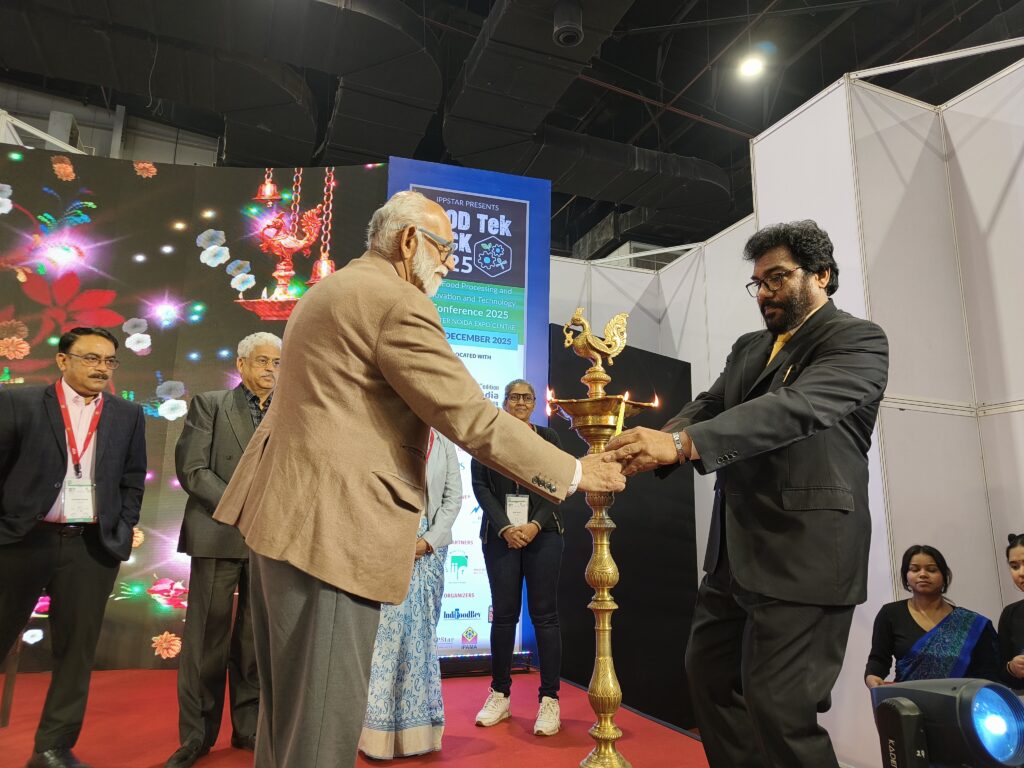
Welcoming the delegates, Ainan Shahhidi, director of 4 Sixes Group, spoke about the need for responsible food packaging and processing to eliminate food waste. Explaining the need and necessity of the conference, Naresh Khanna, editor of Packaging South Asia and IndifoodBev, said he hoped to connect all stakeholders in the food and packaging industries to find feasible solutions to tackle the problem of food waste.
Elaborating on the size of India’s food economy, Khanna said the food industry is estimated to be around Rs 86 lakh crore or US$950 billion, which is roughly about 20% of India’s GDP of US$4 trillion. Food loss and waste are also humongous in nature, roughly as high as 75 million tons or 51 kilograms per capita per year (UNEP’s Food Waste Report 2024), he said, which is a huge challenge to the food and beverages industry. Food loss contributes to around 10% of climate change, which points to the need for the industry, from farm to fork, to find ways and means to reduce food waste, which can feed millions, he said.
Sandeep Ghosh, business head, DS Spiceco, spoke from a consumer perspective, putting the spotlight on responsible and sustainable food processing and packaging and its impact on new markets and exports. In an interesting presentation, Ghosh traced the history of food processing and packaging to elucidate how the produce of one country became the staple of another and explained how food products evolved over the centuries, keeping in mind the key aspects of preserving and packaging.
Explaining the difference between food waste and food loss, Rijota Basu, program head head food loss and waste, WRI India, said 40% of food produced is either lost or wasted, adding around 24% of the global calories are wasted annually. Sanjay Gupta, senior vice president, packaging development and procurement DS Group unveiled his book, Responsible Packaging – An Indian guidebook to the future.
Other speakers in the first two sessions included Aditi Jhala of The Misfits, who promotes a circular economy by converting farm rejects such as an odd-shaped pumpkin or carrot leaves or twin-onions into dips and spreads; and Nitin Sanduja, sales manager, Buhler India, who delivered a presentation on the upcycling of food products and byproducts such as wheat husk, rice bran, and spent grain in brewery in modern retail.
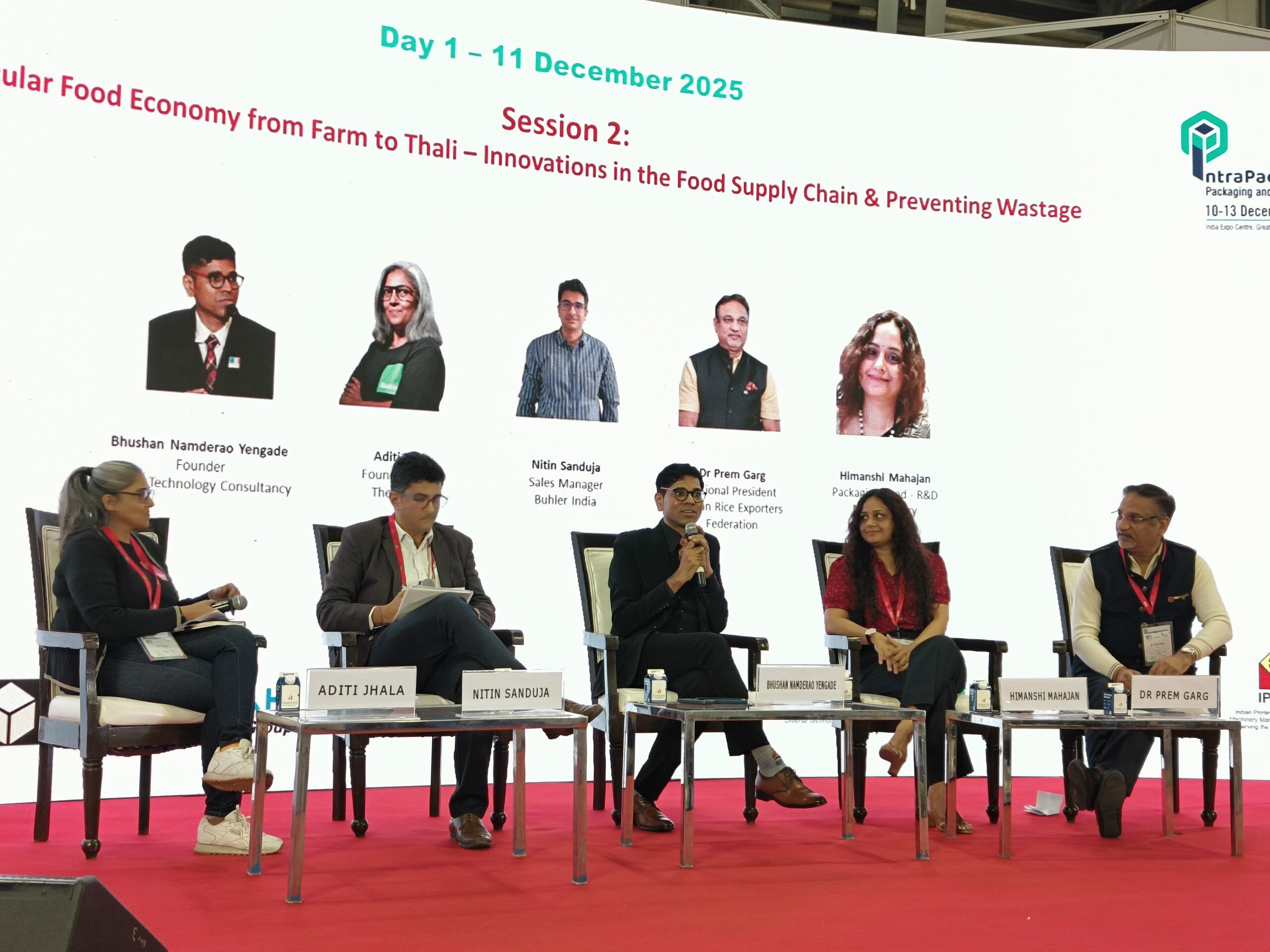
This was followed by a panel discussion on the ‘circular food economy from farm to thali,’ where Aditi Jhala, Nitin Sanduja, moderator Bhushan Namderao Yengade, founder, Binder Technology Consultancy, Himanshi Mahajan, packaging head – R&D, Mother Dairy and Prem Garg, national president, Indian Rice Exporters Federation, discussed innovations in the food supply chain to prevent wastage. The discussions ranged from rice exports to challenges in managing waste.
In an engaging discussion, Ainain Shahhidi, Naresh Khanna, Swapnil Bharadwaj, Central Quality & Regulatory Affairs Manager, Haldiram and Raman Sharma, IT Head, Vinsak, discussed and debated on integrating forensics and digital traceability into the food supply chain to prevent spoilage and to check quality.
Priyanka Sharma, associate manager, technical regulatory affairs, Marico, talked about FSSAI’s updates, followed by a panel discussion on the topic by Swapnil Bhardwaj of Haldiram, Yogendra Patir of UWC Foods, and Kalpam Chauhan of Mother Diary.
K Ravi, founder of Raas Intellisolution, Ashish Pinto from Nesco, Shrikanth Ramamurthy from Parksons Packaging and Sushil Sharma from Sealed Air discussed the urgent challenges in India’s packaging and cold-chain ecosystem.
Seema Atreya of Kanha Group, Ashish Pinto, Kalpam Chauhan, Arijit Mondal of Nestle and Swapnil Bhardwaj, discussed innovations in food and beverage marketing, retail, hospitality, and restaurants, preceded by a presentation on modern F&B marketing by Priyesh Dalmia of Spectalpack.
IndiFoodBev — authentic, impactful and influential
An English-language food and beverage processing and packaging industry B2B platform in print and web, IndiFoodBev is in its third year of publication. It is said that the Indian food and beverage industries represent approximately US$ 900 billion in revenues which implies more than 20% of the country’s GDP. Eliminating the wastage on the farmside can help to deliver more protein to a higher number of the population apart from generating sizable exports. The savings in soil, seeds, water, fertilizer, energy and ultimately food and nutrition could be the most immense contribution that country is poised to make to the moderation of climate change.
To improve your marketing and grow sales to the food and beverage processing and packaging industry, talk to us. Our research and consulting company IppStar [www.ippstar.org] can assess your potential and addressable markets in light of the competition. We can discuss marketing, communication, and sales strategies for market entry and growth.
Suppliers and service providers with a strategy and budget for targeted marketing can discuss using our hybrid print, web, video, and social media channels to create brand recognition linked to market relevance. Our technical writers are ready to meet you and your customers for content.
The second largest producer of fruit and vegetables in the world is continuously expanding processing capacities and delivery systems with appropriate innovative technologies. We cover product and consumer trends, nutrition, processing, research, equipment and packaging from farm to thali. Get our 2025 media kit and recalibrate your role in this dynamic market. Enhance your visibility and relevance to existing markets and turn potential customers into conversations. Ask for a sample copy of our bi-monthly in print or our weekly IndiFoodBev eZine each Wednesday.
For editorial info@ippgroup.in — for advertisement ads1@ippgroup.in and for subscriptions subscription@ippgroup.in
Naresh Khanna – 10 February 2025
Subscribe Now