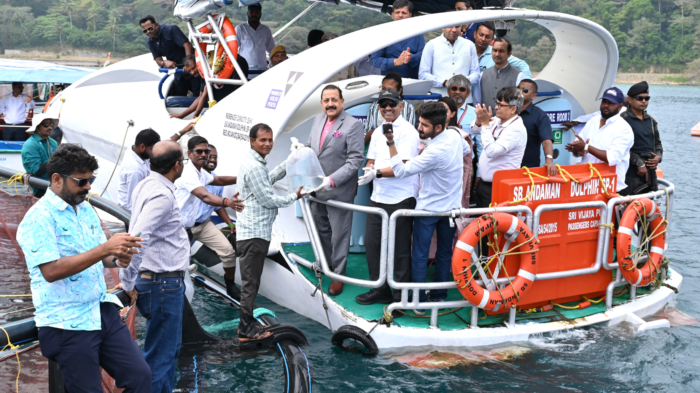
India’s first-ever open-sea marine fish farming project has been inaugurated at North Bay in the Andaman sea — marking a significant milestone in the nation’s pursuit of a Blue Economy driven by sustainable ocean resource utilization.

Union minister of state (independent charge) for science & technology, earth sciences, and minister of state in the prime minister’s office Jitendra Singh on 18 January inaugurated the project.
Speaking at the launch, Singh described the initiative as a landmark step toward harnessing India’s vast marine wealth. The project was launched on-site at North Bay, Sri Vijaya Puram, during the minister’s visit to the open waters of the Andaman Sea.
Dr Singh highlighted that for nearly seven decades after Independence, India’s ocean resources remained largely untapped, despite their immense potential for economic development. Since 2014, he noted, there has been a paradigm shift in India’s approach to maritime development, with growing recognition of the oceans as vital contributors to national prosperity.
Emphasizing the unique diversity of India’s coastal regions, he pointed out that the western, southern, and eastern seaboards each offer distinct ecological and economic opportunities that can collectively strengthen the country’s development trajectory.
The pioneering project is a collaborative effort between the ministry of earth sciences (MoES), its technical arm the National Institute of Ocean Technology (NIOT), and the union territory administration of Andaman and Nicobar Islands. The pilot focuses on open-sea cultivation of marine finfish and seaweed under natural oceanic conditions — integrating cutting-edge marine science with livelihood creation for local communities.
As part of the field visit, Singh launched two livelihood-oriented interventions. Under the marine flora component, seaweed seeds were distributed to local fishing communities to encourage deep-water seaweed farming. Under the marine fauna component, finfish seeds were provided for cage-based farming, supported by NIOT-developed open-sea cages capable of withstanding dynamic marine environments.
Singh noted that while the current initiatives are government-led, the experience and data generated through these pilots could pave the way for future public–private partnerships, enabling wider deployment and sustainable scaling. “This model has the potential to accelerate economic opportunities, expand livelihoods, and strengthen India’s Blue Economy ecosystem,” he said.
Later in the day, the Minister visited the Mahatma Gandhi Marine National Park (MGMNP) near Wandoor — one of India’s first marine parks, established in 1983. Spanning 15 islands and accessible via the Wandoor Jetty, MGMNP is home to vibrant coral reefs, mangroves, and diverse marine life, including turtles and a variety of fish species. Dr. Singh observed that the park exemplifies India’s commitment to marine conservation and ecological balance alongside economic development.
The launch of the North Bay project underscores the government of India’s mission to translate science and technology into tangible field-level impact, empowering coastal and island communities to become active participants in India’s ocean-led growth story.
IndiFoodBev — authentic, impactful and influential
An English-language food and beverage processing and packaging industry B2B platform in print and web, IndiFoodBev is in its third year of publication. It is said that the Indian food and beverage industries represent approximately US$ 900 billion in revenues which implies more than 20% of the country’s GDP. Eliminating the wastage on the farmside can help to deliver more protein to a higher number of the population apart from generating sizable exports. The savings in soil, seeds, water, fertilizer, energy and ultimately food and nutrition could be the most immense contribution that country is poised to make to the moderation of climate change.
To improve your marketing and grow sales to the food and beverage processing and packaging industry, talk to us. Our research and consulting company IppStar [www.ippstar.org] can assess your potential and addressable markets in light of the competition. We can discuss marketing, communication, and sales strategies for market entry and growth.
Suppliers and service providers with a strategy and budget for targeted marketing can discuss using our hybrid print, web, video, and social media channels to create brand recognition linked to market relevance. Our technical writers are ready to meet you and your customers for content.
The second largest producer of fruit and vegetables in the world is continuously expanding processing capacities and delivery systems with appropriate innovative technologies. We cover product and consumer trends, nutrition, processing, research, equipment and packaging from farm to thali. Get our 2025 media kit and recalibrate your role in this dynamic market. Enhance your visibility and relevance to existing markets and turn potential customers into conversations. Ask for a sample copy of our bi-monthly in print or our weekly IndiFoodBev eZine each Wednesday.
For editorial info@ippgroup.in — for advertisement ads1@ippgroup.in and for subscriptions subscription@ippgroup.in
Naresh Khanna – 10 February 2025
Subscribe Now