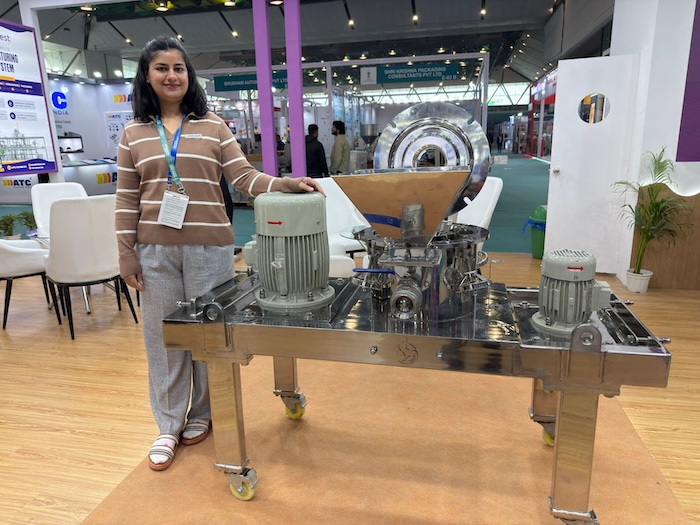
At Indusfood Manufacturing in Delhi in January, Monisha Sharma, director-business strategy at Millnest, focused on an ambitious road map for transforming India’s spice and grain processing sector through digitalization, data-driven manufacturing, and globally benchmarked quality systems.

Millnest positions itself as a complete turnkey solutions provider for powder-based industries, with a strong focus on spices, grains, and fertilizers. “Millnest is into complete turnkey spice processing solutions—along with grains and fertilisers. We do end-to-end anything related to powder handling, including pneumatic conveying and bulk material storage,” Sharma said.
At the exhibition, Millnest’s spotlight was firmly on spices and grains. “We want to showcase how we are experts in powder handling and how digitally and sustainably this can be achieved,” Sharma said.
Millnest is pushing for digital trust-building, which it says is a key differentiator. Rather than relying solely on physical plant visits, the company is enabling customers to experience entire processing facilities virtually. “I want people to experience the entire plant within their systems, from the comfort of their own homes. Trust building through digital transformation is extremely important,” she emphasized.
According to her, this approach resonates strongly with the next generation of processors—successors who are increasingly tech-savvy and data-driven. “They are the ones who will run these plants for the next 25 years. They are far more digitally inclined, and I want them to start using these machines and systems today,” Sharma added.
While data analytics and Industry 4.0 are well-established in sectors such as agrochemicals, Sharma believes the spice and grain industry in India has been slow to adopt these tools. “Only the top players, such as ITC and Everest, are using such technologies, often through their counterparts in the US. Smaller processors are still hesitant,” she observed.
Millnest aims to bridge this gap by embedding IoT-enabled systems and collaborative data platforms into its machinery. “What kind of spice you grind, at what temperature, at what fineness—this data can help you improve your plant and decide where you want to take it in the future. It’s a collaborative effort,” Sharma said.
Predictive modelling, remote monitoring, and AI-assisted process design are all part of Millnest’s vision. “Using AI, you can simply ask for a grain processing flow, design it, and refine it. Our strength lies in combining this digital layer with 50 years of hands-on process experience,” she explained.
Sharma pointed out the challenges Indian processors face when adopting imported technologies. “Foreign machines work well in their environment because their raw material is far cleaner. In India, cleaning, grinding, and quality maintenance are far bigger challenges,” she pointed out.
To address this, Millnest is now investing heavily in advanced sterilization and pasteurization technologies. Partnering with a Netherlands-based company, the firm has set up a dedicated R&D and trial facility in Gujarat. “Sterilization and pasteurization are critical from a quality and export perspective. Once our trials are complete, we want Indian processors across spices, grains, and millets to adopt these systems,” Sharma said.
Powder-handling expertise
Beyond conventional processing solutions, Millnest is introducing large-scale logistics innovation through BTAP wagons—containerized railway wagons capable of handling massive volumes. “These wagons can carry nearly 3,000 metric tons of material in just five hours and unload the same within five hours,” Sharma noted, adding that such capacities are typically seen in mineral handling, not in spices or grains.
Developed through a partnership with Switzerland-based Stag AG, the patented BTAP technology has already been implemented for major cement manufacturers, including Dalmia, Birla, and UltraTech. Millnest now sees strong potential to adapt this high-throughput model for agri-processing, where volume handling is becoming increasingly critical.
IndiFoodBev — authentic, impactful and influential
An English-language food and beverage processing and packaging industry B2B platform in print and web, IndiFoodBev is in its third year of publication. It is said that the Indian food and beverage industries represent approximately US$ 900 billion in revenues which implies more than 20% of the country’s GDP. Eliminating the wastage on the farmside can help to deliver more protein to a higher number of the population apart from generating sizable exports. The savings in soil, seeds, water, fertilizer, energy and ultimately food and nutrition could be the most immense contribution that country is poised to make to the moderation of climate change.
To improve your marketing and grow sales to the food and beverage processing and packaging industry, talk to us. Our research and consulting company IppStar [www.ippstar.org] can assess your potential and addressable markets in light of the competition. We can discuss marketing, communication, and sales strategies for market entry and growth.
Suppliers and service providers with a strategy and budget for targeted marketing can discuss using our hybrid print, web, video, and social media channels to create brand recognition linked to market relevance. Our technical writers are ready to meet you and your customers for content.
The second largest producer of fruit and vegetables in the world is continuously expanding processing capacities and delivery systems with appropriate innovative technologies. We cover product and consumer trends, nutrition, processing, research, equipment and packaging from farm to thali. Get our 2025 media kit and recalibrate your role in this dynamic market. Enhance your visibility and relevance to existing markets and turn potential customers into conversations. Ask for a sample copy of our bi-monthly in print or our weekly IndiFoodBev eZine each Wednesday.
For editorial info@ippgroup.in — for advertisement ads1@ippgroup.in and for subscriptions subscription@ippgroup.in
Naresh Khanna – 10 February 2025
Subscribe Now