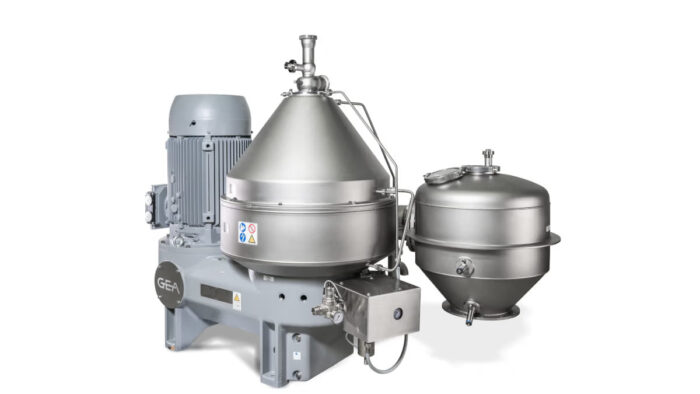
GEA is launching the GSE 150 CPR, a new separator for clarifying pulp-rich citrus juices. The machine is aimed at processors in the medium capacity range who want to keep clarification processes stable even with high and fluctuating solids loads and minimize juice losses in the pulp discharge, the company announced in a release.

The market pressure behind this is clear: In Brazil, the world’s largest orange juice producer, around 48% of the Citrus Belt is affected by the plant disease HLB (citrus greening), according to Fundecitrus, a research institute for the citrus industry. Smaller fruits, lower juice content, and more uneven solids content in the pressed product – these are the direct consequences for processing. At the same time, according to Innova Market Insights, there is growing demand for premium products with defined texture profiles, where pulp content is a defined quality parameter, not a variable left to chance.
Continuous discharge as core technology
Technically, the GSE 150 CPR (Constant Pulp Removal) differs from conventional separators through the use of a separating disc in the self-cleaning bowl in combination with a second centripetal pump. This configuration enables the pulp to be continuously conveyed out of the machine under pressure – up to 4 bar. The decisive effect: the solids-holding volume no longer plays a significant role in process stability. Even with highly fluctuating pulp content, as is typical for greening-affected fruit, the clarification process remains stable. Because part of the flow is continuously discharged, CPR separators process around 50% more product than a conventional separator of comparable size – a difference that quickly pays for itself during operation.
In operation, the GSE 150 CPR typically requires only two to four solids discharges per hour. Fewer discharges mean fewer process interruptions, less product carryover during discharge, and a more stable restart after each discharge. By comparison, a conventional clarifying separator without continuous pulp discharge can reach up to 30 discharges per hour under high solids loading – with correspondingly higher juice losses and declining clarification performance.
Adjusting pulp content instead of just removing it
With pulp-rich citrus juices, it’s not just the clarification performance that counts. The decisive factor is how consistently an operator controls pulp content. GEA offers an optional automatic pulp control system. The standard version is time-controlled; the advanced option continuously measures discharge viscosity and adjusts pulp flow accordingly, minimizing juice losses during operation. For producers who supply different markets with different pulp profiles, this shortens changeover times between batches and reduces losses caused by imprecise control.
The separator is designed for clarifying pulp-rich citrus juices – orange juice, grapefruit juice, lemon juice – and is also suitable for pulp washing processes and cloudy peel extract. As design examples , GEA cites capacities of up to 17,000 liters per hour for orange juice and up to 12,000 liters per hour for lemon juice; the achievable performance depends on the product and solids content.
“When raw fruit quality and solid content fluctuate more strongly, process stability becomes an economic lever. The GSE 150 CPR continuously discharges pulp under pressure and requires only a few discharges per hour – this makes clarification processes more robust and reduces product losses,” says Rüdiger Flocke, area sales manager, Business Line Beverage, GEA.
Technical design and hygiene
All components that come into contact with the product are made of stainless steel; the seals meet food processing requirements. The separator is fully CIP-capable. For solids discharge, the bowl is opened and closed hydraulically with water. The drive is powered by a low-maintenance flat belt on a standard three-phase motor rated at 30 kilowatts. The bowl rotates at 5,300 revolutions per minute.
For operators with high availability requirements, the GEA InsightPartner Separation Monitoring is available as an option. Among other things, this online condition monitoring system continuously records vibrations and forms the basis for condition-based maintenance.
Portfolio addition in the medium capacity range
The GSE 150 CPR complements GEA’s existing CPR series, which includes the GSI 300 CPR, and is aimed at companies that have previously had to rely on machines that were too large or operated with excessively high discharge frequencies. For processors who are investing in professional separation technology for the first time in growing markets such as Egypt, Turkey, or Southeast Asia, the machine offers a cost-efficient entry point that balances investment costs and throughput.
Industry background
The global citrus industry faces growing pressure. On the raw materials side, climate extremes and plant diseases are exacerbating volatility: Extreme weather in Brazil’s Citrus Belt – in 2025, the region recorded around 55 percent less rainfall than usual during critical vegetation phases – is hitting an industry that is already struggling with the consequences of HLB. Global stocks of Brazilian orange juice concentrate (FCOJ) reached a historic low of 146,300 tons in 2025. Under these conditions, processing losses feed directly through to margins.
On the market side, requirements are shifting: according to market studies on the juice and packaged juice segment by Custom Market Insights, the global juice market is growing at around four percent annually, often driven by 100 percent juices, functional beverages, and premium products.
In Europe, trend analyses by Innova Market Insights show stronger consumer preference for natural products, quality, and products that differentiate themselves through texture and pulp content. At the same time, according to the US Department of Agriculture (USDA), the use of oranges for processing is increasing significantly in countries such as Egypt, creating new demand for efficient process technology.
GEA is presenting its bakery solutions at Interpack 2026, stand C27, in hall 6,
IndiFoodBev — authentic, impactful and influential
An English-language food and beverage processing and packaging industry B2B platform in print and web, IndiFoodBev is in its third year of publication. It is said that the Indian food and beverage industries represent approximately US$ 900 billion in revenues which implies more than 20% of the country’s GDP. Eliminating the wastage on the farmside can help to deliver more protein to a higher number of the population apart from generating sizable exports. The savings in soil, seeds, water, fertilizer, energy and ultimately food and nutrition could be the most immense contribution that country is poised to make to the moderation of climate change.
To improve your marketing and grow sales to the food and beverage processing and packaging industry, talk to us. Our research and consulting company IppStar [www.ippstar.org] can assess your potential and addressable markets in light of the competition. We can discuss marketing, communication, and sales strategies for market entry and growth.
Suppliers and service providers with a strategy and budget for targeted marketing can discuss using our hybrid print, web, video, and social media channels to create brand recognition linked to market relevance. Our technical writers are ready to meet you and your customers for content.
The second largest producer of fruit and vegetables in the world is continuously expanding processing capacities and delivery systems with appropriate innovative technologies. We cover product and consumer trends, nutrition, processing, research, equipment and packaging from farm to thali. Get our 2025 media kit and recalibrate your role in this dynamic market. Enhance your visibility and relevance to existing markets and turn potential customers into conversations. Ask for a sample copy of our bi-monthly in print or our weekly IndiFoodBev eZine each Wednesday.
For editorial info@ippgroup.in — for advertisement ads1@ippgroup.in and for subscriptions subscription@ippgroup.in
Naresh Khanna – 10 February 2025
Subscribe Now