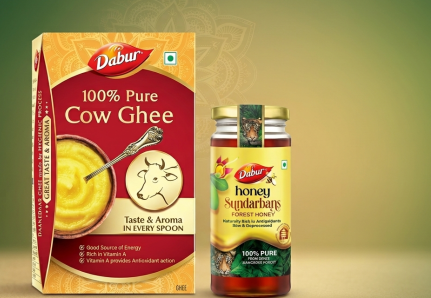
The Delhi High Court granted interim relief to Dabur India, staying a prohibitory order issued by the Food Safety and Standards Authority of India (FSSAI) that had banned the sale of several products carrying “100%” claims.

The FSSAI had barred Dabur from marketing items with labels such as “100% Pure,” “100% Natural,” and “100% Organic,” stating that such absolute claims are ambiguous, scientifically unverifiable, and potentially misleading for consumers.
The directive impacted a wide range of Dabur’s everyday products, including honey, cow ghee, apple cider vinegar, virgin coconut oil, sesame oil, coconut water, and coconut milk.
In its plea before the High Court, Dabur argued that the sudden ban caused significant supply chain disruption. The company contended that the regulator failed to issue a show-cause notice or provide an opportunity to respond, thereby violating principles of natural justice. It also pointed out that “100%” claims are widely used across the industry.
According to Moneycontrol, Dabur further alleged that the FSSAI’s action favored competing manufacturers and put nearly ₹150 crore worth of inventory at risk.
Justice Amit Mahajan noted that Dabur had been selling these products for decades and should have been given a fair hearing before such a ban was imposed.
The court’s stay offers temporary relief to the FMCG company. The broader question of the legality of such labeling and the scientific standards required for absolute purity claims will be examined in detail at the next hearing scheduled for August 24, 2026.
IndiFoodBev — authentic, impactful and influential
An English-language food and beverage processing and packaging industry B2B platform in print and web, IndiFoodBev is in its third year of publication. It is said that the Indian food and beverage industries represent approximately US$ 900 billion in revenues which implies more than 20% of the country’s GDP. Eliminating the wastage on the farmside can help to deliver more protein to a higher number of the population apart from generating sizable exports. The savings in soil, seeds, water, fertilizer, energy and ultimately food and nutrition could be the most immense contribution that country is poised to make to the moderation of climate change.
To improve your marketing and grow sales to the food and beverage processing and packaging industry, talk to us. Our research and consulting company IppStar [www.ippstar.org] can assess your potential and addressable markets in light of the competition. We can discuss marketing, communication, and sales strategies for market entry and growth.
Suppliers and service providers with a strategy and budget for targeted marketing can discuss using our hybrid print, web, video, and social media channels to create brand recognition linked to market relevance. Our technical writers are ready to meet you and your customers for content.
The second largest producer of fruit and vegetables in the world is continuously expanding processing capacities and delivery systems with appropriate innovative technologies. We cover product and consumer trends, nutrition, processing, research, equipment and packaging from farm to thali. Get our 2025 media kit and recalibrate your role in this dynamic market. Enhance your visibility and relevance to existing markets and turn potential customers into conversations. Ask for a sample copy of our bi-monthly in print or our weekly IndiFoodBev eZine each Wednesday.
For editorial info@ippgroup.in — for advertisement ads1@ippgroup.in and for subscriptions subscription@ippgroup.in
Naresh Khanna – 10 February 2025
Subscribe Now