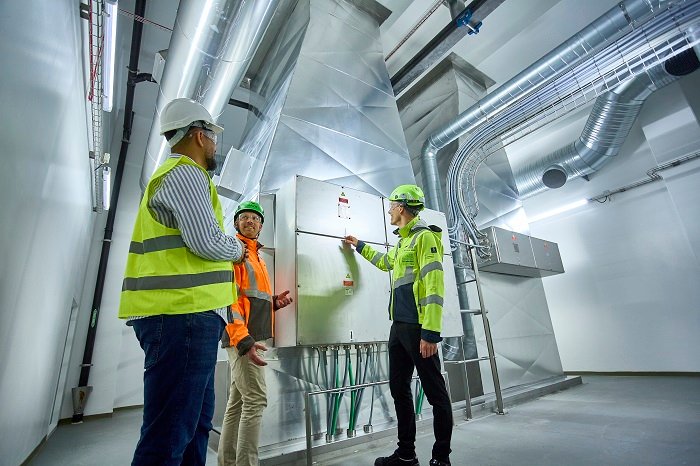
Arla Foods Ingredients is taking a major step towards reducing its CO2 emissions on dairy level. A newly completed investment in a new heating system for Production Tower 4 at the Danmark Protein plant in Videbæk will deliver annual savings of 2,500 tons of CO2, equivalent to the annual heating consumption of more than 900 households using natural gas.

In Videbæk, whey is processed into a range of ingredient and protein products. As part of the project, the tower is being converted from operating with a gas heater to being able to switch between heat from the plant’s existing steam system and a new electric heater. This will reduce the use of natural gas and allow renewable electricity to take over part of the operation. Calculations show that Tower 4 will be able to operate 100% on renewable electricity for 23% of the time.
“This is one of those investments where we simultaneously improve operational reliability, strengthen security of supply and reduce our climate impact. The fact that we can achieve such a large reduction through a single solution highlights the potential of electrifying our production,” says Mogens Bøgh Pedersen, director of the Danmark Protein plant.
Electrification significantly reduces CO2 emissions
By being able to switch between the existing steam system and electricity, Arla Foods Ingredients creates a strong financial business case while also supporting the need for flexible consumption in the Danish power grid. This allows Arla Foods Ingredients to use electricity when wind and solar power drive prices down, while reducing electricity consumption when supply and demand push prices higher.
The new solution is an important part of Arla’s strategy to electrify production and provides greater flexibility in energy consumption, enhanced reliability and opportunities for future development.
While the new heating system in Tower 4 is now operational, a similar project is being planned for Tower 5. Here, the gas heating system will also be replaced by a combined steam and electric heating solution. Together, the investments in Towers 4 and 5 will reduce CO2 emissions by up to 5,200 tonnes annually, equivalent to the annual heating consumption of more than 1,900 households.
“In addition to delivering substantial CO2e savings, this investment also represents a very strong business case. It is therefore a solution that we will naturally seek to scale across our other sites,” says Paul van Rooij, Vice President, Supply Chain, Arla Foods Ingredients.
Facts about the investment
*Investment in a new heating system for Tower 4: approximately 8.3 million Euros
*Expected annual CO₂ reduction for Tower 4: approximately 2,500 tons
*Total reduction potential for Towers 4 and 5: up to 5,200 tonnes of CO₂
According to Danish Energy Agency standards, an average 125 m² home consumes around 13.4 MWh (13,400 kWh) of heat annually. A reduction of 2,500 tons of CO₂ is equivalent to approximately 12,315 MWh of natural gas, corresponding to the annual heating consumption of around 919 households. At full potential, a reduction of 5,200 tonnes of CO₂ would equal the annual heating consumption of approximately 1,911 households
IndiFoodBev — authentic, impactful and influential
An English-language food and beverage processing and packaging industry B2B platform in print and web, IndiFoodBev is in its third year of publication. It is said that the Indian food and beverage industries represent approximately US$ 900 billion in revenues which implies more than 20% of the country’s GDP. Eliminating the wastage on the farmside can help to deliver more protein to a higher number of the population apart from generating sizable exports. The savings in soil, seeds, water, fertilizer, energy and ultimately food and nutrition could be the most immense contribution that country is poised to make to the moderation of climate change.
To improve your marketing and grow sales to the food and beverage processing and packaging industry, talk to us. Our research and consulting company IppStar [www.ippstar.org] can assess your potential and addressable markets in light of the competition. We can discuss marketing, communication, and sales strategies for market entry and growth.
Suppliers and service providers with a strategy and budget for targeted marketing can discuss using our hybrid print, web, video, and social media channels to create brand recognition linked to market relevance. Our technical writers are ready to meet you and your customers for content.
The second largest producer of fruit and vegetables in the world is continuously expanding processing capacities and delivery systems with appropriate innovative technologies. We cover product and consumer trends, nutrition, processing, research, equipment and packaging from farm to thali. Get our 2025 media kit and recalibrate your role in this dynamic market. Enhance your visibility and relevance to existing markets and turn potential customers into conversations. Ask for a sample copy of our bi-monthly in print or our weekly IndiFoodBev eZine each Wednesday.
For editorial info@ippgroup.in — for advertisement ads1@ippgroup.in and for subscriptions subscription@ippgroup.in
Naresh Khanna – 10 February 2025
Subscribe Now