Researchers at the Sustainable Packaging Lab, Natural and Medical Sciences Research Center, University of Nizwa have found a way to recover a useful natural material from date seeds and add it to biodegradable films that may have future food-packaging applications.
Inspired by a local Omani resource
The study was conducted by scientists from the Sustainable Packaging Lab (NMSRC) and led by Prof. Ahmed Al-Harrasi, Dr. Saurabh Bhatia with contributions from Talha Shireen Khan. The team focused on date seeds, which are widely available in Oman but are often treated as low-value waste.
Date palms are important to Oman’s agriculture and economy. Because date seeds make up a noticeable part of each fruit, the date industry produces a large and steady supply of this agricultural residue.
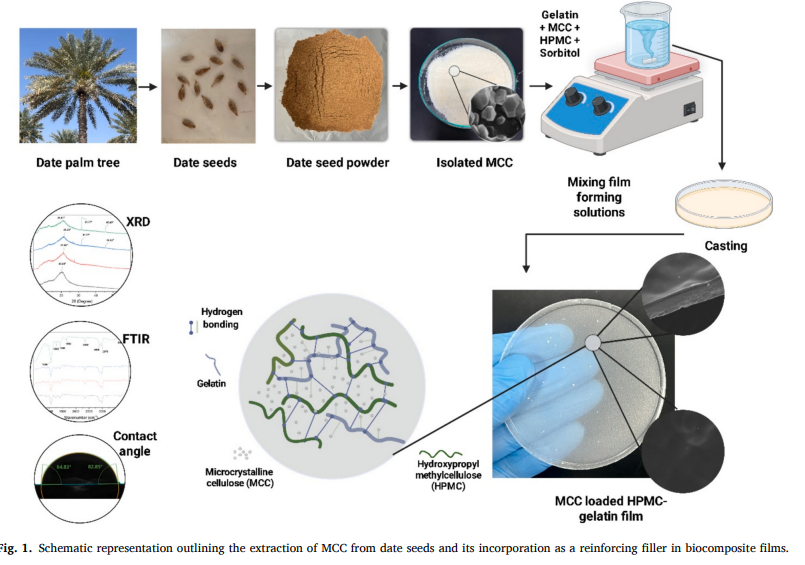
The researchers explored whether date seeds could be turned into a useful material for packaging. They recovered microcrystalline cellulose (MCC) from the seeds and prepared it for use in biodegradable films.
Promising results
The study showed that a useful microcrystalline cellulose could be recovered from date seeds. Tests confirmed that the material had characteristics that could help in improving the packaging films.
The recovered MCC acted as a functional filler and influenced the physical, structural and surface properties of the biodegradable films. Its effects depended strongly on the amount added, highlighting the importance of optimizing the formulation.
The recovered material was added in small amounts to biodegradable films. The researchers then examined the films to understand their strength, appearance, response to heat and interaction with moisture.
Improved resistance to water on the surface
One of the clearest findings was that water spread less easily across films containing the date-seed material. This suggests that the addition helped make the film surface more resistant to water.
The films also remained generally smooth and continuous, without major visible cracks or gaps. These results suggest that material recovered from date seeds deserves further study for possible packaging uses.
Finding the right amount is important
The study found that adding more of the date-seed material did not improve every feature of the films. Larger amount of MCC made the films thicker and caused uneven distribution in the films. Also, mechanical strength and moisture-related properties also became less favorable.
Overall, the smallest amount tested gave the best balance of properties. It improved the film’s surface resistance to water while maintaining acceptable strength and a more even appearance.
According to Prof. Ahmed Al-Harrasi and Dr. Saurabh Bhatia, date seeds contain useful natural materials that can be recovered and incorporated into biodegradable films. They emphasized that optimizing the amount used is essential before practical packaging applications can be considered.
Looking ahead
This work is an early step toward a possible packaging material, not a finished commercial product. Further studies are needed to improve performance, confirm safety for contact with food, test the films with real food products and determine whether production can be expanded efficiently and sustainably.
Even so, the study shows how locally available agricultural waste can support innovation. By recovering a useful natural material from date seeds, the researchers have identified a possible way to give a familiar Omani by-product a valuable new purpose.
The original study, ‘Date seeds-derived microcrystalline cellulose reinforced films for food packaging applications: Development and characterization,’ was published in the International Journal of Biological Macromolecules by Elsevier. DOI: 10.1016/j.ijbiomac.2026.153107
IndiFoodBev — authentic, impactful and influential
An English-language food and beverage processing and packaging industry B2B platform in print and web, IndiFoodBev is in its third year of publication. It is said that the Indian food and beverage industries represent approximately US$ 900 billion in revenues which implies more than 20% of the country’s GDP. Eliminating the wastage on the farmside can help to deliver more protein to a higher number of the population apart from generating sizable exports. The savings in soil, seeds, water, fertilizer, energy and ultimately food and nutrition could be the most immense contribution that country is poised to make to the moderation of climate change.
To improve your marketing and grow sales to the food and beverage processing and packaging industry, talk to us. Our research and consulting company IppStar [www.ippstar.org] can assess your potential and addressable markets in light of the competition. We can discuss marketing, communication, and sales strategies for market entry and growth.
Suppliers and service providers with a strategy and budget for targeted marketing can discuss using our hybrid print, web, video, and social media channels to create brand recognition linked to market relevance. Our technical writers are ready to meet you and your customers for content.
The second largest producer of fruit and vegetables in the world is continuously expanding processing capacities and delivery systems with appropriate innovative technologies. We cover product and consumer trends, nutrition, processing, research, equipment and packaging from farm to thali. Get our 2025 media kit and recalibrate your role in this dynamic market. Enhance your visibility and relevance to existing markets and turn potential customers into conversations. Ask for a sample copy of our bi-monthly in print or our weekly IndiFoodBev eZine each Wednesday.
For editorial info@ippgroup.in — for advertisement ads1@ippgroup.in and for subscriptions subscription@ippgroup.in
Naresh Khanna – 10 February 2025
Subscribe Now