A growing disruption in the Strait of Hormuz is raising alarms over global fertilizer supplies, according to an article by Tristan Gaudiaut of Statista. Since February 28, 2026, escalating tensions involving Iran, Israel, and the United States have severely restricted commercial shipping through the vital waterway, leaving it largely closed with limited passage granted to select vessels.
The Strait plays a critical role in global trade, particularly for energy and bulk commodities, and analysts warn that prolonged closures could strain supply chains worldwide. ING notes that fertilizer availability could tighten significantly in import-dependent regions such as Brazil, India, South Asia, and parts of the European Union if disruptions continue.
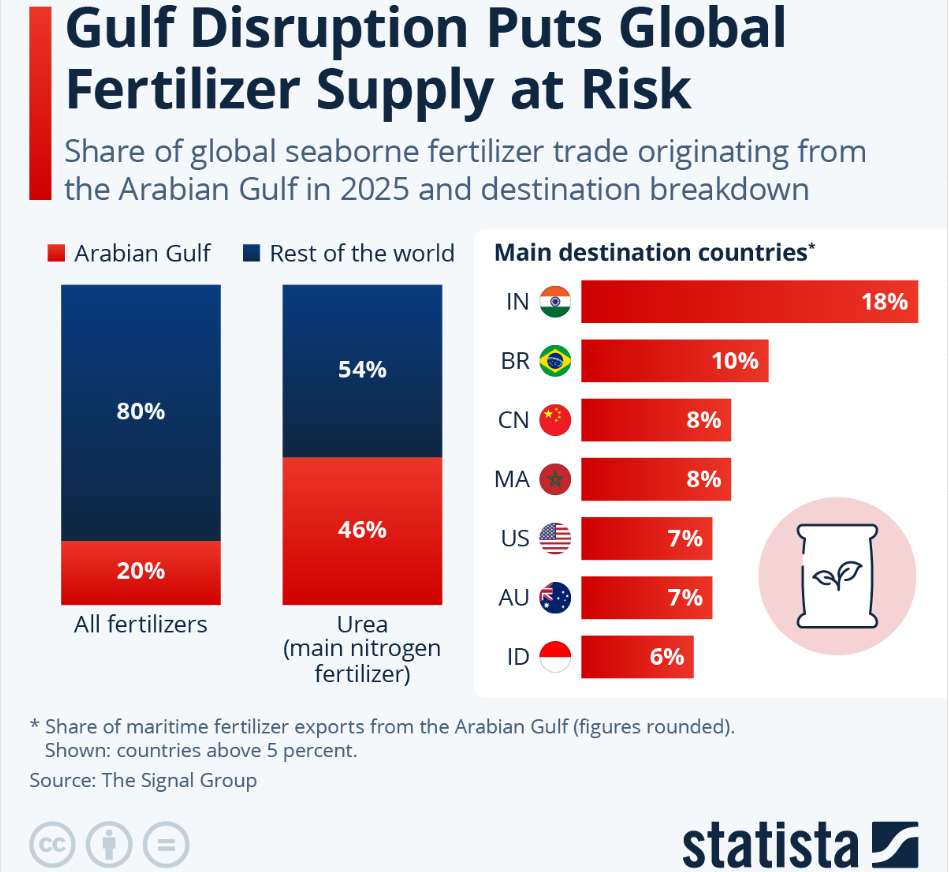
Data from Signal Group highlights the scale of the risk, showing that roughly 20% of global seaborne fertilizer exports originate from the Arabian Gulf. The dependency is even greater for urea, the most widely used nitrogen fertilizer, with nearly 46 percent of global trade tied to Gulf producers and major importers including India, Brazil, and China. India accounted for 18% followed by Brazil (10%) and China (8%), with additional significant shares going to Morocco, the United States, Australia and Indonesia (6 to 8%), the report says.
Experts caution that sustained supply interruptions could drive up fertilizer and energy costs, increasing food production expenses and fueling inflation. Vulnerable regions, particularly in Africa and South Asia, may face heightened food security risks if shortages persist.
IndiFoodBev — authentic, impactful and influential
An English-language food and beverage processing and packaging industry B2B platform in print and web, IndiFoodBev is in its third year of publication. It is said that the Indian food and beverage industries represent approximately US$ 900 billion in revenues which implies more than 20% of the country’s GDP. Eliminating the wastage on the farmside can help to deliver more protein to a higher number of the population apart from generating sizable exports. The savings in soil, seeds, water, fertilizer, energy and ultimately food and nutrition could be the most immense contribution that country is poised to make to the moderation of climate change.
To improve your marketing and grow sales to the food and beverage processing and packaging industry, talk to us. Our research and consulting company IppStar [www.ippstar.org] can assess your potential and addressable markets in light of the competition. We can discuss marketing, communication, and sales strategies for market entry and growth.
Suppliers and service providers with a strategy and budget for targeted marketing can discuss using our hybrid print, web, video, and social media channels to create brand recognition linked to market relevance. Our technical writers are ready to meet you and your customers for content.
The second largest producer of fruit and vegetables in the world is continuously expanding processing capacities and delivery systems with appropriate innovative technologies. We cover product and consumer trends, nutrition, processing, research, equipment and packaging from farm to thali. Get our 2025 media kit and recalibrate your role in this dynamic market. Enhance your visibility and relevance to existing markets and turn potential customers into conversations. Ask for a sample copy of our bi-monthly in print or our weekly IndiFoodBev eZine each Wednesday.
For editorial info@ippgroup.in — for advertisement ads1@ippgroup.in and for subscriptions subscription@ippgroup.in
Naresh Khanna – 10 February 2025
Subscribe Now