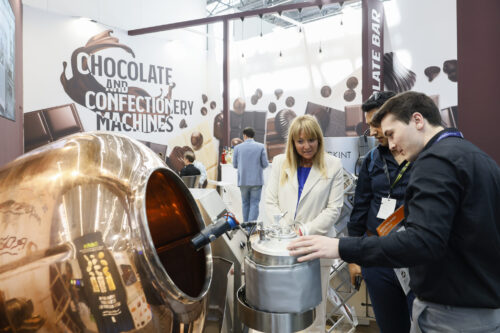
The confectionery and bakery industry is growing – yet at the same time faces significant pressure to transform. Remaining competitive requires investment. To this end, Interpack 2026 will bring together the industry’s technological offerings across three halls covering around 40,000 square meters.
Interpack 2026 once again offers its visitors dedicated zones for their respective sectors. The confectionery and bakery zone spans Halls 1, 3 and 4, directly at the South Entrance of the Düsseldorf Exhibition Centre. Manufacturers will find solutions there covering the entire value chain – from raw material processing through shaping and coating to primary and secondary packaging.
Exhibitors here include Aasted, Sollich, Theegarten-Pactec, SACMI Packaging & Chocolate, Bühler and Coperion. This means the technological core of the industry is represented on site. This is complemented by the world’s largest selection of packaging materials and supplies in Halls 7–10. In total, over 2,800 exhibitors from around the world are expected at Interpack from 7 to 13 May.
Stable and growing
The outlook is positive despite numerous challenges. The global market for baked goods stood at 177 million tonnes in 2024. Growth of 9.6 per cent is expected by 2029. Markets in the Middle East and Africa are developing particularly dynamically. The global confectionery market is also set to grow by 4.5% by 2029. Latin America, the Middle East and Africa are showing double-digit growth rates, whilst North America is experiencing a slight decline (source: Euromonitor International/VDMA). The market environment is therefore stable. At the same time, sales regions, cost structures and regulatory frameworks are shifting.
Need for action
The scale of the challenges is highlighted by companies exhibiting in the confectionery and bakery sector at Interpack 2026. One of these is Bühler, which can be found in Hall 3 at Interpack. Thomas Isom, global head of business development, Consumer Foods at Bühler, explains, for example, “The greatest pressure for transformation stems from the combined impact of raw material crises, sustainability requirements, health regulations and rising costs. The key levers for companies therefore lie in three areas: resilient and sustainable raw material and supply chains, recipe and product innovation (particularly sugar reduction and alternative ingredients), and increased efficiency and flexible production.”
These structural requirements are compounded by a tight cost situation. “The confectionery industry, and the chocolate industry in particular, is currently under massive cost pressure, primarily due to sharply rising raw material prices. This is increasing the demand for highly efficient and durable production facilities. At the same time, rising energy costs are forcing investment in modern technologies that significantly reduce energy consumption,” says Klaus-Dietrich Franzmeier, director of sales & marketing at Sollich. The company is exhibiting across more than 1,000 square meters in Hall 3, making it one of the largest exhibitors at Interpack.
Against a backdrop of fluctuating raw material costs, staff shortages and growing uncertainties regarding trade and tariffs, Chris Isom, general manager food, Coperion Food, Health & Nutrition Division, emphasizes the urgency of ensuring throughput and quality with fewer staff, “This requires stricter process control, faster changeovers, and more hygienic and consistent operations. Those companies that modernize intelligently will be successful, by utilising automation and integrated system improvements to increase product consistency, enhance flexibility and reduce total cost of ownership.” Coperion can be found in Hall 4.
Strategic direction-setting
The question is therefore no longer whether modernization is necessary, but how comprehensive it should be. Klaus-Dietrich Franzmeier of Sollich puts it plainly: “To remain competitive by 2030, companies must consistently rely on modern technologies. The use of artificial intelligence – both in development and in service – will be a decisive factor for success.”
Matt Craig, Coperion food, health & nutrition division, also sees strategic investment as key: “Make investment decisions in line with the areas in which the industry is actually investing: modernization and upgrades rather than solely the construction of entirely new production sites. Bakeries are prioritizing packaging, software/IT/AI, robotics and automation, as well as key process steps such as mixing and material handling – because these investments deliver measurable improvements in quality, efficiency and plant availability.”
Companies that want to be successful by 2030 must align their strategy along three core axes, says Thomas Bischof (Bühler): “1. Resilient and sustainable raw material and supply chains, 2. Healthier and differentiated product innovations, 3. Digital, efficient and flexible production. “Those who consistently combine these three dimensions can address costs, sustainability and consumer expectations simultaneously.”
Decision-making platform
Bühler will also be showcasing these strategic approaches at Interpack 2026. In the ‘Minimarket’ and the ‘Food Sensation Lab,’ producers will find inspiration and ideas for new products. Bühler will also demonstrate how manufacturers can optimize their production processes and prepare for the challenges of a fluctuating market environment. The focus here is on digitalization and flexibility. In addition, innovations in the areas of chocolate mass and chocolate molding, biscuit and wafer production, as well as cereals and extrusion technology, will be presented.
Sollich is also showcasing specific developments for confectionery production. The company will present a new generation of encroaching machines at Interpack 2026. Furthermore, in collaboration with SweetConnect GmbH, machine learning functionalities are being further developed to provide plant operators with more targeted support for efficient and stable process control.
Coperion is focusing on integration. Equipment, control systems and automation are linked in such a way that modernization projects deliver tangible results – such as greater product consistency, faster changeovers, improved hygiene and a robust data foundation.
At Interpack 2026, the company will showcase solutions for modernizing existing production lines. These include hygienic mixing technologies such as the DIOSNA spiral mixer, application technologies such as Bakon Disc Spraying, and flexible depositing solutions featuring the Unifiller MultiStation. The SBX platform will also be presented for extrusion applications.
IndiFoodBev — authentic, impactful and influential
An English-language food and beverage processing and packaging industry B2B platform in print and web, IndiFoodBev is in its third year of publication. It is said that the Indian food and beverage industries represent approximately US$ 900 billion in revenues which implies more than 20% of the country’s GDP. Eliminating the wastage on the farmside can help to deliver more protein to a higher number of the population apart from generating sizable exports. The savings in soil, seeds, water, fertilizer, energy and ultimately food and nutrition could be the most immense contribution that country is poised to make to the moderation of climate change.
To improve your marketing and grow sales to the food and beverage processing and packaging industry, talk to us. Our research and consulting company IppStar [www.ippstar.org] can assess your potential and addressable markets in light of the competition. We can discuss marketing, communication, and sales strategies for market entry and growth.
Suppliers and service providers with a strategy and budget for targeted marketing can discuss using our hybrid print, web, video, and social media channels to create brand recognition linked to market relevance. Our technical writers are ready to meet you and your customers for content.
The second largest producer of fruit and vegetables in the world is continuously expanding processing capacities and delivery systems with appropriate innovative technologies. We cover product and consumer trends, nutrition, processing, research, equipment and packaging from farm to thali. Get our 2025 media kit and recalibrate your role in this dynamic market. Enhance your visibility and relevance to existing markets and turn potential customers into conversations. Ask for a sample copy of our bi-monthly in print or our weekly IndiFoodBev eZine each Wednesday.
For editorial info@ippgroup.in — for advertisement ads1@ippgroup.in and for subscriptions subscription@ippgroup.in
Naresh Khanna – 10 February 2025
Subscribe Now