India’s agriculture sector continues to serve as the backbone of the country’s food security system even as it undergoes gradual structural change, the latest Economic Survey says. Sustained growth in farm output, combined with an extensive food management framework, has helped ensure food availability and affordability for a large population, it states, while revealing areas where policy adjustments are increasingly necessary to address emerging challenges such as resource constraints, climate risks, and fiscal pressures.
Food security, livelihoods and growth
Agriculture and allied activities contribute roughly one-fifth of India’s gross value added, yet they support the livelihoods of nearly half of the country’s workforce. This imbalance between income contribution and employment underlines the sector’s strategic importance for inclusive growth and social stability. The survey highlights that agriculture’s resilience has been critical in maintaining food security, especially during periods of economic uncertainty.
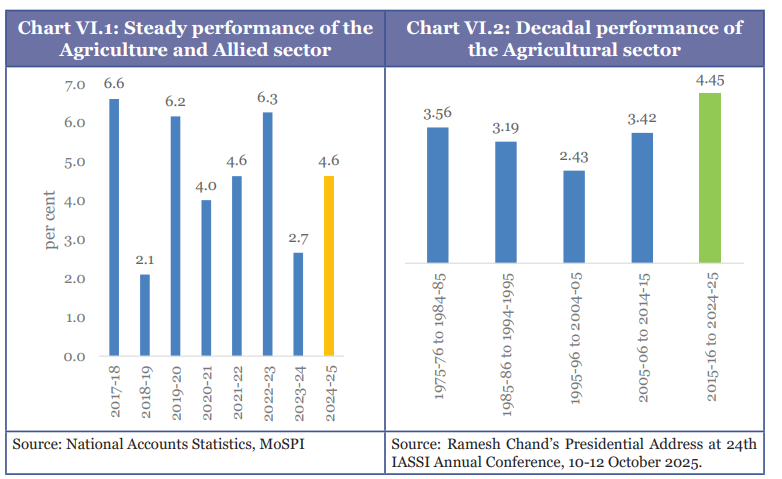
Over the past decade, agriculture and allied activities have recorded an average real growth rate of around 4.4%. Allied sectors such as livestock, fisheries, and horticulture have emerged as major growth drivers. Livestock has significantly expanded its contribution to agricultural value added, while fisheries have shown rapid growth, reflecting policy support and rising demand for protein-rich foods. This diversification has helped stabilise rural incomes and reduce overdependence on traditional crops.
Foodgrain production remains the foundation of India’s food security framework. For the agricultural year 2024-25, total foodgrain output is estimated at more than 3,577 lakh metric tonnes, supported by higher production of rice, wheat, maize, and coarse cereals. This steady rise has reinforced the country’s ability to meet domestic demand and maintain adequate public stocks.
Horticulture signals shift in agriculture
Alongside foodgrains, horticulture has assumed a larger role in agricultural output. Horticulture production has exceeded foodgrain production in volume, reflecting a shift towards high-value crops such as fruits and vegetables. The survey says this transition not only improves farm incomes but also supports better nutritional outcomes, aligning agricultural production with changing consumption.
Enhancing productivity is a core policy objective. The survey outlines several mission-mode initiatives aimed at improving yields and ensuring food security, including the National Food Security and Nutrition Mission. Special focus has been placed on pulses and oilseeds through dedicated programs to reduce import dependence and ensure domestic availability of essential nutrients and edible oils.
Irrigation, water management and soil
Water availability continues to be a key determinant of agricultural performance. While irrigation coverage has expanded over time, disparities across crops and regions persist. Rice and wheat enjoy higher irrigation coverage, whereas pulses and coarse cereals remain largely rain-fed. The Pradhan Mantri Krishi Sinchai Yojana seeks to close these gaps by expanding assured irrigation and promoting efficient water-use practices such as micro-irrigation. Improving water efficiency is increasingly important amid climate variability and resource constraints.
The survey draws attention to soil degradation and imbalanced fertiliser use as major risks to sustainable productivity. The Soil Health Card scheme has expanded soil testing and advisory services, but excessive use of nitrogen relative to phosphorus and potassium continues to affect soil quality. Addressing these distortions is essential for maintaining yields without increasing environmental stress or input costs.
Credit and income
Institutional credit to agriculture has expanded steadily, enabling farmers to invest in inputs, technology, and mechanisation. Schemes such as the Kisan Credit Card and interest subvention programmes have played a key role, while digital initiatives like the Kisan Rin Portal aim to improve transparency and access. Mechanisation support through custom hiring centres has benefited small farmers, and platforms such as the National Agriculture Market are improving price discovery and market integration.
Price support continues to be a central pillar of farm income policy. Minimum Support Prices are announced to provide a margin over production costs, particularly for staple crops. In addition, direct income support under the PM-KISAN scheme has provided predictable financial assistance to farmers, helping cushion income volatility and improve household security.
Public procurement
Public procurement of rice and wheat, combined with buffer stocking, remains crucial to India’s food security framework. The Public Distribution System ensures access to subsidised foodgrains for vulnerable populations and has played a stabilising role during economic and social shocks. These mechanisms form one of the largest food management systems in the world.
Rising costs and risks
The survey flags concerns over the rising fiscal and storage costs associated with large buffer stocks. Procurement has expanded beyond immediate food security requirements, particularly in rice and wheat, leading to high carrying costs and storage pressures. Greater efficiency in stock management and diversification of procurement towards pulses and oilseeds could help balance food security objectives with fiscal sustainability.
Risk mitigation has gained importance as climate variability increases. Crop insurance schemes such as the Pradhan Mantri Fasal Bima Yojana aim to protect farmers against losses from weather shocks, pests, and diseases. Technology-enabled assessments are improving implementation and encouraging farmers to adopt modern practices with reduced risk.
The survey highlights renewed efforts to strengthen cooperatives and farmer-producer organizations. Revitalising primary agricultural credit societies and promoting collective marketing are seen as ways to improve farmers’ access to inputs, credit, and markets while enhancing bargaining power within value chains.
In conclusion, the Economic Survey presents a positive picture of an agriculture sector that has successfully safeguarded national food security through sustained production growth and robust food management systems. However, it also emphasises the need for policy recalibration to address emerging challenges such as resource constraints, climate risks, and fiscal pressures. Aligning food security goals with productivity, diversification, and sustainability will be critical to ensuring long-term resilience in Indian agriculture.
IndiFoodBev — authentic, impactful and influential
An English-language food and beverage processing and packaging industry B2B platform in print and web, IndiFoodBev is in its third year of publication. It is said that the Indian food and beverage industries represent approximately US$ 900 billion in revenues which implies more than 20% of the country’s GDP. Eliminating the wastage on the farmside can help to deliver more protein to a higher number of the population apart from generating sizable exports. The savings in soil, seeds, water, fertilizer, energy and ultimately food and nutrition could be the most immense contribution that country is poised to make to the moderation of climate change.
To improve your marketing and grow sales to the food and beverage processing and packaging industry, talk to us. Our research and consulting company IppStar [www.ippstar.org] can assess your potential and addressable markets in light of the competition. We can discuss marketing, communication, and sales strategies for market entry and growth.
Suppliers and service providers with a strategy and budget for targeted marketing can discuss using our hybrid print, web, video, and social media channels to create brand recognition linked to market relevance. Our technical writers are ready to meet you and your customers for content.
The second largest producer of fruit and vegetables in the world is continuously expanding processing capacities and delivery systems with appropriate innovative technologies. We cover product and consumer trends, nutrition, processing, research, equipment and packaging from farm to thali. Get our 2025 media kit and recalibrate your role in this dynamic market. Enhance your visibility and relevance to existing markets and turn potential customers into conversations. Ask for a sample copy of our bi-monthly in print or our weekly IndiFoodBev eZine each Wednesday.
For editorial info@ippgroup.in — for advertisement ads1@ippgroup.in and for subscriptions subscription@ippgroup.in
Naresh Khanna – 10 February 2025
Subscribe Now