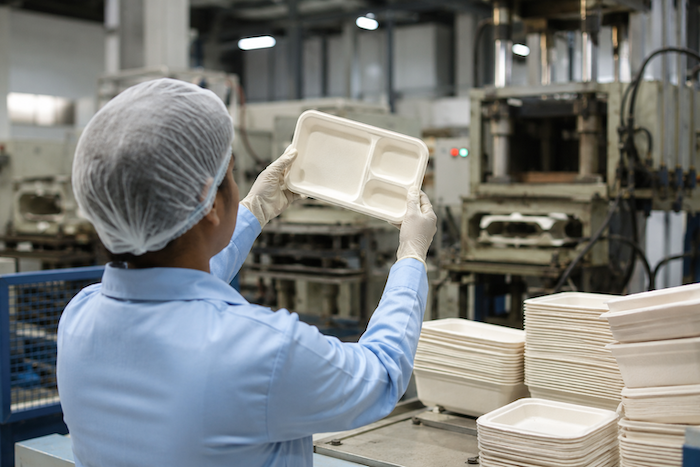
Before asking which EPR category a compostable pack falls into, ask yourself – is it plastic packaging at all? An uncoated molded fiber item containing no plastic is not. Add a lining and that changes, but a compostable resin does not settle the category issue. Category III covers multilayered packaging with at least one plastic layer and one layer of other material, so a fiber-and-plastic laminate is classified by its construction, not by whether the lining is compostable.

The March 2024 amendment added a fifth category and widened the fourth. Category IV now covers “Carry bags and commodities made of compostable plastics,” as well as packaging sheet. Category V is the same wording for biodegradable plastics. Both sit inside the EPR framework with a category of their own, and compostable plastics must conform to IS/ISO 17088:2021.
Minimum recycling levels differ. Categories II and III run 30, 40, 50 and 60% across 2024-25 to 2027-28; Categories I and IV run 50, 60, 70 and 80%. Compostable packaging sits on the same track as rigid plastic.
The wording then changes what compliance means. For Category IV, “The minimum level of recycling means processing plastic packaging waste for composting through industrial composting facilities.” Whether that outcome is achieved depends on collection and on access to industrial composting, which is a separate question from the obligation.
Compostable, biodegradable, and the label that settles it
These are distinct in law, and since March 2024 each carries its own mandatory label. Biodegradable plastics are defined as “Plastics, other than compostable plastics, which undergo degradation by biological processes in specific environments such as soil, landfill, sewage sludge, fresh water, marine, without leaving any microplastics or visible or distinguishable or toxic residue, which has adverse environmental impact.”
Rule 11(3) requires every compostable pack or commodity to bear the label, “Compostable only under industrial composting.” Rule 11(4) requires biodegradable items to carry a label naming a number of days and a specific recipient environment, such as soil, landfill or water.
That disposes of the home compostable question. The Rules create no such category, and the label India requires says the opposite of a home claim. A certificate under another scheme does not displace IS/ISO 17088:2021 or the CPCB requirement.
Rule 4(1)(ha), inserted in 2024, provides that manufacturers of compostable or biodegradable plastic carry bags or commodities “Shall obtain a certificate from the Central Pollution Control Board before marketing or selling.” CPCB’s procedure adds a printed code, the certificate number, and a QR code generated from the manufacturer’s details. That is a chain a buyer can check rather than take on trust.
There is a quick test, but not the one you want
CPCB publishes a quick verification test to distinguish compostable from conventional plastics. In dichloromethane, PLA and PBAT dissolve while PE and PP do not. In boiled xylene, the result reverses. In water, PLA and PBAT sink and PE and PP float.
It identifies a polymer. It does not prove compostability – and CPCB flags a false positive. “Styrene-based polymers undergo dissolution in DCM and may appear as compostable plastics.”
Certification is separate, and there is a short route. A full report covers four components: disintegration, ultimate aerobic biodegradation, seed germination, and heavy metal analysis, the last two at 180 days, tested at CIPET, a BIS-recognized laboratory, or a NABL-accredited one. CPCB will issue a provisional certificate on an interim report covering the first two, valid for six months and extendable by six. So a fast turnaround tells a buyer little by itself.
The same lining decision is priced abroad too. Under the UK regime, confirmed year 1 base fees were GBP 461 a ton for fiber-based composite against GBP 196 for paper and card, and from January 2026 the plastic layers must exceed 5% of the packaging by mass before it counts as fiber-based composite.
What to check before you quote
Whether it is plastic packaging at all, and on what construction. Which category applies, III, IV or V. Whether the CPCB certificate exists and the QR code resolves. Which label it carries. And which laboratory ran which components, and when. None of this argues against compostable packaging. It argues for reading the obligation that comes with it, which is the part buyers tend to skip and the part that shows up in an audit.
Sameer Kulkarni works on export compliance content at Ecofy (Pratishthan Industries Pvt. Ltd.), a molded fibre foodservice packaging manufacturer in Maharashtra that exports to distributors, importers, and foodservice buyers in more than 30 countries.
IndiFoodBev — authentic, impactful and influential
An English-language food and beverage processing and packaging industry B2B platform in print and web, IndiFoodBev is in its third year of publication. It is said that the Indian food and beverage industries represent approximately US$ 900 billion in revenues which implies more than 20% of the country’s GDP. Eliminating the wastage on the farmside can help to deliver more protein to a higher number of the population apart from generating sizable exports. The savings in soil, seeds, water, fertilizer, energy and ultimately food and nutrition could be the most immense contribution that country is poised to make to the moderation of climate change.
To improve your marketing and grow sales to the food and beverage processing and packaging industry, talk to us. Our research and consulting company IppStar [www.ippstar.org] can assess your potential and addressable markets in light of the competition. We can discuss marketing, communication, and sales strategies for market entry and growth.
Suppliers and service providers with a strategy and budget for targeted marketing can discuss using our hybrid print, web, video, and social media channels to create brand recognition linked to market relevance. Our technical writers are ready to meet you and your customers for content.
The second largest producer of fruit and vegetables in the world is continuously expanding processing capacities and delivery systems with appropriate innovative technologies. We cover product and consumer trends, nutrition, processing, research, equipment and packaging from farm to thali. Get our 2025 media kit and recalibrate your role in this dynamic market. Enhance your visibility and relevance to existing markets and turn potential customers into conversations. Ask for a sample copy of our bi-monthly in print or our weekly IndiFoodBev eZine each Wednesday.
For editorial info@ippgroup.in — for advertisement ads1@ippgroup.in and for subscriptions subscription@ippgroup.in
Naresh Khanna – 10 February 2025
Subscribe Now