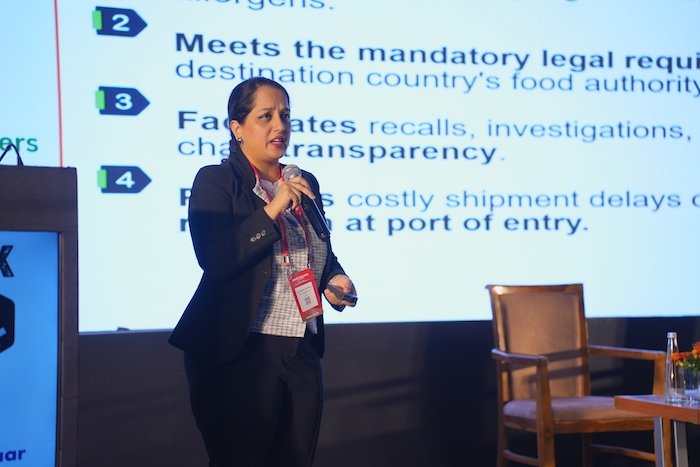
At the FoodTekPack Conference 2026 in Gandhinagar, Rashida Vapiwala of LabelBlind discussed how automated compliance tools can help Indian food brands navigate complex labelling requirements and prepare products for international markets.

As Indian food brands increasingly look beyond domestic markets, packaging and labelling are becoming important components of their export strategy. A product that complies with Indian regulations may not necessarily meet the requirements of the country where it is intended to be sold. Different markets have their own rules governing ingredients, allergens, nutrition information, quantities, languages and mandatory declarations.
This was the focus of a presentation by Rashida Vapiwala, founder of LabelBlind, at the conference. Vapiwala placed her arguments in the context of India’s growing international trade ambitions, as Indian companies increasingly target markets such as the US, Canada, Australia, the Gulf, Southeast Asia, the UK and the European Union.
“Each of these countries has regulatory compliances of their own,” Vapiwala said. For food manufacturers, expanding into international markets requires more than developing products and establishing distribution networks. Packaging must be adapted to destination-market regulations. Ingredient declarations may need to follow a specific format, allergens must be correctly identified, nutrition information may have to be presented differently, and labels may require translation into other languages.
The complexity increases for companies selling across multiple geographies. Regulatory requirements can differ depending on product categories and the claims made on the packaging.
Vapiwala’s presentation positioned automation as a way of simplifying this process. According to her, LabelBlind’s platform is designed to harmonize regulatory requirements and help manufacturers generate labels compatible with different markets. The presentation highlighted that the system can address labelling requirements across 22 countries and markets, including the US, Canada, Gulf countries, the UK, EU and Southeast Asia.
The platform considers a range of requirements, including ingredient permissibility, allergens, nutritional practices, quantity declarations, language translation, multi-category labels and different nutrition formats.
The presentation also demonstrated the company’s FolSol platform and its workflow for generating a food label. The process begins with the creation of master data for a business and its brands. Information such as addresses, consumer-care details and storage instructions can be entered once and used across multiple products and labels.
The next stage involves the ingredients and recipe database. According to the presentation, FolSol is powered by a database of around 30,000 ingredients, including raw and packaged food products. Ingredients specific to a company’s formulation can also be mapped into the system.
Once the recipe is entered, it can be used to create a label through an automated workflow. The ingredient list can be arranged in descending order of quantity, while ingredients requiring percentage declarations can be highlighted. Nutritional values can be pulled from the database for the required nutrition declaration.
Other information, including applicable mandatory declarations, addresses, consumer-care details and storage instructions, can be integrated into the label from the previously created master data. The workflow takes into account requirements related to plastic waste management and legal metrology.
The aim is to bring together information that manufacturers would otherwise need to verify across multiple sources and regulatory requirements.
The significance of automation, however, goes beyond saving time. For companies managing large product portfolios, changes in formulations, ingredients, or regulations can require packaging information to be reviewed repeatedly. A structured digital workflow can potentially reduce manual intervention and improve consistency across labels.
As India continues to strengthen its position in global food trade, regulatory compliance is likely to become an increasingly important part of export readiness. For manufacturers, getting a product ready for an international market will involve not only ensuring the quality and safety of what goes inside the pack, but also ensuring that every mandatory detail on the outside meets the requirements of the destination market.
As Vapiwala’s presentation demonstrated, automated labelling tools could help bridge this gap, making compliance a more integrated part of the journey from product formulation to the international shelf.
IndiFoodBev — authentic, impactful and influential
An English-language food and beverage processing and packaging industry B2B platform in print and web, IndiFoodBev is in its third year of publication. It is said that the Indian food and beverage industries represent approximately US$ 900 billion in revenues which implies more than 20% of the country’s GDP. Eliminating the wastage on the farmside can help to deliver more protein to a higher number of the population apart from generating sizable exports. The savings in soil, seeds, water, fertilizer, energy and ultimately food and nutrition could be the most immense contribution that country is poised to make to the moderation of climate change.
To improve your marketing and grow sales to the food and beverage processing and packaging industry, talk to us. Our research and consulting company IppStar [www.ippstar.org] can assess your potential and addressable markets in light of the competition. We can discuss marketing, communication, and sales strategies for market entry and growth.
Suppliers and service providers with a strategy and budget for targeted marketing can discuss using our hybrid print, web, video, and social media channels to create brand recognition linked to market relevance. Our technical writers are ready to meet you and your customers for content.
The second largest producer of fruit and vegetables in the world is continuously expanding processing capacities and delivery systems with appropriate innovative technologies. We cover product and consumer trends, nutrition, processing, research, equipment and packaging from farm to thali. Get our 2025 media kit and recalibrate your role in this dynamic market. Enhance your visibility and relevance to existing markets and turn potential customers into conversations. Ask for a sample copy of our bi-monthly in print or our weekly IndiFoodBev eZine each Wednesday.
For editorial info@ippgroup.in — for advertisement ads1@ippgroup.in and for subscriptions subscription@ippgroup.in
Naresh Khanna – 10 February 2025
Subscribe Now