Amazon and the Indian Institute of Technology (IIT) Roorkee are developing recyclable, home-compostable packaging from crop residues – intending to reduce plastic consumption, cut carbon emissions, and help farmers profit from side streams, according to an Amazon blog post.
India produces nearly 500 million tons of agricultural waste each year and this partnership will help convert this waste into eco-friendly packaging. Through the development of packaging materials derived from crop residue, the initiative seeks to ease reliance on virgin wood pulp, which is sourced directly from freshly felled trees.
Over a 15-month research period, the team will process farm byproducts such as wheat straw and sugarcane residue into durable, high-quality paper mailers. The resulting materials are light yet tough. They are also recyclable and suitable for home composting, offering a practical alternative to conventional wood pulp paper and plastic packaging. Amazon said.
Beyond packaging innovation, this effort addresses the widespread issue of stubble burning—the practice of setting fire to leftover crop residue after harvest, which significantly worsens air pollution in Delhi-NCR and the northern plains of India at the onset of winter. At the same time, reducing dependence on imported virgin wood pulp could open up new revenue streams for farmers by creating demand for agricultural byproducts that would otherwise go unused.
How researchers are turning waste into packaging
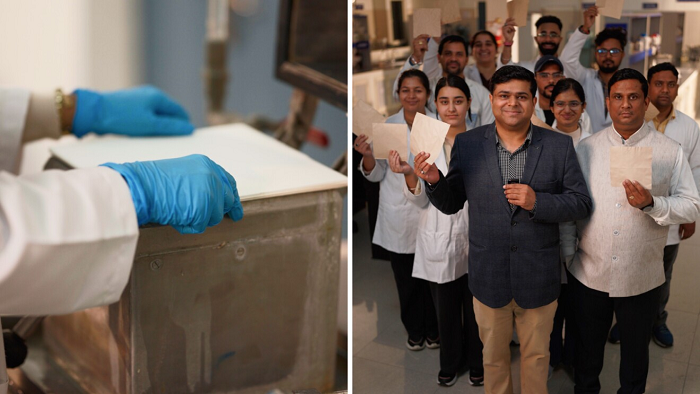
The process of converting farm residue into Amazon packaging starts at the INNOPAP (Innovations in Paper and Packaging) lab within IIT Roorkee’s Department of Paper and Packaging Technology, where wheat straw and bagasse—materials typically discarded post-harvest—are delivered for treatment.
Initially, the crop residue is processed in an autoclave digester, which breaks down the raw biomass into pulp. This step transforms agricultural waste into usable fiber and helps limit the need for virgin inputs traditionally required in paper manufacturing.
After pulping, the material is thoroughly washed and screened to eliminate impurities and maintain consistent standards. The refined pulp then moves through pressing and drying stages to form paper sheets. Each sample is produced according to Amazon’s durability and recyclability requirements, ensuring it performs to specification.
What begins as discarded farm waste ends up as fully functional, recyclable mailers ready for customer shipments.
What does the collaboration entail?
As outlined in the Amazon blog post, the partnership with IIT Roorkee’s Department of Paper and Packaging Technology will begin with laboratory-scale research and testing over 15 months. If performance benchmarks are met, Amazon plans to support the transition to industrial trials, process validation, and eventual commercial-scale production by the middle to latter part of next year.
Kamal Kishore Pant, director of IIT Roorkee, states, “Sustainability is no longer optional; it has become a pressing national imperative. This partnership between IIT Roorkee and Amazon represents meaningful progress toward India’s circular economy ambitions, in alignment with government initiatives.
“By converting agricultural residues into biodegradable packaging solutions, we are tackling both stubble burning and the country’s reliance on virgin materials, while developing scalable innovations that serve industry, farmers, and the broader community. This collaboration highlights how academic expertise combined with industry engagement can help accelerate India’s shift toward a more sustainable and self-reliant future.”
Abhinav Singh, vice-president of operations at Amazon India, says, “At Amazon, we operate one of India’s fastest, safest, and most dependable logistics networks, and we remain focused on making it increasingly sustainable. Through our partnership with IIT Roorkee, we are advancing new packaging solutions created from crop residue.”
He continues, “India generates close to 500 million tons of agricultural waste each year, and redirecting it into packaging applications supports a circular economy while decreasing dependence on traditional materials.”
The research initiative is being led by Prof. Vibhore Kumar Rastogi and Dr. Anurag Kulshreshtha from the INNOPAP Lab at IIT Roorkee’s Saharanpur Campus.
Innovating for sustainable packaging with Amazon
As part of broader efforts to cut packaging waste, Amazon reports that more than half of customer orders in India are shipped either in their original manufacturer packaging or with reduced packaging materials. The company delivers items in product packaging to customers in over 300 cities nationwide. Since 2019, Amazon India has removed all single-use plastic from packaging across its fulfilment centers.
Amazon India notes that it is committed to running its operations in a more sustainable manner. Through The Climate Pledge, the company has set a target of reaching net-zero carbon emissions across its operations by 2040.
Progress has been swift. Investments span renewable energy, packaging redesign, electrification of transportation, circular economy initiatives, and AI-driven efficiencies. Amazon has also pledged to replenish more water to Indian communities than it consumes in its direct operations by 2027.
IndiFoodBev — authentic, impactful and influential
An English-language food and beverage processing and packaging industry B2B platform in print and web, IndiFoodBev is in its third year of publication. It is said that the Indian food and beverage industries represent approximately US$ 900 billion in revenues which implies more than 20% of the country’s GDP. Eliminating the wastage on the farmside can help to deliver more protein to a higher number of the population apart from generating sizable exports. The savings in soil, seeds, water, fertilizer, energy and ultimately food and nutrition could be the most immense contribution that country is poised to make to the moderation of climate change.
To improve your marketing and grow sales to the food and beverage processing and packaging industry, talk to us. Our research and consulting company IppStar [www.ippstar.org] can assess your potential and addressable markets in light of the competition. We can discuss marketing, communication, and sales strategies for market entry and growth.
Suppliers and service providers with a strategy and budget for targeted marketing can discuss using our hybrid print, web, video, and social media channels to create brand recognition linked to market relevance. Our technical writers are ready to meet you and your customers for content.
The second largest producer of fruit and vegetables in the world is continuously expanding processing capacities and delivery systems with appropriate innovative technologies. We cover product and consumer trends, nutrition, processing, research, equipment and packaging from farm to thali. Get our 2025 media kit and recalibrate your role in this dynamic market. Enhance your visibility and relevance to existing markets and turn potential customers into conversations. Ask for a sample copy of our bi-monthly in print or our weekly IndiFoodBev eZine each Wednesday.
For editorial info@ippgroup.in — for advertisement ads1@ippgroup.in and for subscriptions subscription@ippgroup.in
Naresh Khanna – 10 February 2025
Subscribe Now