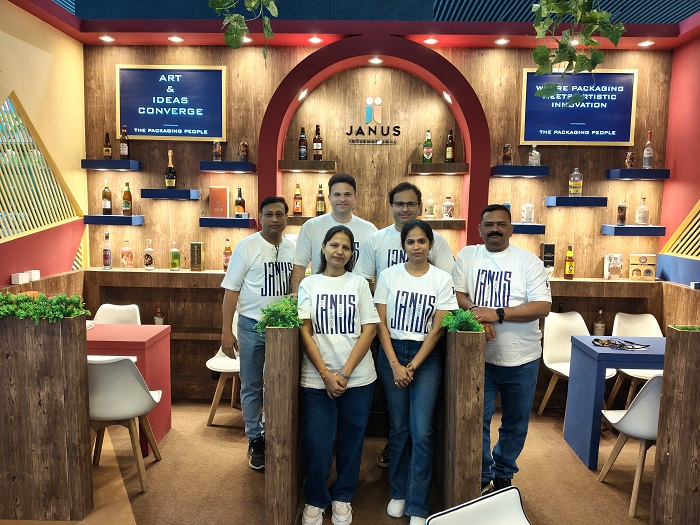
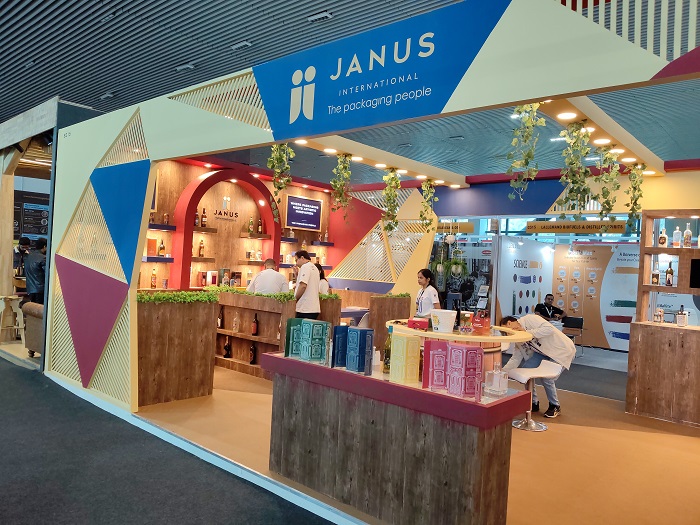
For Janus International owner Denver Annunciation, the Brews & Spirits Expo 2025 in Bengaluru reaffirmed why the show has become a key fixture on the company’s calendar. “This is probably our third or fourth time here, and it’s always been a good show,” he said. “You don’t need a massive crowd. What matters is that the people coming to you are the right ones.”
Held from 27 to 29 November at the KTPO Convention Centre, the expo attracted a focused audience of brand owners, senior management and decision-makers—exactly the profile Janus International looks for. “You’ll always get 10-20% who are just browsing, that’s part and parcel of the business,” Annunciation said. “But the majority are owners or senior management. That’s what makes this show valuable.”
Janus International, known for its work across labels, packaging design and premium finishes, showcased a wide range of solutions at the event, including aluminium-based packaging and high-end label applications for alcoholic beverages.
Much of the conversation around the stand reflected a broader shift in India’s alcobev space. Once a market dominated by a handful of brands, it has seen an explosion of innovation over the past decade. “Ten years ago, you’d hear of four or five gin brands. Today there are 70 or 80,” Annunciation noted. “It started with gin, now it’s moving into tequila and other categories. People are experimenting with local flowers, fruits and botanicals, especially from regions like the Northeast. Real innovation is happening at this level.”
While large companies continue to focus on volumes, Annunciation believes smaller, independent brands are driving creativity. “These are still startups. Eventually, when someone becomes big, they tend to get acquired. But right now, this is where the energy is,” he said.
Spirit-related work currently accounts for about 55–60% of Janus International’s business, a share that has deliberately come down from earlier levels. “Before the pandemic, we were almost 90-95% alcobev,” he said. “Since then, we’ve consciously de-risked. Everything has grown, but we’ve added non-spirits businesses and so the overall mix is more balanced.”
That philosophy also shapes the company’s growth strategy. Rather than chasing aggressive expansion, Janus International has focused on steady, sustainable progress. “Since 2020, we’ve grown consistently, but not exponentially,” Annunciation said. “Regular growth, consistent profitability, and balancing operations, finances and excellence—that’s the focus. We’re not interested in aggressive growth.”
Investment, however, has remained a priority. Over the past three years, the company has expanded its Thane plant significantly, adding multiple conventional narrow-web presses and strengthening its digital capabilities. Janus International currently operates six conventional presses and two digital presses, with a third digital machine scheduled for installation by February or March ahead of the next season.
Efficiency is central to these investments. “On digital, we’re beating global average utilization,” Annunciation said. “That’s why we were confident about adding another machine. We benchmark ourselves against global standards and push to exceed them.”
On the role of digital printing in labels, Annunciation remains pragmatic. “The market is growing, but in India the share of digital hasn’t really increased,” he said. “If digital was 15% of our turnover earlier, it’s still around 15% today—just on a much larger base. Everything has grown.”
He believes the pace of digital adoption in India will depend on several factors, including labor costs, per capita income, and input prices. “In the West, labor shortages and high costs are accelerating the shift to digital,” he said. “India is different. Labor is still available and relatively affordable. Digital will grow, but how fast is the million-dollar question.”
IndiFoodBev — authentic, impactful and influential
An English-language food and beverage processing and packaging industry B2B platform in print and web, IndiFoodBev is in its third year of publication. It is said that the Indian food and beverage industries represent approximately US$ 900 billion in revenues which implies more than 20% of the country’s GDP. Eliminating the wastage on the farmside can help to deliver more protein to a higher number of the population apart from generating sizable exports. The savings in soil, seeds, water, fertilizer, energy and ultimately food and nutrition could be the most immense contribution that country is poised to make to the moderation of climate change.
To improve your marketing and grow sales to the food and beverage processing and packaging industry, talk to us. Our research and consulting company IppStar [www.ippstar.org] can assess your potential and addressable markets in light of the competition. We can discuss marketing, communication, and sales strategies for market entry and growth.
Suppliers and service providers with a strategy and budget for targeted marketing can discuss using our hybrid print, web, video, and social media channels to create brand recognition linked to market relevance. Our technical writers are ready to meet you and your customers for content.
The second largest producer of fruit and vegetables in the world is continuously expanding processing capacities and delivery systems with appropriate innovative technologies. We cover product and consumer trends, nutrition, processing, research, equipment and packaging from farm to thali. Get our 2025 media kit and recalibrate your role in this dynamic market. Enhance your visibility and relevance to existing markets and turn potential customers into conversations. Ask for a sample copy of our bi-monthly in print or our weekly IndiFoodBev eZine each Wednesday.
For editorial info@ippgroup.in — for advertisement ads1@ippgroup.in and for subscriptions subscription@ippgroup.in
Naresh Khanna – 10 February 2025
Subscribe Now