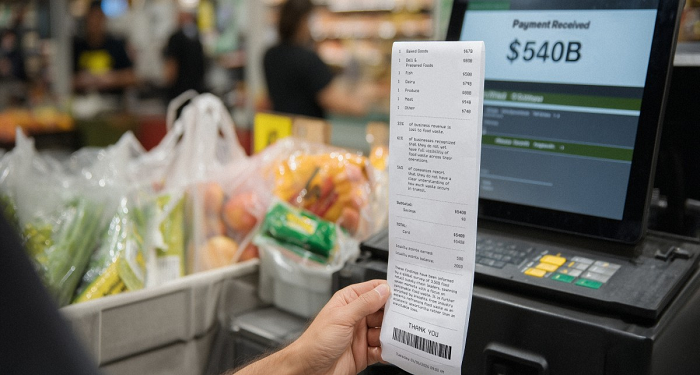
Independent modeling warns that the economic cost of food waste across the global supply chain is forecast to reach US$540 billion by 2026, up from US$526 billion last year, says a new report released by Avery Dennison.

As businesses return from 2025’s holiday trading season, new data has revealed that food waste continues to erode margins and is one of the most costly, yet hidden, challenges in the global retail supply chain, says the Making the Invisible Visible: Unlocking the Hidden Value of Food Waste to Drive Growth and Profitability report, published on 6 January by Avery Dennison, a global materials science and digital identification solutions company.
In addition, the report findings show that, on average, food waste costs are equivalent to 33% of total revenues in the food retail supply chain annually from post-farm up to the point-of-sale.
Extensive research involving 3,500 global food retailers and supply chain leaders reveals that, despite growing awareness, 61% of businesses say they still lack full visibility into where food waste occurs across their operations. Limited influence over the most waste-intensive areas of the supply chain is a common challenge, highlighting the urgent need for targeted innovation and cross-supply chain collaboration, Avery Dennison said in a release.
The data highlights how leaders are consistently challenged at various points throughout the supply chain and most specifically across perishables. When asked to identify the three most difficult categories for waste, half pointed to meat (50%), 45% cited produce, and 28% mentioned baked goods. Over half (51%) of business leaders said that inventory management and overstocking contribute significantly to food waste within their operations. Tackling this will require a combination of solutions, including item-level inventory visibility, demand forecasting and real-time shelf-life management.
Transit remains a connecting thread between the different perishable categories, with 56% of companies reporting that they do not have a clear understanding of how much food waste happens when goods are being transported.
If current trends continue, the cumulative cost of food waste from 2025 to 2030 is expected to reach US$3.4 trillion, coinciding with the 2030 deadline for the UN’s Sustainable Development Goal 12.3, which aims to halve global food waste. Despite this goal, the report uncovered that over a quarter (27%) of leaders said that they would not meet the 2030 deadline.
Julie Vargas, VP/GM, Enterprise Intelligent Labels Growth, Avery Dennison, says, “Food waste has become an accepted cost of doing business, but it doesn’t have to be. Innovation exists today to help overcome the complexity of food waste by unlocking new possibilities and transforming a historic operating cost into measurable value across the global retail supply chain.
“The retail ecosystem is changing, but not enough retailers are changing with it. The biggest challenge is what we can’t see. From transit to shelf, blind spots are silently eroding margins. With the right innovation, we can turn this loss into measurable value and shift the conversation on food waste, from being purely seen as a sustainability issue, into a business critical one. This is about unlocking efficiency and growth across the entire supply chain.”
A high cost challenge intensified by the holiday season
Meat has emerged as one of the most difficult categories for waste management, with 72% of supply chain leaders citing it as their biggest challenge. Given its high unit cost in grocery and food retail, even small reductions in waste can deliver significant financial gains. Economic modeling forecasts meat waste to amount to $94 billion in lost output across the global supply chain in 2026, almost one fifth of the total cumulative loss across the year, with fresh produce closely behind at $88 billion.
Just ahead of peak season trading results are announced, Avery Dennison found that over two thirds of businesses (67%) were predicting that meat waste during the holiday season was expected to noticeably reduce their margins and that managing this issue over one of the busiest times of the year had become a bigger operational concern than before (69%).
For retailers, pressures presented by economic volatility, poor adaptability to market-related shocks and difficulty adjusting to shifting consumer demands are exacerbating systemic food waste issues. Almost three quarters (74%) of retailers admit inflation is making it harder than ever to predict demand for fresh meat and 73% report a rising demand amongst consumers for smaller meat portions or alternatives.
Michael Colarossi, VP, head of enterprise sustainability, Avery Dennison, adds, “For too long, food waste has been positioned almost exclusively as a sustainability and societal issue. We must recognize it as the business opportunity it truly is. In fact, over seven in ten (73%) business leaders told us that they see tackling food waste as a growth opportunity. That’s why the $540 billion in lost value should be a clear call to action for the food retail supply chain to cut waste and boost efficiencies. Only by uncovering the blind spots in the chain can we take meaningful steps to reduce loss, build resilience and create lasting value for both businesses and the planet.”
IndiFoodBev — authentic, impactful and influential
An English-language food and beverage processing and packaging industry B2B platform in print and web, IndiFoodBev is in its third year of publication. It is said that the Indian food and beverage industries represent approximately US$ 900 billion in revenues which implies more than 20% of the country’s GDP. Eliminating the wastage on the farmside can help to deliver more protein to a higher number of the population apart from generating sizable exports. The savings in soil, seeds, water, fertilizer, energy and ultimately food and nutrition could be the most immense contribution that country is poised to make to the moderation of climate change.
To improve your marketing and grow sales to the food and beverage processing and packaging industry, talk to us. Our research and consulting company IppStar [www.ippstar.org] can assess your potential and addressable markets in light of the competition. We can discuss marketing, communication, and sales strategies for market entry and growth.
Suppliers and service providers with a strategy and budget for targeted marketing can discuss using our hybrid print, web, video, and social media channels to create brand recognition linked to market relevance. Our technical writers are ready to meet you and your customers for content.
The second largest producer of fruit and vegetables in the world is continuously expanding processing capacities and delivery systems with appropriate innovative technologies. We cover product and consumer trends, nutrition, processing, research, equipment and packaging from farm to thali. Get our 2025 media kit and recalibrate your role in this dynamic market. Enhance your visibility and relevance to existing markets and turn potential customers into conversations. Ask for a sample copy of our bi-monthly in print or our weekly IndiFoodBev eZine each Wednesday.
For editorial info@ippgroup.in — for advertisement ads1@ippgroup.in and for subscriptions subscription@ippgroup.in
Naresh Khanna – 10 February 2025
Subscribe Now