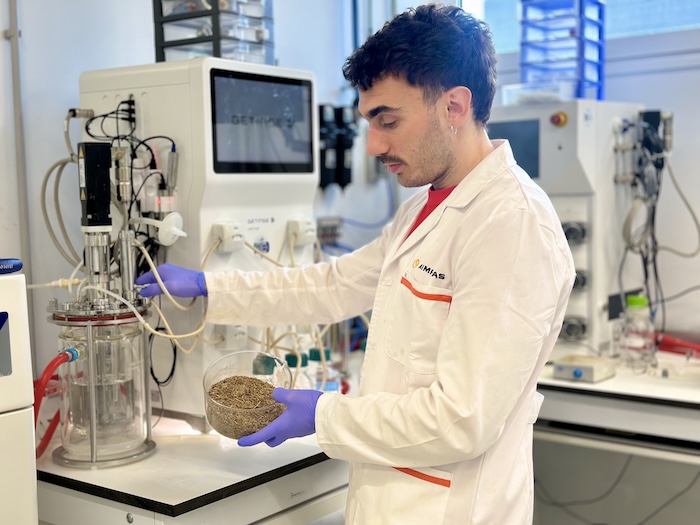
Every year, the Valencian agricultural sector generates around 800,000 tons of plant waste, such as rice straw and citrus pruning waste. Currently, the methods for recovering this biomass are costly, as they require commercial enzymes that can represent up to 40% of the cost of the process, which limits its industrial viability. To solve this problem, AIMPLAS, the Plastics Technology Centre, is leading the Biovalsa project, an initiative that seeks to develop innovative processes for manufacturing sustainable bioplastics from agricultural waste and pruning residues. The project is funded by IVACE+i Innovation and receives financial support from the European Union through the ERDF Comunitat Valenciana programme for the 2021-2027 period.
Biovalsa will develop a new process that will enable the use of agricultural waste to manufacture bioplastics, a sustainable alternative to petroleum-based synthetics. This initiative aims to develop alternative routes for recovering value from rice straw biomass, thereby avoiding the use of costly chemical compounds. Specifically, the idea is to replace the usual treatments with others that allow the three fractions (cellulose, hemicellulose and lignin) that make up the lignocellulosic biomass to be recovered for use in various applications of interest to the bioplastics industry.
Cellulose will thus be used to produce lactic acid, a key compound in the manufacture of PLA, the most widely used bioplastic, while hemicellulose is expected to yield succinic acid, which is necessary for the production of PBS, another sustainable biopolymer with greater flexibility and heat resistance.
Finally, the antimicrobial properties of lignin make it suitable for recovery and use as an additive to prevent the proliferation of microorganisms, which increases the market value and expands the potential applications of these biodegradable and compostable materials.
Collaborating companies and centres
Coordinated by AIMPLAS, which contributes its experience in both waste recovery and biopolymer manufacturing, “Biovalsa” also brings together specialists from the University Institute of Food Engineering at the Polytechnic University of Valencia (FoodUPV) and three other companies based in the Valencian Community. Bioban will contribute its genomic analysis capabilities to identify the most suitable bacterial strains for carrying out the treatments, while Viromii will study the economic viability of new processes for obtaining biocomposites. Finally, Prime Biopolymers, as the end customer, will be responsible for producing the biomaterials and analyzing applicability of the materials obtained during the project.
The project is in its first year of development, during which progress has been made in separating the components of rice straw using alternative methods that do not involve toxic substances. Different strains of bacteria and microorganisms capable of breaking down cellulose and hemicellulose to generate the lactic and succinic acids necessary for the production of bioplastics are also being tested.
Biovalsa is aligned with the conclusions of the Strategic Specialised Innovation Committees (CEIE) on Circular Economy and Enabling Technologies, promoted by IVACE+i Innovación. In the first case, it responds to the development of materials and technologies for the production of high added-value products from waste and, in the second, it urges the application of biotechnology to improve processes and products. It also falls within the main axes of the Valencian Community’s Smart Specialisation Strategy, S3, which is coordinated by the Regional Ministry of Industry, Tourism, Innovation and Trade.
IndiFoodBev — authentic, impactful and influential
An English-language food and beverage processing and packaging industry B2B platform in print and web, IndiFoodBev is in its third year of publication. It is said that the Indian food and beverage industries represent approximately US$ 900 billion in revenues which implies more than 20% of the country’s GDP. Eliminating the wastage on the farmside can help to deliver more protein to a higher number of the population apart from generating sizable exports. The savings in soil, seeds, water, fertilizer, energy and ultimately food and nutrition could be the most immense contribution that country is poised to make to the moderation of climate change.
To improve your marketing and grow sales to the food and beverage processing and packaging industry, talk to us. Our research and consulting company IppStar [www.ippstar.org] can assess your potential and addressable markets in light of the competition. We can discuss marketing, communication, and sales strategies for market entry and growth.
Suppliers and service providers with a strategy and budget for targeted marketing can discuss using our hybrid print, web, video, and social media channels to create brand recognition linked to market relevance. Our technical writers are ready to meet you and your customers for content.
The second largest producer of fruit and vegetables in the world is continuously expanding processing capacities and delivery systems with appropriate innovative technologies. We cover product and consumer trends, nutrition, processing, research, equipment and packaging from farm to thali. Get our 2025 media kit and recalibrate your role in this dynamic market. Enhance your visibility and relevance to existing markets and turn potential customers into conversations. Ask for a sample copy of our bi-monthly in print or our weekly IndiFoodBev eZine each Wednesday.
For editorial info@ippgroup.in — for advertisement ads1@ippgroup.in and for subscriptions subscription@ippgroup.in
Naresh Khanna – 10 February 2025
Subscribe Now