The Indian snack sector is undergoing a structural transformation, combining its deep culinary heritage with advanced food science, automation, and compliance-driven manufacturing. This strategic shift was clearly articulated at Indusfood Manufacturing 2026, where senior industry leaders mapped a roadmap to scale Indian snacks into globally competitive ready-to-eat (RTE) products.

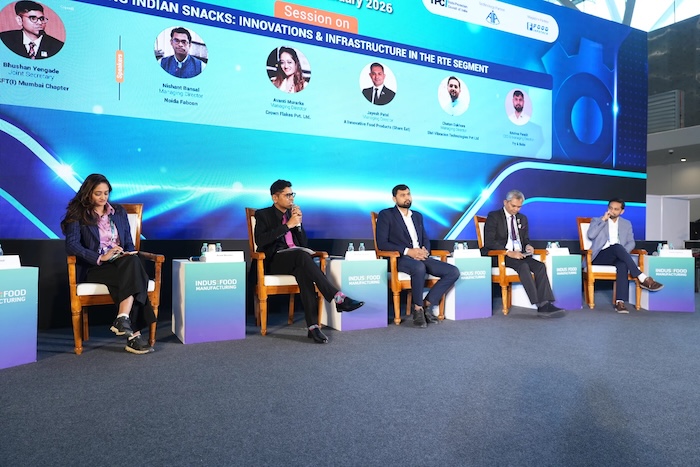
The high-level session, “Scaling Indian Snacks: Innovations and Infrastructure in the RTE Segment,” was chaired by internationally respected Food Technologist Bhushan Namdeorao Yengade, founder of Binder Technology Consultancy. The discussion highlighted that international success now hinges not only on flavour authenticity but equally on engineering precision, hygienic design, ingredient standardisation, and regulatory adherence.
Presenting Binder Technology’s insights from his Asia-Pacific market study, Yengade explained that global snack consumption patterns have shifted decisively in the post-COVID period. Consumers are increasingly moving from impulse-driven snacking toward what he termed “mindful indulgence,” prioritising health, functionality, and transparency.
As the vice president (market research) of the Council for Promotion, Research & Trade in Traditional Foods, Yengade stated that the accelerating global demand for high-protein snack formats, clean-label ingredient systems, and clearly articulated nutritional transparency is actively shaping what he calls “Tradition 2.0,” a new development model in which traditional Indian foods are systematically re-engineered, validated, and optimised through modern food science without compromising their cultural identity.
Infrastructure emerged as a major determinant of scalability. Nishant Bansal, managing director of Noida Fabcon, noted that challenges during expansion typically arise in material handling systems, thermal process stability, and packaging automation rather than in recipe development.
Ingredient consistency was highlighted by Avanti Murarka, managing director of Crown Flakes, who discussed the growing reliance on dehydrated potato ingredients. She stressed that precise control over hydration behaviour, granule size, and texture is critical for predictable performance on high-speed forming and frying lines.
Addressing export readiness, Jayesh Patel, managing director of A Innovative Food Products (SharEat), spoke on the complexities of converting street foods such as pani puri into globally compliant FMCG products. He emphasised strict microbiological control, allergen segregation, and moisture management.
Chetan Dakhore, managing director of Shri Vibracion Technologies, underscored the importance of hygienic material handling, noting that breakage, dust generation, and seasoning loss directly affect yield, food safety, and brand perception.
On the processing, Krishna Pandit, CEO and managing director of Fry & Bake Technologies, showcased advances in direct-heating fryers and continuous oil filtration systems that reduce oil degradation while enhancing product quality and nutritional outcomes.
The session concluded with consensus that Indian snacks are transitioning from regional specialities to globally scalable, science-led products.
IndiFoodBev — authentic, impactful and influential
An English-language food and beverage processing and packaging industry B2B platform in print and web, IndiFoodBev is in its third year of publication. It is said that the Indian food and beverage industries represent approximately US$ 900 billion in revenues which implies more than 20% of the country’s GDP. Eliminating the wastage on the farmside can help to deliver more protein to a higher number of the population apart from generating sizable exports. The savings in soil, seeds, water, fertilizer, energy and ultimately food and nutrition could be the most immense contribution that country is poised to make to the moderation of climate change.
To improve your marketing and grow sales to the food and beverage processing and packaging industry, talk to us. Our research and consulting company IppStar [www.ippstar.org] can assess your potential and addressable markets in light of the competition. We can discuss marketing, communication, and sales strategies for market entry and growth.
Suppliers and service providers with a strategy and budget for targeted marketing can discuss using our hybrid print, web, video, and social media channels to create brand recognition linked to market relevance. Our technical writers are ready to meet you and your customers for content.
The second largest producer of fruit and vegetables in the world is continuously expanding processing capacities and delivery systems with appropriate innovative technologies. We cover product and consumer trends, nutrition, processing, research, equipment and packaging from farm to thali. Get our 2025 media kit and recalibrate your role in this dynamic market. Enhance your visibility and relevance to existing markets and turn potential customers into conversations. Ask for a sample copy of our bi-monthly in print or our weekly IndiFoodBev eZine each Wednesday.
For editorial info@ippgroup.in — for advertisement ads1@ippgroup.in and for subscriptions subscription@ippgroup.in
Naresh Khanna – 10 February 2025
Subscribe Now