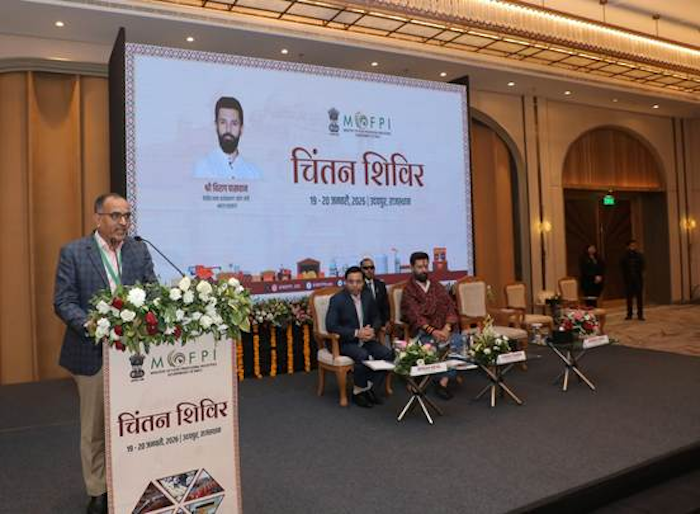
The two-day Chintan Shivir organized by the Union ministry of food processing industries in Udaipur, Rajasthan, charted a strategic roadmap to build a competitive, inclusive, and globally integrated food processing ecosystem—one that drives innovation, value-chain integration, export competitiveness, and farmer-centric growth.

Bringing together senior representatives from 22 central ministries, 27 state governments and union territories, over 30 industry members, academic institutions, NIFTEMs, and Invest India, the Shivir reflected a whole-of-government and whole-of-industry commitment to shaping the future of India’s food processing sector through policy reforms, collaborative action, and sustainable development.
The deliberations were attended by the secretary, special secretary, and senior officials of MoFPI, alongside senior state and UT representatives, including additional chief secretaries from Uttar Pradesh and Maharashtra, and principal secretaries from Andhra Pradesh and Punjab. Officials from key central ministries and departments—such as the department of commerce and separtment of agriculture & farmers welfare—also contributed to rich and outcome-oriented discussions.
Vision for a modern food processing ecosystem
Inaugurating the Chintan Shivir, Union minister for food processing industries, Chirag Paswan, reaffirmed the government’s resolve to build a modern, competitive and inclusive food processing sector that enhances farmer incomes, reduces post-harvest losses, promotes value addition, ensures food safety and nutrition, and creates large-scale employment, especially for youth and women.
He underscored food processing as a critical pillar for strengthening agri-value chains, expanding exports, and positioning India as a trusted global supplier of high-quality, value-added and sustainable food products aligned with national development priorities.
The Minister released special publications on technological advancements in food processing and success stories of startup grant challenge winners, reinforcing MoFPI’s focus on innovation and entrepreneurship.
Key challenges and strategic recommendations
The Shivir featured structured brainstorming across six thematic groups addressing the key drivers of India’s food processing ecosystem.
Discussions focused on — Doubling the level of food processing in the next five years through targeted interventions; Enhancing exports and strengthening India’s global positioning; Expanding high-growth segments such as nutraceuticals, fortified foods, plant-based proteins, and alcoholic beverages; Strengthening regulatory mechanisms for food safety and quality; and Building robust farm-to-fork value chains.
Misconceptions around processed foods
The groups proposed actionable recommendations, including: expanding MSME participation, developing cold-chain and logistics infrastructure, establishing a National Food Processing Promotion Council, introducing a Bharat Quality Food Mark, and promoting science- and risk-based regulation with AI-enabled monitoring. Recommendations also emphasised cluster-based processing hubs, value-chain financing, indigenous machinery manufacturing, and nutrition-focused awareness initiatives.
Driving holistic sectoral development
States and UTs showcased successful policy innovations and best practices. Uttar Pradesh presented its roadmap to double processing capacity through incentives and infrastructure; Maharashtra highlighted women-led enterprises and fortified food promotion; Andhra Pradesh showcased cluster-based value-chain successes in coffee, cocoa, and fisheries. Chhattisgarh, Madhya Pradesh, and Uttarakhand shared models focused on exports, horticulture-led growth, and FPO-driven processing.
On the sidelines, the minister inaugurated a Common Incubation Facility at Krishi Upaj Mandi Samiti, Udaipur, developed under the PMFME scheme, to process minor forestry products such as custard apple, jamun, amla, aloe vera, and spices—promoting local entrepreneurship and sustainable livelihoods.
Concluding the Chintan Shivir, the minister appreciated the collaborative, forward-looking spirit of all participants and reaffirmed MoFPI’s commitment to handholding stakeholders and accelerating implementation of key recommendations. He called for sustained coordination between the Centre, States, industry, and institutions to realise India’s vision of becoming a global leader in food processing.
IndiFoodBev — authentic, impactful and influential
An English-language food and beverage processing and packaging industry B2B platform in print and web, IndiFoodBev is in its third year of publication. It is said that the Indian food and beverage industries represent approximately US$ 900 billion in revenues which implies more than 20% of the country’s GDP. Eliminating the wastage on the farmside can help to deliver more protein to a higher number of the population apart from generating sizable exports. The savings in soil, seeds, water, fertilizer, energy and ultimately food and nutrition could be the most immense contribution that country is poised to make to the moderation of climate change.
To improve your marketing and grow sales to the food and beverage processing and packaging industry, talk to us. Our research and consulting company IppStar [www.ippstar.org] can assess your potential and addressable markets in light of the competition. We can discuss marketing, communication, and sales strategies for market entry and growth.
Suppliers and service providers with a strategy and budget for targeted marketing can discuss using our hybrid print, web, video, and social media channels to create brand recognition linked to market relevance. Our technical writers are ready to meet you and your customers for content.
The second largest producer of fruit and vegetables in the world is continuously expanding processing capacities and delivery systems with appropriate innovative technologies. We cover product and consumer trends, nutrition, processing, research, equipment and packaging from farm to thali. Get our 2025 media kit and recalibrate your role in this dynamic market. Enhance your visibility and relevance to existing markets and turn potential customers into conversations. Ask for a sample copy of our bi-monthly in print or our weekly IndiFoodBev eZine each Wednesday.
For editorial info@ippgroup.in — for advertisement ads1@ippgroup.in and for subscriptions subscription@ippgroup.in
Naresh Khanna – 10 February 2025
Subscribe Now