India is likely to face a hotter and drier start to the 2026 monsoon season, with the India Meteorological Department (IMD) downgrading its rainfall outlook while warning of widespread heatwave conditions that could strain agriculture and water resources.

The updated forecast signals a challenging season ahead, particularly for rain-fed farming regions already vulnerable to temperature stress and uneven rainfall distribution as well as for the agriculture-heavy economy.
Deficient rains and delayed monsoon onset (June to September) stall the crucial planting phase for summer crops, and to mitigate risks, agricultural experts encourage shifting away from water-intensive crops (like paddy) toward pulses and oilseeds.
Reduced rainfall also limits the replenishment of dams and aquifers, creating potential irrigation bottlenecks heading into the subsequent Rabi (winter) crop season.
This spells further bad news for farmers who are facing rising input costs as geopolitical issues in the Middle East, including the Iran conflict, continue to strain supply chains and inflate fertilizer prices.
“To minimize these impacts, strategies can include efficient water resource management, promotion of water conservation practices, contingency planning for agriculture, strengthening drought monitoring and use of early warning services of IMD, and enhancing preparedness measures in sectors that are particularly vulnerable to rainfall deficits,” the government stated.
Less rainfall
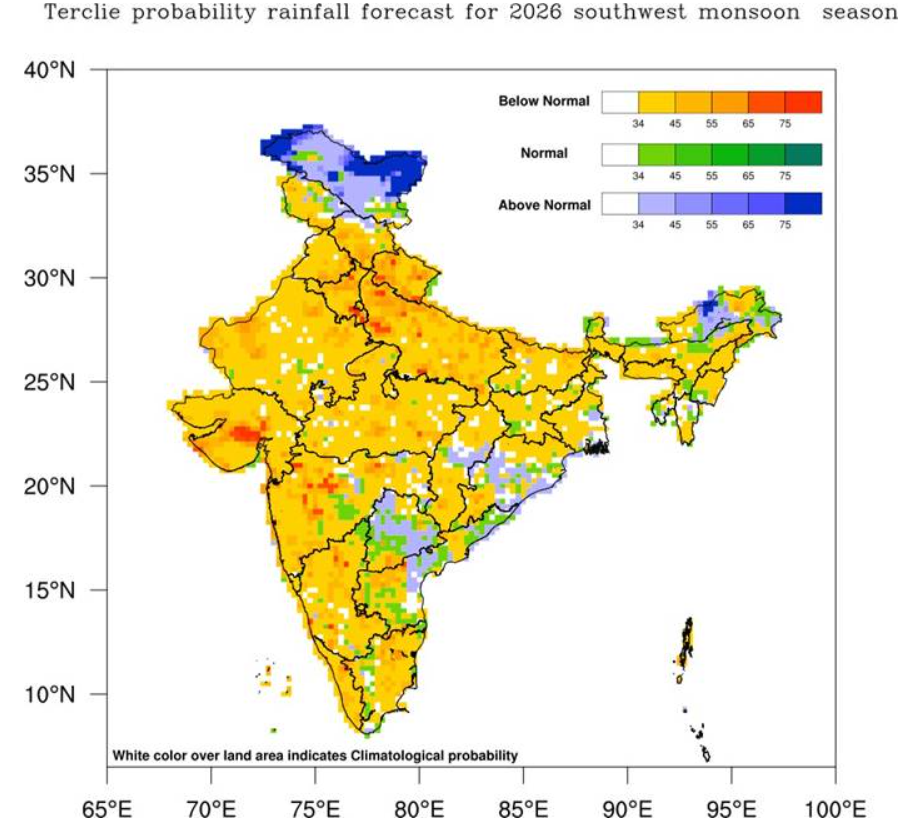
In its second-stage forecast released on 29 May, the IMD projected that the southwest monsoon seasonal rainfall (June to September) will be around 90% of the Long Period Average (LPA), with a margin of error of ±4%.
This marks a cautious downgrade – lower than 92% IMD had forecast in April – from earlier expectations and places the overall rainfall in the “below normal” category. Notably, there is an 84% probability that rainfall will remain below normal or deficient across the country.
The spatial distribution of rainfall is a concern. Most parts of India are expected to receive below-normal rainfall, with only limited areas in northwest and northeast India, parts of the southern peninsula, and pockets of east-central India likely to see normal or above-normal precipitation. This uneven distribution raises concerns for the monsoon core zone, which supports a large share of India’s rain-fed agriculture.
Adding to the concern is the forecast for June, the critical onset month of the monsoon. Rainfall during June 2026 is expected to remain below normal, at less than 92% of the LPA. At the same time, temperatures are predicted to stay above normal across most parts of the country, increasing the risk of heat stress on crops during early sowing stages.
Hotter days
The IMD has also warned of above-normal heatwave days across several key agricultural states, including Uttar Pradesh, Punjab, Haryana, Bihar, Odisha, Chhattisgarh, Gujarat, and Andhra Pradesh. Isolated regions in Maharashtra, Telangana, Tamil Nadu, and Himachal Pradesh may also experience intense heat. These conditions could adversely impact crop yields, soil moisture retention, and irrigation demand, especially in areas dependent on timely monsoon rains.
Climate drivers are playing a significant role in shaping this outlook. Neutral El Niño–Southern Oscillation (ENSO) conditions are currently transitioning towards El Niño, which is typically associated with weaker monsoons in India.
The IMD said weak El Nino conditions are expected to develop in June, strengthening towards second half of the season. El Niño is characterized by warmer-than-average sea surface temperatures in the central and eastern Pacific Ocean.
The Indian Ocean Dipole (IOD) is also expected to remain neutral, offering limited counterbalance to the El Niño effect.
The implications of a weaker monsoon extend beyond agriculture. Reduced rainfall could affect water availability, hydropower generation, and overall ecosystem stability, while increasing the likelihood of drought conditions in several regions. Higher temperatures and prolonged dry spells may also lead to increased power demand and stress on public health systems.
The IMD has advised state governments and local authorities to prepare for these conditions through water conservation measures, agricultural contingency planning, and enhanced drought monitoring. Farmers, particularly in rain-fed regions, may need to adjust cropping patterns and rely on early warning systems to mitigate risks.
With the monsoon outlook turning less favorable and heat risks intensifying, the coming months will be critical for both policymakers and the agricultural sector as they navigate a season marked by uncertainty and climate variability.
IndiFoodBev — authentic, impactful and influential
An English-language food and beverage processing and packaging industry B2B platform in print and web, IndiFoodBev is in its third year of publication. It is said that the Indian food and beverage industries represent approximately US$ 900 billion in revenues which implies more than 20% of the country’s GDP. Eliminating the wastage on the farmside can help to deliver more protein to a higher number of the population apart from generating sizable exports. The savings in soil, seeds, water, fertilizer, energy and ultimately food and nutrition could be the most immense contribution that country is poised to make to the moderation of climate change.
To improve your marketing and grow sales to the food and beverage processing and packaging industry, talk to us. Our research and consulting company IppStar [www.ippstar.org] can assess your potential and addressable markets in light of the competition. We can discuss marketing, communication, and sales strategies for market entry and growth.
Suppliers and service providers with a strategy and budget for targeted marketing can discuss using our hybrid print, web, video, and social media channels to create brand recognition linked to market relevance. Our technical writers are ready to meet you and your customers for content.
The second largest producer of fruit and vegetables in the world is continuously expanding processing capacities and delivery systems with appropriate innovative technologies. We cover product and consumer trends, nutrition, processing, research, equipment and packaging from farm to thali. Get our 2025 media kit and recalibrate your role in this dynamic market. Enhance your visibility and relevance to existing markets and turn potential customers into conversations. Ask for a sample copy of our bi-monthly in print or our weekly IndiFoodBev eZine each Wednesday.
For editorial info@ippgroup.in — for advertisement ads1@ippgroup.in and for subscriptions subscription@ippgroup.in
Naresh Khanna – 10 February 2025
Subscribe Now