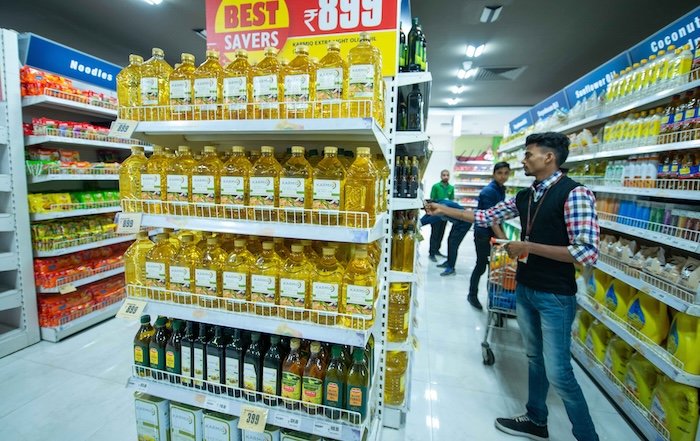
The government has introduced new standard pack sizes for edible oils under the Legal Metrology framework, aiming to improve price transparency and ensure fair trade practices across the market.
The move, announced on by the department of consumer affairs 6 June 2026, revises the existing standard operating procedure (SoP) from December 2023 following consultations with industry bodies representing nearly 90% of India’s edible oil sector.
The updated rules address the widespread issue of inconsistent packaging sizes, which has made it difficult for consumers to compare prices and assess value.
Under the revised guidelines, commonly used edible oils—including palm, soybean, sunflower, mustard, groundnut, sesame, rice bran, cottonseed, and corn oil—must now be sold in standardized pack sizes. These include 200 ml/g, 500 ml/g, 1 liter/kg, 2 liter/kg, 3 liter/kg, 4 liter/kg, 5 liter/kg, 15 liter/kg, and 20 liter/kg.
To further enhance transparency, manufacturers will also be required to display both volume and equivalent weight on packaging, enabling easier comparison across brands. The rules apply equally to domestically produced and imported edible oils.
However, smaller packs below 200 ml or 200 grams have been exempted to ensure affordability and accessibility for consumers. Minor edible oils are also excluded from the standardisation requirement.
The government has allowed a three-month transition period for manufacturers, packers, and importers to comply, although early adoption is encouraged. Existing provisions related to testing, sampling, and permissible errors will remain unchanged.
Officials say the initiative will empower consumers to make informed purchasing decisions while promoting uniformity and fair competition within the industry.
IndiFoodBev — authentic, impactful and influential
An English-language food and beverage processing and packaging industry B2B platform in print and web, IndiFoodBev is in its third year of publication. It is said that the Indian food and beverage industries represent approximately US$ 900 billion in revenues which implies more than 20% of the country’s GDP. Eliminating the wastage on the farmside can help to deliver more protein to a higher number of the population apart from generating sizable exports. The savings in soil, seeds, water, fertilizer, energy and ultimately food and nutrition could be the most immense contribution that country is poised to make to the moderation of climate change.
To improve your marketing and grow sales to the food and beverage processing and packaging industry, talk to us. Our research and consulting company IppStar [www.ippstar.org] can assess your potential and addressable markets in light of the competition. We can discuss marketing, communication, and sales strategies for market entry and growth.
Suppliers and service providers with a strategy and budget for targeted marketing can discuss using our hybrid print, web, video, and social media channels to create brand recognition linked to market relevance. Our technical writers are ready to meet you and your customers for content.
The second largest producer of fruit and vegetables in the world is continuously expanding processing capacities and delivery systems with appropriate innovative technologies. We cover product and consumer trends, nutrition, processing, research, equipment and packaging from farm to thali. Get our 2025 media kit and recalibrate your role in this dynamic market. Enhance your visibility and relevance to existing markets and turn potential customers into conversations. Ask for a sample copy of our bi-monthly in print or our weekly IndiFoodBev eZine each Wednesday.
For editorial info@ippgroup.in — for advertisement ads1@ippgroup.in and for subscriptions subscription@ippgroup.in
Naresh Khanna – 10 February 2025
Subscribe Now