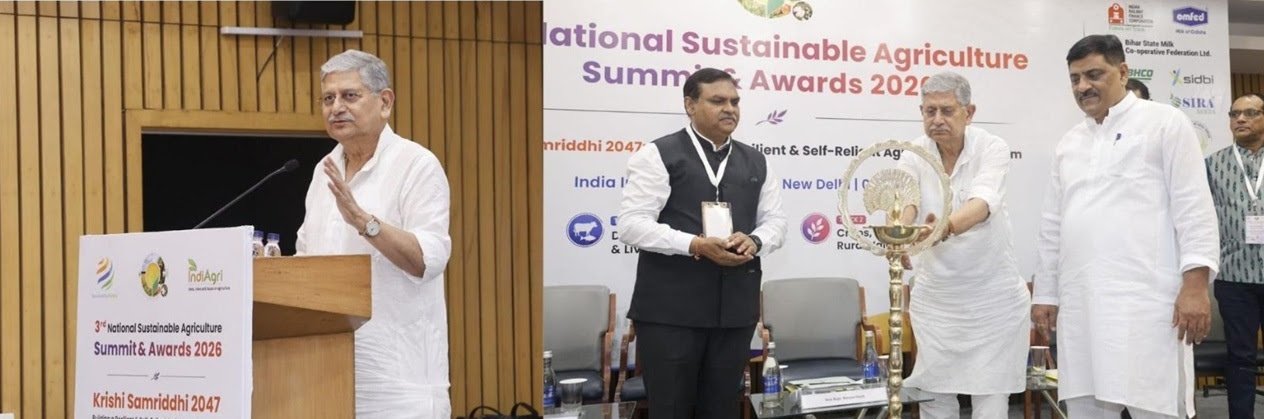
The vision of building a resilient, self-reliant and future-ready agricultural ecosystem took centre stage at the 3rd National Sustainable Agriculture Summit & Awards 2026, where policymakers, industry leaders, financial institutions, scientists, cooperatives, agri-entrepreneurs and progressive farmers came together to deliberate on the theme ‘Krishi Samridhi 2047: Building a Resilient and Self-Reliant Agriculture Ecosystem.’

Organized by Sustainability Matters, IndiAgri and Alliance for Change, Transformation & Innovation (ACTION), the Summit emerged as a national platform for dialogue on the future of Indian agriculture, focusing on sustainability, climate resilience, innovation, rural entrepreneurship, food security, natural resource management and farmer prosperity.
In his keynote address, Rajiv Ranjan (Lalan) Singh, Union minister for fisheries, animal husbandry & dairying and panchayati raj emphasized that the goals of Atmanirbhar Bharat and Viksit Bharat 2047 can only be achieved through a strong rural economy and empowered farmers.
He highlighted the government’s efforts to strengthen agriculture and allied sectors through scientific interventions, infrastructure development, value-chain enhancement, technology adoption and sustainable rural enterprises.
“For India to emerge as a developed nation by 2047, our farmers must be empowered and our rural economy must become stronger and more self-reliant. Agriculture and allied sectors will continue to play a central role in driving inclusive growth and prosperity,” the minister said.
The Summit brought together a distinguished gathering of leaders and stakeholders including Sanjay Kumar Jha, member of Parliament (Rajya Sabha); Meenesh C. Shah, chairman, National Dairy Development Board (NDDB); Manoj Kumar Dubey, chairman & managing director, Indian Railway Finance Corporation (IRFC); Dr Rajendra Prasad, general manager, SIDBI; Gajendra Kumar, joint general manager (marketing), KRIBHCO; senior policymakers, researchers, industry leaders and representatives of farmer organizations and cooperatives.
Addressing the Summit, Sanjay Kumar Jha said, “The future of Indian agriculture lies in creating integrated and diversified rural economies. Agriculture, horticulture, dairy, fisheries, water conservation and rural enterprises must work together to generate sustainable livelihoods and strengthen rural India. The vision of Krishi Samridhi 2047 requires collaborative action from governments, institutions, industry and farmers alike.”
Dr Meenesh C Shah, chairman, NDDB said, “India’s agricultural future depends on creating strong and sustainable rural ecosystems where productivity, value addition, institutions and innovation work together. Cooperatives have demonstrated the power of collective action, and partnerships across sectors will be critical in building a resilient and globally competitive agricultural economy.”
“As India advances towards Viksit Bharat 2047, investments in infrastructure, connectivity, logistics and financing will play a critical role in transforming rural economies. Sustainable agricultural growth requires long-term institutional support, and platforms such as this Summit help bring together diverse stakeholders committed to that objective,” opined Manoj Kumar Dubey, CMD, IRFC.
Dr Rajendra Prasad said, “Innovation, entrepreneurship and access to finance are vital pillars of a self-reliant agricultural ecosystem. Strengthening agri-enterprises, startups, farmer producer organisations and rural businesses will not only create employment but also unlock new opportunities for value creation and inclusive growth across rural India.”
Gajendra Kumar highlighted the need to make agriculture more attractive and future-ready for younger generations. He said, “One of the biggest challenges before Indian agriculture today is that many young people are moving away from farming. Rural India has been transformed by the communication revolution, and agriculture must evolve accordingly. At the same time, challenges such as climate change and excessive use of fertilisers require collective solutions driven by innovation, sustainability and responsible resource management.”
Speaking on the occasion, Dr KC Ravi, director general, Sustainable Agriculture Summit & Awards, said, “Krishi Samridhi 2047 is not merely a vision for agricultural growth; it is a roadmap for building resilience across the entire rural ecosystem. Sustainability, technology, water security, market access and farmer-centric policies must work together to create long-term prosperity and strengthen India’s food and economic security.”
“The journey towards Krishi Samridhi 2047 requires policy continuity, institutional innovation and stronger convergence between government, industry, academia and farming communities. Agriculture today is no longer confined to food production alone; it is intrinsically linked to livelihoods, sustainability, climate resilience, water security and rural economic growth. Building a self-reliant agricultural ecosystem will require integrated solutions that are scalable, inclusive and future-ready.” said Dr Jayadev Sarangi, former secretary, government of Delhi and Goa.
Dr Navneet Anand, executive director, Sustainability Matters, said, “The future of Indian agriculture will be defined by partnerships. Governments, financial institutions, industry, academia, startups and farmers must collaborate to build an ecosystem that is productive, sustainable, climate-resilient and economically rewarding. This Summit seeks to catalyse those partnerships and contribute meaningfully to India’s journey towards Krishi Samridhi 2047.”
The Summit featured high-level discussions on climate-smart agriculture, digital innovation, sustainable farming systems, water stewardship, agricultural financing, cooperative development, rural entrepreneurship, natural farming, technology adoption and emerging opportunities across the agricultural value chain.
A major highlight of the event was the National Sustainable Agriculture Awards 2026, which recognised exemplary contributions by farmers, cooperatives, agribusinesses, startups, institutions, government agencies and development organisations from across the country for advancing sustainability, innovation and inclusive growth in agriculture and allied sectors.
The Summit was supported by IRFC, SIDBI, COMFED, OMFED, HURL, KRIBHCO and SIRA Seeds, reflecting a shared commitment to strengthening India’s agricultural ecosystem and advancing the vision of a resilient, self-reliant and prosperous rural economy.
IndiFoodBev — authentic, impactful and influential
An English-language food and beverage processing and packaging industry B2B platform in print and web, IndiFoodBev is in its third year of publication. It is said that the Indian food and beverage industries represent approximately US$ 900 billion in revenues which implies more than 20% of the country’s GDP. Eliminating the wastage on the farmside can help to deliver more protein to a higher number of the population apart from generating sizable exports. The savings in soil, seeds, water, fertilizer, energy and ultimately food and nutrition could be the most immense contribution that country is poised to make to the moderation of climate change.
To improve your marketing and grow sales to the food and beverage processing and packaging industry, talk to us. Our research and consulting company IppStar [www.ippstar.org] can assess your potential and addressable markets in light of the competition. We can discuss marketing, communication, and sales strategies for market entry and growth.
Suppliers and service providers with a strategy and budget for targeted marketing can discuss using our hybrid print, web, video, and social media channels to create brand recognition linked to market relevance. Our technical writers are ready to meet you and your customers for content.
The second largest producer of fruit and vegetables in the world is continuously expanding processing capacities and delivery systems with appropriate innovative technologies. We cover product and consumer trends, nutrition, processing, research, equipment and packaging from farm to thali. Get our 2025 media kit and recalibrate your role in this dynamic market. Enhance your visibility and relevance to existing markets and turn potential customers into conversations. Ask for a sample copy of our bi-monthly in print or our weekly IndiFoodBev eZine each Wednesday.
For editorial info@ippgroup.in — for advertisement ads1@ippgroup.in and for subscriptions subscription@ippgroup.in
Naresh Khanna – 10 February 2025
Subscribe Now