India’s agriculture sector is under mounting strain as escalating temperatures threaten to undermine crop yields, food systems, livestock productivity and rural livelihoods, according to the Asia-Pacific Disaster Report 2025 released on 26 November by the United Nations Economic and Social Commission for Asia and the Pacific (ESCAP).
Titled ‘Rising Heat, Rising Risk: Policy Pathways for Regional Resilience,’ the report says rising temperatures are creating cascading impacts across Asia and the Pacific, with agriculture emerging as one of the most severely affected sectors.
It identifies Afghanistan, India, Pakistan, Nepal and Bangladesh as the five countries consistently at high risk of agricultural heat stress, a measure developed by ESCAP to assess the exposure and vulnerability of food systems to extreme heat.
Heat stress and declining farm productivity
The report warns that “agriculture is now under unprecedented pressure from rising temperatures,” as heat hits crop yields, livestock productivity, and the labor capacity of agricultural workers. Prolonged exposure to high temperatures affects not only plant growth but also the physical endurance of farmers, resulting in reduced field hours and lower overall output.
Under the IPCC’s high-emissions scenario (SSP5–8.5), severe and extreme heat conditions will increase dramatically in frequency, intensity and geographic extent by the end of the century. The number of days with a heat index exceeding 35°C — the threshold for severe heat stress — is projected to rise sharply, transforming once-episodic events into chronic seasonal or even year-round hazards.
Across Asia and the Pacific, working hours lost to heat stress are projected to more than double from 3.75 million to over 8.1 million full-time job equivalents between 1995 and 2030. For a country like India, where agriculture remains a major source of employment, such losses represent both an economic and social challenge.
Food, water and energy systems
The report emphasizes that heat impacts are “cascading and interrelated,” disrupting not only crops but also food–energy–water systems. Extreme heat increases irrigation demand, reduces soil moisture, and raises evaporation rates, while simultaneously decreasing the efficiency of power generation and transmission.
As electricity demand for cooling surges, power plants themselves become less efficient under high ambient temperatures. ESCAP’s projections show that the proportion of power plants exposed to days above 40°C will more than double, affecting agricultural irrigation, storage, and rural processing facilities.
Rural livelihoods and equity dimensions
According to the report, heat stress compounds existing inequalities in rural areas. Smallholder farmers and agricultural labourers face the most severe risks, as many lack access to irrigation, cooling, and protective infrastructure. The entrenchment of rural poverty traps is a major concern, with declining productivity and recurring crop losses deepening socioeconomic vulnerability.
The report highlights that in India and neighbouring countries, agricultural losses are now intertwined with health risks, as outdoor workers endure heat indices above safe limits for prolonged periods. ESCAP notes that such conditions “directly threaten health and reduce economic productivity,” with implications for nutrition, income, and community stability.
Regional heat risk and South Asia
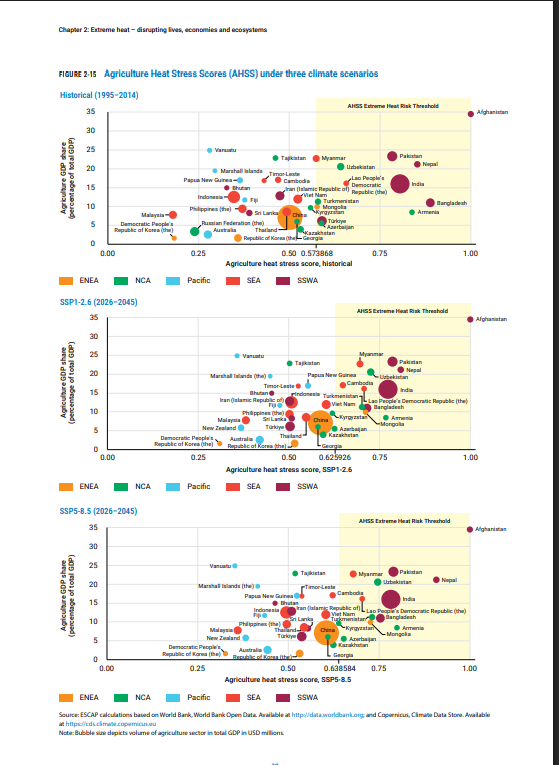
Agriculture contributes more than a quarter of the region’s GDP and employs the majority of the rural labor force, making it central to food security, livelihoods and employment. But extreme heat is already pushing crops and livestock to “severe stress”, the report warned. In 2022, India’s staple wheat crop withered following unprecedented March heatwaves during a critical late growth stage.
In 2024, India experienced one of the deadliest years for heat-related disasters. The report records that the heatwave in India during March to June 2024 caused around 700 fatalities, affecting 17 states and bringing record-breaking temperatures. October 2024 was the warmest month in 123 years, with the national mean temperature reaching 25.75°C — 0.65°C above the 1991–2020 average. Delhi recorded a new high of 52.9°C.
Such extremes, ESCAP warns, will become more frequent and severe under current warming trends. The cumulative effect will be a “transformation of the agricultural riskscape,” as regions once suitable for key crops may become marginal or nonviable due to chronic heat stress and shifting rainfall patterns.
“Ensuring food security in the Asia-Pacific region will increasingly hinge on how well the region can adapt its agricultural systems to the new reality of more frequent and intense heat stress,” the report pointed out.
Integrating heat resilience into agriculture policy
Rather than creating new funding mechanisms, the report advocates integrating heat resilience into existing adaptation and development frameworks.
It says countries such as India should embed heat indices into crop calendars and early warning systems; use anticipatory finance to trigger support for farmers during heat extremes; invest in climate-responsive social protection for agricultural workers; and align national programmes with heat-ready multi-hazard early warning systems (MHEWS).
ESCAP underscores that heat adaptation does not require exclusive financing, but must be strategically mainstreamed into agriculture, energy, water and health sectors. Regional cooperation—through shared data, space-based monitoring, and early warning tools—can help lower costs and accelerate implementation.
The report concludes that “the rising threat of extreme heat demands a new level of urgency.” In India and across the region, long-term heat resilience strategies must replace reactive relief measures. ESCAP calls on governments to treat heat as a core disaster risk factor, not an isolated event.
“Investing in heat preparedness can yield triple development dividends,” the report asserts—by avoiding economic losses, improving resource efficiency, and delivering co-benefits such as health protection and social stability.
Without decisive, integrated action, however, India’s agricultural backbone could face irreversible damage as the planet warms and “rising heat transforms the very foundation of livelihoods, food systems, and rural resilience.”
“Heat knows no borders; therefore, policy responses must anticipate impacts, reduce exposure and vulnerability at scale and safeguard those most at risk. With urgency, clarity and cooperation, lives and livelihoods across the region can be protected,” said United Nations under-secretary-general and executive secretary of ESCAP, Armida Salsiah Alisjahbana.
IndiFoodBev — authentic, impactful and influential
An English-language food and beverage processing and packaging industry B2B platform in print and web, IndiFoodBev is in its third year of publication. It is said that the Indian food and beverage industries represent approximately US$ 900 billion in revenues which implies more than 20% of the country’s GDP. Eliminating the wastage on the farmside can help to deliver more protein to a higher number of the population apart from generating sizable exports. The savings in soil, seeds, water, fertilizer, energy and ultimately food and nutrition could be the most immense contribution that country is poised to make to the moderation of climate change.
To improve your marketing and grow sales to the food and beverage processing and packaging industry, talk to us. Our research and consulting company IppStar [www.ippstar.org] can assess your potential and addressable markets in light of the competition. We can discuss marketing, communication, and sales strategies for market entry and growth.
Suppliers and service providers with a strategy and budget for targeted marketing can discuss using our hybrid print, web, video, and social media channels to create brand recognition linked to market relevance. Our technical writers are ready to meet you and your customers for content.
The second largest producer of fruit and vegetables in the world is continuously expanding processing capacities and delivery systems with appropriate innovative technologies. We cover product and consumer trends, nutrition, processing, research, equipment and packaging from farm to thali. Get our 2025 media kit and recalibrate your role in this dynamic market. Enhance your visibility and relevance to existing markets and turn potential customers into conversations. Ask for a sample copy of our bi-monthly in print or our weekly IndiFoodBev eZine each Wednesday.
For editorial info@ippgroup.in — for advertisement ads1@ippgroup.in and for subscriptions subscription@ippgroup.in
Naresh Khanna – 10 February 2025
Subscribe Now