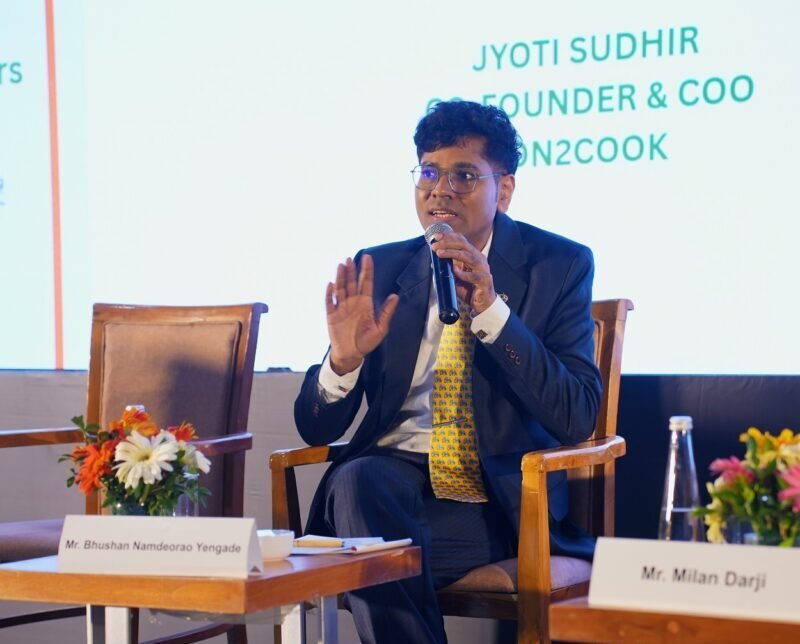
Gandhinagar on 25 July 2026 – India’s ambitious drive to modernise its food supply chain and curb post-harvest losses took center-stage at the FoodTekPack 2026 Conference at At the one-day conference alongside the Indusfood exhibition, Bhushan Namderao Yengade, founder of Binder Technology Consultancy and National vice president of Market Research at CPRTTF, led industry leaders in calling for aggressive technological intervention.

Moderating a high-level panel discussion titled ‘Save Food, Innovations in Food Processing and Packaging,’ Yengade and industry experts mapped out strategies to boost export compliance and protect brand integrity. The conference, co-located with the first Indusfood Ahmedabad exhibition at the Helipad Exhibition Centre, highlighted the stark economic realities of India’s food supply inefficiencies and the food processing innovations and automated solutions emerging to fix them.
The scale of waste
Yengade, presented sobering data on the country’s logistical vulnerabilities. He drew attention to the landmark study by the CIPHET, which outlines the massive scale of food losses across Indian agricultural supply chains. The food industry technologist and expert, having conducted extensive field research into domestic supply chain networks, noted that structural gaps continue to erode profitability for farmers and exporters alike.
Having been directly involved in the Government of India’s National Mission on Food Processing for the Maharashtra State, where he drove initiatives to reduce food waste through technical upgradation he shared his deep execution expertise. He underscored how data-driven tracking and real-time condition monitoring are now essential infrastructure for high-value food exports facing strict international regulatory compliance.
Automation and cost efficiency
The discussion widened as panelists addressed industrial scaling. Foram Badani, assistant director at the Indian Institute of Packaging, Ahmedabad, emphasized that automated packaging lines are vital to eliminating human error and contamination. Badani stated that automation serves as a primary shield for brand integrity, ensuring that sensitive products meet stringent foreign import rules while extending shelf life.
Operational costs remain a critical hurdle for Indian processors looking to compete globally. Milan Darji, team leader of Technology for Consumer Foods & Value Nutrition at Bühler India, demonstrated how processing innovations directly lower overheads by creating new products and byproducts from food waste hitherto used for energy and animal feed. Darji outlined advancements in optical sorting and energy-efficient thermal processing that reduce resource consumption. By upgrading legacy machinery with intelligent, self-optimizing and innovative systems, processors can dramatically cut down product giveaway and operational downtime, translating directly into new protein products and healthier bottom lines.
Crucially, Yengade positioned agile young enterprises as the vanguard of this transformation. “Start-ups in the food industry are moving faster than traditional players,” he observed, pointing to a new wave of agritech firms utilizing artificial intelligence and machine learning to de-risk logistics, track shipments, and dynamically convert unavoidable food waste into high-value protein and secondary products.
The consensus from the panel was clear – India’s path to becoming a global food export powerhouse relies on fusing technological innovation with robust packaging standards to eliminate systemic waste.
IndiFoodBev — authentic, impactful and influential
An English-language food and beverage processing and packaging industry B2B platform in print and web, IndiFoodBev is in its third year of publication. It is said that the Indian food and beverage industries represent approximately US$ 900 billion in revenues which implies more than 20% of the country’s GDP. Eliminating the wastage on the farmside can help to deliver more protein to a higher number of the population apart from generating sizable exports. The savings in soil, seeds, water, fertilizer, energy and ultimately food and nutrition could be the most immense contribution that country is poised to make to the moderation of climate change.
To improve your marketing and grow sales to the food and beverage processing and packaging industry, talk to us. Our research and consulting company IppStar [www.ippstar.org] can assess your potential and addressable markets in light of the competition. We can discuss marketing, communication, and sales strategies for market entry and growth.
Suppliers and service providers with a strategy and budget for targeted marketing can discuss using our hybrid print, web, video, and social media channels to create brand recognition linked to market relevance. Our technical writers are ready to meet you and your customers for content.
The second largest producer of fruit and vegetables in the world is continuously expanding processing capacities and delivery systems with appropriate innovative technologies. We cover product and consumer trends, nutrition, processing, research, equipment and packaging from farm to thali. Get our 2025 media kit and recalibrate your role in this dynamic market. Enhance your visibility and relevance to existing markets and turn potential customers into conversations. Ask for a sample copy of our bi-monthly in print or our weekly IndiFoodBev eZine each Wednesday.
For editorial info@ippgroup.in — for advertisement ads1@ippgroup.in and for subscriptions subscription@ippgroup.in
Naresh Khanna – 10 February 2025
Subscribe Now