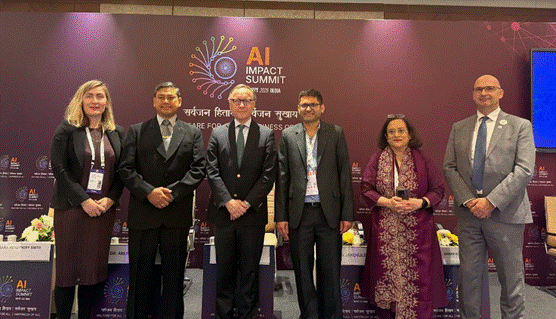
Apart from other topics, the recent India AI Impact Summit 2026 also focused on how artificial intelligence can address one of the most persistent global challenges — the gap between food production, distribution and access.
Deliberations at the session ‘AI for Inclusive and Resilient Agricultural Food Systems’ examined the role of data, digital infrastructure and cross-border cooperation in enabling climate-resilient agriculture, strengthening supply chains and ensuring that farmers are fully integrated into emerging digital ecosystems.
Speakers highlighted that the real opportunity lies not only in higher yields, but in building intelligent, connected food systems that can respond in real time to demand, reduce wastage and improve market access. Achieving this, they noted, will require interoperable data governance, transparent AI systems, and clear pathways for innovation to move from pilots to large-scale deployment with the participation of industry, governments and multilateral institutions.
Ambassador of the Netherlands to India, Harry Verweij, highlighted the strategic importance of AI-enabled agriculture for sustainability and national resilience. Noting the rapid pace of digital adoption in the sector, he said it offers “clear opportunities to increase productivity and the sustainability of global food production, improve nature conservation, and foster climate resilience in an inclusive way.”These advances ultimately contribute to “the autonomy and stability of nations,” he said
Dejan Jakovljević, chief information officer and director, Food and Agriculture Organization (FAO), warned that digital exclusion now directly translates into economic and social exclusion. Observing that participation in digital systems has become unavoidable, he said that if farmers or communities are left out, “they are effectively excluded from every ecosystem,” adding that the rise of AI makes it imperative to ensure “equal opportunity within our digital ecosystems.”
Distinguished Fellow, NITI Frontier Hub, Debjani Ghosh, drew attention to the structural imbalance in global food distribution, noting that while the world produces enough to feed its population, gaps in access and logistics continue to drive both hunger and wastage. Emphasising the need for industry-led scale, she said the priority is to clearly define problem statements and create “a clear route to market and commercialization,” advocating dedicated Centres of Excellence and innovation hubs to solve these complex challenges.
Sara Rendtorff Smith from Applied Research Lead for Data-driven Governance and AI Policy, Massachusetts Institute of Technology, underscored the importance of transparency and interoperable governance frameworks for scaling AI across global food supply chains. Pointing to the complexity created by fragmented regulatory systems, she said that “farmers and regulators need transparency in how AI systems make their decisions,” and stressed that stronger interoperability is essential for enabling trade traceability and resilient cross-border agricultural networks.
The session also highlighted that AI-driven agricultural systems can move beyond productivity gains to enable climate-resilient farming, intelligent supply chains and inclusive market access. By linking digital infrastructure with transparent governance, private-sector innovation and international cooperation, speakers emphasised that AI can help build food systems that are not only more efficient, but also more equitable and resilient.
IndiFoodBev — authentic, impactful and influential
An English-language food and beverage processing and packaging industry B2B platform in print and web, IndiFoodBev is in its third year of publication. It is said that the Indian food and beverage industries represent approximately US$ 900 billion in revenues which implies more than 20% of the country’s GDP. Eliminating the wastage on the farmside can help to deliver more protein to a higher number of the population apart from generating sizable exports. The savings in soil, seeds, water, fertilizer, energy and ultimately food and nutrition could be the most immense contribution that country is poised to make to the moderation of climate change.
To improve your marketing and grow sales to the food and beverage processing and packaging industry, talk to us. Our research and consulting company IppStar [www.ippstar.org] can assess your potential and addressable markets in light of the competition. We can discuss marketing, communication, and sales strategies for market entry and growth.
Suppliers and service providers with a strategy and budget for targeted marketing can discuss using our hybrid print, web, video, and social media channels to create brand recognition linked to market relevance. Our technical writers are ready to meet you and your customers for content.
The second largest producer of fruit and vegetables in the world is continuously expanding processing capacities and delivery systems with appropriate innovative technologies. We cover product and consumer trends, nutrition, processing, research, equipment and packaging from farm to thali. Get our 2025 media kit and recalibrate your role in this dynamic market. Enhance your visibility and relevance to existing markets and turn potential customers into conversations. Ask for a sample copy of our bi-monthly in print or our weekly IndiFoodBev eZine each Wednesday.
For editorial info@ippgroup.in — for advertisement ads1@ippgroup.in and for subscriptions subscription@ippgroup.in
Naresh Khanna – 10 February 2025
Subscribe Now