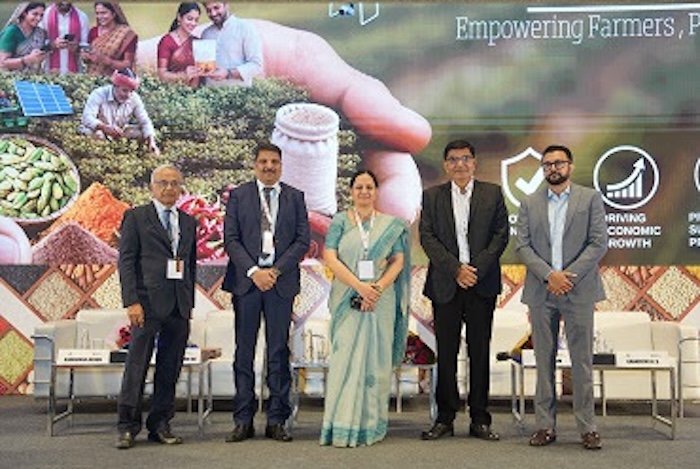
The World Spice Organisation (WSO), the not-for-profit technical partner of the All-India Spices Exporters Forum (AISEF), successfully concluded its 5th National Spice Conference (NSC) 2026 at the Novotel Jaipur Convention Centre, Rajasthan.

Held on September 19-20 under the theme “Empowering Farmers, Protecting Consumers,” the conference brought together farmers, farmer producer organizations (FPOs), processors, exporters, regulators, researchers, technology providers and other stakeholders from across the spice value chain.
The two-day conference focused on strengthening farmer incomes, food safety, responsible sourcing, sustainability, innovation and market access, with discussions addressing challenges across the spice value chain. The event also featured an exhibition showcasing technologies and indigenous agri-products and a dedicated Buyer–Seller Meet to facilitate market linkages.
Speaking at the conclusion of the conference, Ramkumar Menon, chairman, World Spice Organisation, said, “NSC 2026 has brought the different stakeholders of the spice value chain together around two priorities that are closely connected: enabling farmers to create greater value from their produce and ensuring that consumers can place greater trust in the spices they use. The discussions over the two days have highlighted the importance of stronger farm-level practices, responsible sourcing, food safety, innovation and market linkages. The focus now is on carrying these conversations forward through meaningful collaboration and action across the value chain.”
The first session of Day 2 focused on changing regulations in organic farming & certifications, examining the evolving certification landscape and its implications for farmers and other stakeholders in the spice value chain. This was followed by a session on the Role of FPOs in Consumer Protection and Food Safety, highlighting the role of farmer organizations in strengthening quality and compliance at the farm level.
Manoj Kumar Menon, CEO, ICCOA said, “India’s organic sector has come a long way from being a niche segment. With organic exports growing from Rs67 crore in 2005 to over INR 5,400 crore in 2025, the sector has significant potential for further growth. However, as global markets and regulations evolve, strengthening certification, maintaining credibility and ensuring compliance will be critical to sustaining this momentum.”
The conference then turned to Buyers’ Requirements, with Ganapathy K D, business committee chairman, NSC 2026, outlining key considerations for producers and FPOs in meeting evolving market expectations. The program concluded with a dedicated Buyer–Seller Meet, providing an interface between producers and buyers and creating opportunities for stronger market connections across the spice value chain.
Across the two days, the conference covered a broad range of issues including farmer empowerment and income growth, sustainability and responsible sourcing, food safety and consumer protection, innovation and future readiness, farmer challenges and crop outlook, organic farming and certifications, FPOs and market requirements. Discussions also highlighted emerging solutions in areas such as digital traceability, post-harvest infrastructure, farm-level technologies, testing and processing, warehousing and financing.
The conference provided a common platform for stakeholders to exchange knowledge and perspectives on strengthening India’s spice value chain, with the 2026 edition placing particular emphasis on connecting farm-level practices with consumer safety, quality and evolving market requirements.
The National Spice Conference 2026 concluded with a renewed focus on strengthening collaboration across the spice ecosystem and creating stronger linkages between farmers, FPOs, industry, regulators and buyers. The discussions over the two days highlighted the need for continued engagement and practical solutions to support a safer, more sustainable and more rewarding spice value chain.
IndiFoodBev — authentic, impactful and influential
An English-language food and beverage processing and packaging industry B2B platform in print and web, IndiFoodBev is in its third year of publication. It is said that the Indian food and beverage industries represent approximately US$ 900 billion in revenues which implies more than 20% of the country’s GDP. Eliminating the wastage on the farmside can help to deliver more protein to a higher number of the population apart from generating sizable exports. The savings in soil, seeds, water, fertilizer, energy and ultimately food and nutrition could be the most immense contribution that country is poised to make to the moderation of climate change.
To improve your marketing and grow sales to the food and beverage processing and packaging industry, talk to us. Our research and consulting company IppStar [www.ippstar.org] can assess your potential and addressable markets in light of the competition. We can discuss marketing, communication, and sales strategies for market entry and growth.
Suppliers and service providers with a strategy and budget for targeted marketing can discuss using our hybrid print, web, video, and social media channels to create brand recognition linked to market relevance. Our technical writers are ready to meet you and your customers for content.
The second largest producer of fruit and vegetables in the world is continuously expanding processing capacities and delivery systems with appropriate innovative technologies. We cover product and consumer trends, nutrition, processing, research, equipment and packaging from farm to thali. Get our 2025 media kit and recalibrate your role in this dynamic market. Enhance your visibility and relevance to existing markets and turn potential customers into conversations. Ask for a sample copy of our bi-monthly in print or our weekly IndiFoodBev eZine each Wednesday.
For editorial info@ippgroup.in — for advertisement ads1@ippgroup.in and for subscriptions subscription@ippgroup.in
Naresh Khanna – 10 February 2025
Subscribe Now