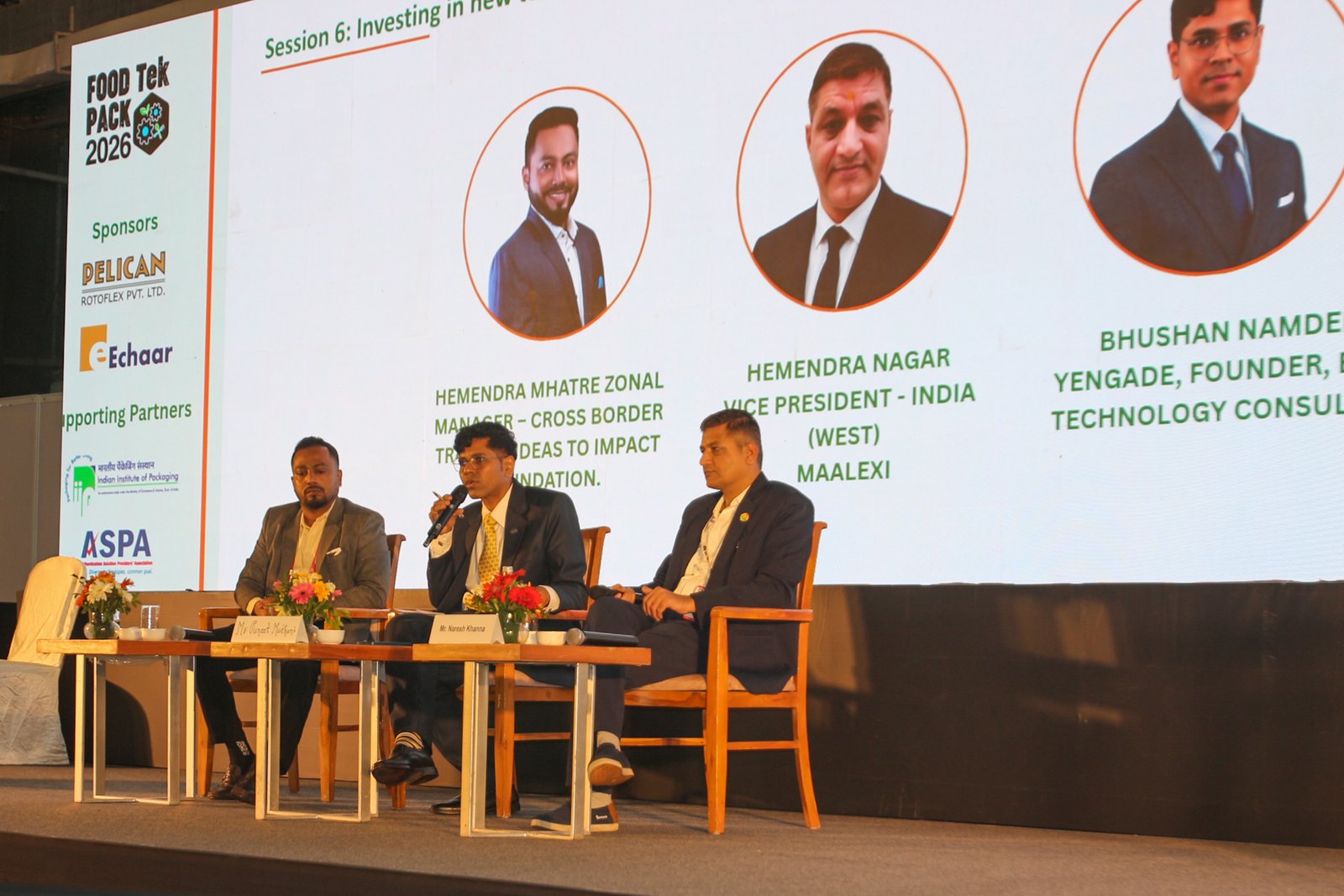
Investing in technology, automation and sustainable packaging will be critical for strengthening India’s food processing ecosystem and enhancing its global competitiveness, speakers said during a panel discussion on “Investing in new technologies for food processing and packaging innovation, and supply chain automation” at the FoodTekPack Conference. Moderated by Bhushan Namderao Yengande, founder of Binder Technology, the session featured Hemendra Mhatre, zonal manager – cross border trade, Ideas to Impact Foundation, and Hemendra Nagar, vice president, Maalexi.

Opening the discussion, Yengande highlighted the growing importance of digital commerce for food businesses. He noted that eCommerce has fundamentally changed consumer buying behaviour, making online visibility and product presentation as important as product quality. “Nearly 40-50% of food products are now being purchased online, not only in India but across international markets as well. Brand owners must ensure that their products are visible on the right platforms and backed by effective packaging and branding,” he said.
Speaking on the role of technology in international trade, Hemendra Nagar explained how AI-driven digital platforms are helping reduce risks for both exporters and buyers. According to Nagar, first-time exporters often struggle to identify reliable overseas buyers, while importers remain uncertain about product quality and supplier credibility.
“Our platform connects suppliers and buyers on a single AI-enabled ecosystem to mitigate risk. It assures buyers about product quality while providing suppliers greater confidence regarding payments,” Nagar said. He added that technologies such as blockchain and AI can improve transparency by recording product specifications, pricing and quality parameters before a transaction is executed.
The discussion also focused on the challenges confronting India’s food processing industry amid global economic uncertainties. Yengande observed that geopolitical disruptions, slowing investments and changing supply chains are forcing food businesses to rethink their growth strategies. Since nearly half of India’s population depends directly or indirectly on agriculture, strengthening food processing infrastructure has become increasingly important, he noted.
Addressing the issue of scaling operations, Mhatre stressed that businesses should first assess their market readiness before expanding production capacity. “Scaling up is not just about increasing production. MSMEs need to understand whether they are targeting the right market, whether they should adopt a B2B or B2C strategy, and whether eCommerce fits their business model. Planning should come only after proper assessment,” he said.
On automation, Mhatre acknowledged that although artificial intelligence has become a widely discussed topic, its adoption in manufacturing remains limited. He urged businesses to move beyond using AI for routine tasks and instead integrate automation into business operations through data-driven decision-making.
“Automation provides clarity through data. Every business needs accurate information on sales, production and operations. Data-centric decision-making is what will help businesses become more competitive,” he said.
The panel also emphasised the importance of export-oriented packaging. Nagar pointed out that exporters must carefully understand destination-country regulations, certification requirements and labelling standards before shipping products overseas.
“Every country has different packaging and labelling requirements. Exporters must study these regulations thoroughly and adapt their packaging accordingly to avoid compliance issues,” he said.
Sustainability emerged as another major theme during the discussion. Mhatre encouraged manufacturers to adopt biodegradable alternatives such as bamboo-based packaging while reducing dependence on conventional plastics.
“Businesses should view sustainable packaging as a competitive advantage. Consumers increasingly value environmentally responsible products, and adopting eco-friendly packaging can become a strong unique selling proposition,” he said.
The panel further examined the role of technology in strengthening India’s food supply chain. From cold storage management to logistics and product-specific transportation systems, digital technologies are helping reduce post-harvest losses while improving product quality during transit. The speakers noted that exports of Indian agricultural products continue to grow, making efficient supply chain management more important than ever.
Highlighting government support available to the sector, Yengande drew attention to initiatives such as the Pradhan Mantri Kisan Sampada Yojana and the country’s network of mega food parks. These integrated facilities offer processing infrastructure, packaging units, laboratories, waste management systems and logistics support, enabling startups and MSMEs to establish operations with lower capital investment.
Concluding the session, the panellists agreed that the future of India’s food processing industry will depend on greater adoption of digital technologies, stronger collaboration across the supply chain, sustainable packaging practices and effective utilisation of government support schemes. As global markets become increasingly competitive, they said, businesses that embrace innovation and technology will be better positioned to scale operations and expand exports.
IndiFoodBev — authentic, impactful and influential
An English-language food and beverage processing and packaging industry B2B platform in print and web, IndiFoodBev is in its third year of publication. It is said that the Indian food and beverage industries represent approximately US$ 900 billion in revenues which implies more than 20% of the country’s GDP. Eliminating the wastage on the farmside can help to deliver more protein to a higher number of the population apart from generating sizable exports. The savings in soil, seeds, water, fertilizer, energy and ultimately food and nutrition could be the most immense contribution that country is poised to make to the moderation of climate change.
To improve your marketing and grow sales to the food and beverage processing and packaging industry, talk to us. Our research and consulting company IppStar [www.ippstar.org] can assess your potential and addressable markets in light of the competition. We can discuss marketing, communication, and sales strategies for market entry and growth.
Suppliers and service providers with a strategy and budget for targeted marketing can discuss using our hybrid print, web, video, and social media channels to create brand recognition linked to market relevance. Our technical writers are ready to meet you and your customers for content.
The second largest producer of fruit and vegetables in the world is continuously expanding processing capacities and delivery systems with appropriate innovative technologies. We cover product and consumer trends, nutrition, processing, research, equipment and packaging from farm to thali. Get our 2025 media kit and recalibrate your role in this dynamic market. Enhance your visibility and relevance to existing markets and turn potential customers into conversations. Ask for a sample copy of our bi-monthly in print or our weekly IndiFoodBev eZine each Wednesday.
For editorial info@ippgroup.in — for advertisement ads1@ippgroup.in and for subscriptions subscription@ippgroup.in
Naresh Khanna – 10 February 2025
Subscribe Now