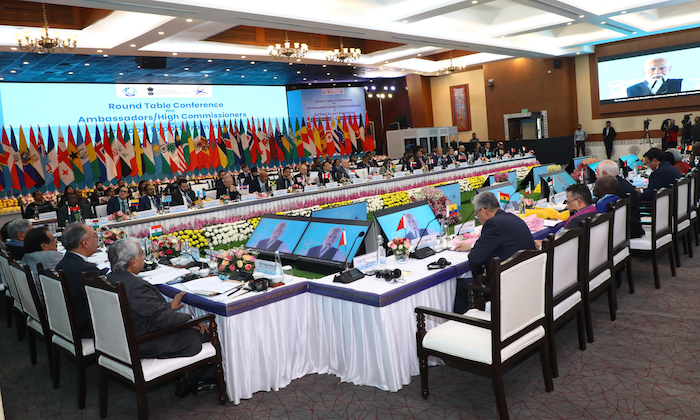
Adoption of smart and sustainable packaging, promotion of eco-friendly materials, enhancement of digital traceability systems, technology-driven supply chains, and international collaboration to reduce food waste and strengthen India’s seafood export ecosystem were the key highlights of a recent roundtable on seafood export promotion in New Delhi.

The department of fisheries, under the ministry of fisheries, animal husbandry and dairying, successfully organised the roundtable under the chairmanship of Rajiv Ranjan Singh alias Lalan Singh, union minister of fisheries, animal husbandry & dairying and panchayati raj, in New Delhi.
The conference brought together diplomats from 40 countries, along with representatives from international organizations including FAO, AFD, GIZ, BOBP, ADB and IFAD, marking a strong show of international cooperation. Discussions focused on sustainability, climate change, technology transfer, green innovation, packaging, capacity building and seafood value-chain enhancement.
Packaging and its role in reducing food waste featured prominently in the deliberations. Speakers underscored that smart and sustainable packaging is now central to preserving seafood freshness, preventing spoilage, and reducing loss across the supply chain.
They noted that intelligent, data-driven packaging systems—including RFID tags, freshness sensors and connected labels—can help trace temperature and handling conditions, providing accurate shelf-life information and ensuring compliance with export standards. Emphasis was also placed on eco-design and recyclable materials, which align with circular economy goals while maintaining product integrity.
Rajiv Ranjan Singh highlighted India’s emergence as a global fisheries and aquaculture power, noting that exports have doubled in the past decade. He shared that the government’s new frameworks on traceability and high-sea fishing will strengthen compliance and transparency, helping India meet sustainability and quality benchmarks demanded by global markets.
SP Singh Baghel, minister of state, stressed that seafood remains vital for nutrition and employment and that the department of fisheries is adopting a comprehensive value-chain approach, encompassing production, processing, packaging, and export. George Kurian noted that India’s seafood exports are on track to reach ₹1 lakh crore, backed by a 21% rise in export value within seven months.
Abhilaksh Likhi, union secretary, department of fisheries, observed that quality packaging, digital traceability, and regulatory alignment are transforming India’s seafood sector, making exports more competitive and sustainable. He emphasized that packaging is no longer a passive element but a key enabler of food safety, transparency, and market confidence.
Sagar Mehra, joint Ssecretary (inlandfisheries), said robust packaging and traceability standards will help Indian seafood gain greater access to premium markets and ensure consumer trust.
Representatives from participating countries appreciated India’s initiatives and expressed interest in collaborating on technology transfer, certification, packaging innovation and sustainable aquaculture. Konda Chavva from FAO reaffirmed the organisation’s support for India’s efforts in digital traceability and sustainable seafood systems, while Dodda Venkata Swamy, chairman, MPEDA, reiterated MPEDA’s focus on “trade, trust and technology” to strengthen India’s export ecosystem.
The conference concluded with Bijay Kumar Behera, chief executive of NFDB, extending gratitude to dignitaries and delegates. He noted that the insights gathered will help build a more competitive, diversified and sustainable seafood export ecosystem—anchored in smart packaging, innovation, and responsible trade practices.
(This information has been processed from a PIB release)
IndiFoodBev — authentic, impactful and influential
An English-language food and beverage processing and packaging industry B2B platform in print and web, IndiFoodBev is in its third year of publication. It is said that the Indian food and beverage industries represent approximately US$ 900 billion in revenues which implies more than 20% of the country’s GDP. Eliminating the wastage on the farmside can help to deliver more protein to a higher number of the population apart from generating sizable exports. The savings in soil, seeds, water, fertilizer, energy and ultimately food and nutrition could be the most immense contribution that country is poised to make to the moderation of climate change.
To improve your marketing and grow sales to the food and beverage processing and packaging industry, talk to us. Our research and consulting company IppStar [www.ippstar.org] can assess your potential and addressable markets in light of the competition. We can discuss marketing, communication, and sales strategies for market entry and growth.
Suppliers and service providers with a strategy and budget for targeted marketing can discuss using our hybrid print, web, video, and social media channels to create brand recognition linked to market relevance. Our technical writers are ready to meet you and your customers for content.
The second largest producer of fruit and vegetables in the world is continuously expanding processing capacities and delivery systems with appropriate innovative technologies. We cover product and consumer trends, nutrition, processing, research, equipment and packaging from farm to thali. Get our 2025 media kit and recalibrate your role in this dynamic market. Enhance your visibility and relevance to existing markets and turn potential customers into conversations. Ask for a sample copy of our bi-monthly in print or our weekly IndiFoodBev eZine each Wednesday.
For editorial info@ippgroup.in — for advertisement ads1@ippgroup.in and for subscriptions subscription@ippgroup.in
Naresh Khanna – 10 February 2025
Subscribe Now