According to the latest Nescafé Plan 2030 Progress Report, Nescafé sourced 53% of its green coffee from farmers adopting regenerative agriculture practices in 2025. The increase was driven by a higher volume of green coffee received from those farmers and the expansion of Nescafé’s field programs. In 2025, more than 1 600 Nescafé agronomists and field staff supported farmers in 15 countries through training and technical support on regenerative agriculture. Nescafé also adapted its procurement approach to source more coffee from farmer units adopting these regenerative practices.

The Nescafé Plan 2030 prioritizes regenerative agriculture to enhance farming practices and coffee supply resilience, benefiting farmers and farmland ecosystems. Practices such as agroforestry, cover crops and optimized fertilization can help improve soil health and support long-term yields. Intercropping can also create new revenue streams for farmers and help diversify their income. In 2025, Nescafé reported an 18.3% reduction in greenhouse gas (GHG) emissions from its green coffee compared with its 2018 baseline.
“With more than half of our green coffee sourced from farmers adopting regenerative agriculture practices in 2025, Nescafé has reached a major milestone,” said Antje Shaw, head of sustainability for Nescafé. “This shows how we are working with farmers to scale regenerative agriculture across our coffee supply chain. We aim to support farmers in this transition, strengthen resilience to climate change and help secure Nestlé’s long-term access to coffee, a key growth driver for the company.”
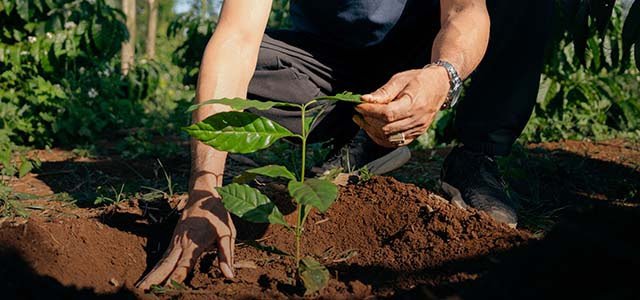
As coffee trees age, they naturally become less productive and may become more vulnerable to climate change, further reducing yields. Nestlé therefore helps farmers renovate their plots with new coffee varieties that are more resilient to climate change and disease. In 2025, Nescafé distributed 20.3 million coffee plantlets to farmers.
In the same year, 94.3% of Nescafé coffee was responsibly sourced,1 meaning green coffee lots were traceable to identified groups of farmers and independently certified or verified as being produced in alignment with Nestlé’s responsible sourcing requirements.
Beyond farming, the 2025 Nescafé Plan progress report also covers manufacturing, distribution and packaging across Nescafé’s value chain. Within Nescafé’s operations, the three main sources of carbon emissions are manufacturing, logistics and packaging. In 2025, 98.6% of the electricity used in Nescafé coffee manufacturing sites was renewably sourced, contributing to GHG emissions reductions.
The report also highlights Nescafé’s efforts to strengthen human rights in coffee-growing communities through due diligence, supplier capability building and partnerships to expand impact on the ground.
In 2025, Nescafé co-developed the Nescafé Plan Child Protection Framework with its strategic partner, Terre des Hommes, to strengthen child protection systems in coffee supply chains. In 2026, Nescafé extended its partnership with the International Labour Organization (ILO) to advance labor rights in coffee supply chains.
“We believe in supporting systems that protect children today and help secure better opportunities for the future”, said Roy Tjan, Child rights and business global advisor, Terre des Hommes. “Our partnership with Nescafé reinforces this belief by integrating the company’s child protection efforts on the ground with the community and public State systems already in place.”
“Evidence-based and participatory approaches are essential to achieving lasting improvements in working conditions,” said Ockert Dupper, global program manager, Vision Zero Fund, International Labour Organization. “Partnerships such as the one with Nescafé play a key role in enabling these approaches to be implemented effectively and at scale.”
Through its integrated approach, the Nescafé Plan aims to help build a more resilient coffee supply chain for the future.
IndiFoodBev — authentic, impactful and influential
An English-language food and beverage processing and packaging industry B2B platform in print and web, IndiFoodBev is in its third year of publication. It is said that the Indian food and beverage industries represent approximately US$ 900 billion in revenues which implies more than 20% of the country’s GDP. Eliminating the wastage on the farmside can help to deliver more protein to a higher number of the population apart from generating sizable exports. The savings in soil, seeds, water, fertilizer, energy and ultimately food and nutrition could be the most immense contribution that country is poised to make to the moderation of climate change.
To improve your marketing and grow sales to the food and beverage processing and packaging industry, talk to us. Our research and consulting company IppStar [www.ippstar.org] can assess your potential and addressable markets in light of the competition. We can discuss marketing, communication, and sales strategies for market entry and growth.
Suppliers and service providers with a strategy and budget for targeted marketing can discuss using our hybrid print, web, video, and social media channels to create brand recognition linked to market relevance. Our technical writers are ready to meet you and your customers for content.
The second largest producer of fruit and vegetables in the world is continuously expanding processing capacities and delivery systems with appropriate innovative technologies. We cover product and consumer trends, nutrition, processing, research, equipment and packaging from farm to thali. Get our 2025 media kit and recalibrate your role in this dynamic market. Enhance your visibility and relevance to existing markets and turn potential customers into conversations. Ask for a sample copy of our bi-monthly in print or our weekly IndiFoodBev eZine each Wednesday.
For editorial info@ippgroup.in — for advertisement ads1@ippgroup.in and for subscriptions subscription@ippgroup.in
Naresh Khanna – 10 February 2025
Subscribe Now