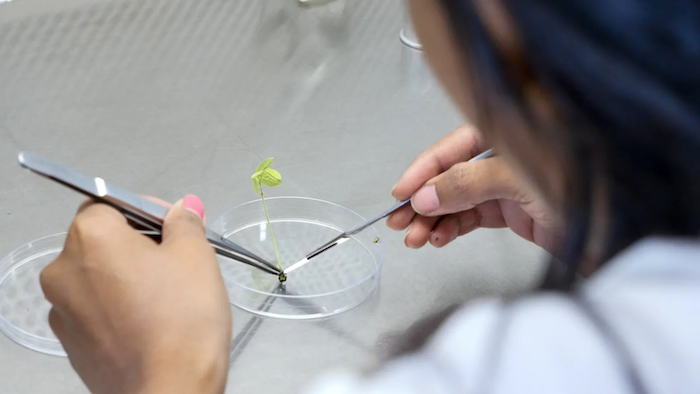
In a recent study, the International Crops Research Institute for the Semi-Arid Tropics (ICRISAT), together with collaborators from the Leibniz Institute of Plant Genetics and Crop Plant Research (IPK), Germany, and the University of Queensland, Australia, proposes a new framework that could transform crop breeding by integrating biology-driven pangenetics with artificial intelligence (AI)-powered prediction models.

Published in Molecular Plant, the study presents a forward-looking strategy for leveraging rapidly evolving AI prediction models to address the complexities of breeding the next generation of crops.
The breeding research dilemma: Biology or prediction?
In crop breeding, genomic prediction effectively captures statistical patterns and correlations associated with complex traits (for example, grain yield per hectare), but often overlooks the underlying biological relationships among component traits that collectively determine plant performance (for example, the trade-offs and interactions between yield, grain quality, and stress tolerance). In contrast, functional biology-based approaches provide mechanistic and causal insights into trait regulation but are often validated in limited genetic backgrounds and environmental conditions.
The study argues that integrating functional genomics, genebank diversity, and advanced AI can accelerate the development of climate-resilient, high-yielding, nutritious, and market-ready crop varieties suited to future agricultural challenges.
“This strategy presents a transformative vision for crop breeding. When AI-powered prediction is integrated with functional genomics and the vast diversity conserved in genebanks, it can shape the next era of crop improvement. At ICRISAT, we are advancing AI-enabled approaches across the entire agri-food value chain to develop future-ready technologies and services for dryland agriculture, contributing to global food security,” said Dr Himanshu Pathak, director general, ICRISAT.
Modern crop breeding has largely progressed along two complementary yet distinct paths: molecular genetics, which focuses on understanding the biological mechanisms underlying traits, and quantitative genetics, which emphasizes statistical prediction using large-scale genomic and phenotypic data. While both approaches have independently contributed to crop improvement, the authors argue that integrating them offers unprecedented opportunities to design next-generation crop ideotypes tailored to specific environments, production systems, and market demands.
Dr Stanford Blade, deputy director general – Research & Innovation, ICRISAT, added, “ICRISAT’s breeding programs span six crops and generate vast amounts of genomic and phenomic data. By integrating AI with biology, as outlined in this roadmap, we can translate biological discoveries into scalable crop improvement solutions in a much shorter time frame.”
The article advocates the concept of pangenetics, an emerging framework that extends beyond pangenomics by linking genomic variation with functional trait biology. These biologically informed genomic features can then be incorporated into AI-driven prediction models, including deep learning frameworks, to improve prediction accuracy, identify superior breeding lines more efficiently, and accelerate genetic gain.
“ICRISAT continues to refine its breeding programs to make them more efficient. Our recently developed Speed Breeding Protocols are one example. This represents another promising direction through which we can deliver superior crop varieties to farmers with greater speed, precision, and efficiency as these concepts move from theory to practical implementation,” said Dr Raman Babu, global research program director – Accelerated Crop Improvement, ICRISAT.
Realizing this transformative vision will require stronger interdisciplinary collaboration across genomics, breeding, physiology, AI, and data science, alongside investments in data-sharing platforms, responsible governance of genomic resources, and capacity building for the next generation of researchers.
Dr Manish K. Pandey, principal scientist – Genebank & Trait Discovery, ICRISAT, added, “The study positions AI not merely as a computational tool, but as a unifying framework capable of connecting biological discovery with scalable breeding decisions to accelerate crop improvement for a climate-challenged world.”
“We are already advancing key components of this vision through large-scale genebank genomics, pangenome development, trait discovery, and AI-assisted predictive breeding research.”
The work leading to this strategy paper was supported by the department of biotechnology (DBT), government of India; the Indian Council of Agricultural Research (ICAR) through the ICAR–ICRISAT collaborative program; the Gates Foundation, USA; the Crop Trust, Germany; the CGIAR Genebanks Accelerator; the CGIAR Science Program on Breeding for Tomorrow; and the global initiative VACS (Vision for Adapted Crops and Soils).
IndiFoodBev — authentic, impactful and influential
An English-language food and beverage processing and packaging industry B2B platform in print and web, IndiFoodBev is in its third year of publication. It is said that the Indian food and beverage industries represent approximately US$ 900 billion in revenues which implies more than 20% of the country’s GDP. Eliminating the wastage on the farmside can help to deliver more protein to a higher number of the population apart from generating sizable exports. The savings in soil, seeds, water, fertilizer, energy and ultimately food and nutrition could be the most immense contribution that country is poised to make to the moderation of climate change.
To improve your marketing and grow sales to the food and beverage processing and packaging industry, talk to us. Our research and consulting company IppStar [www.ippstar.org] can assess your potential and addressable markets in light of the competition. We can discuss marketing, communication, and sales strategies for market entry and growth.
Suppliers and service providers with a strategy and budget for targeted marketing can discuss using our hybrid print, web, video, and social media channels to create brand recognition linked to market relevance. Our technical writers are ready to meet you and your customers for content.
The second largest producer of fruit and vegetables in the world is continuously expanding processing capacities and delivery systems with appropriate innovative technologies. We cover product and consumer trends, nutrition, processing, research, equipment and packaging from farm to thali. Get our 2025 media kit and recalibrate your role in this dynamic market. Enhance your visibility and relevance to existing markets and turn potential customers into conversations. Ask for a sample copy of our bi-monthly in print or our weekly IndiFoodBev eZine each Wednesday.
For editorial info@ippgroup.in — for advertisement ads1@ippgroup.in and for subscriptions subscription@ippgroup.in
Naresh Khanna – 10 February 2025
Subscribe Now