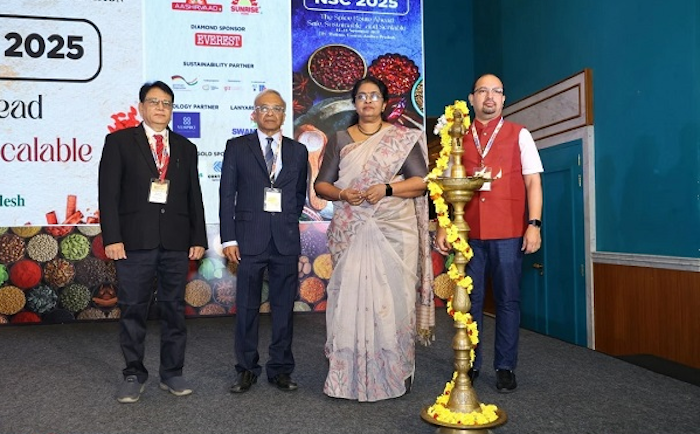
Developing a resilient and globally competitive spice ecosystem through enhanced food safety, sustainable agriculture, and scalable innovations was the focus of the fourth edition of the National Spice Conference (NSC) 2025.
Held in Guntur on 14-15 November, the event themed ‘Spice Route Ahead – Safe, Sustainable, and Scalable,’ saw strong participation from industry leaders, policymakers, scientific institutions, farmer producer organizations (FPOs), and sustainability practitioners from across the spice value chain.
The World Spice Organisation (WSO), a not-for-profit technical partner of the All India Spices Exporters Forum, conducted the event.
The conference brought together representatives from the Food Safety and Standards Authority of India (FSSAI), the Ministry of agriculture, scientific panels, leading spice companies, agri-innovation firms, and FPOs. Discussions centered on improving India’s position in the global spice trade by strengthening compliance frameworks, accelerating the adoption of sustainable practices, and enabling farmers to access emerging opportunities in domestic and international markets.
Ramkumar Menon, chairman of WSO, spoke on the evolving priorities of the sector, stating, “The spice sector has recognized the importance of sustainability, and the WSO is contributing to this through programs such as the National Sustainable Spice Program, which supports over 25,000 farmers across India.”
Paresh Shah, chairman of the FSSAI Scientific Panel on Pesticide Residues, commented on regulatory developments, highlighting the growing emphasis on ensuring safe, traceable, and compliant spices for both domestic consumers and global markets. Remashree, director of the Spices Board, and Sarath Babu Guddala, AGM at NABARD, outlined government efforts toward sustainable cultivation, improved productivity, and expanded support for farmers adapting to evolving quality requirements.
Industry leaders such as Rajiv Shah, managing director of Everest Spices, and Prakash Namboodiri, BU Head at AB Mauri, shared insights on market trends, technology adoption, and quality expectations that will shape the future of spice processing and trade. Experts such as Jasmer Dhingra, programs director at IDH India, Homey Cherian, director at DASD, and Ganapathy KD, executive director at Nedspice Processing India, emphasized the need for science-based agricultural practices to ensure compliance and market readiness.
The first day of the conference featured technical sessions on food safety, sustainable supply chain practices, agri and process innovations, and the role of communities of practice in driving inclusive growth. Speakers discussed strategies to enhance spice quality, strengthen traceability, and integrate agri-technologies for better farm productivity and environmental outcomes. Farmer groups and FPOs shared field-level experiences, fostering an exchange of practical insights to strengthen supply chain resilience.
The second day focused on emerging trends, updates on spice crops, balancing growth with responsibility, and providing a dedicated interface to connect producers, processors, and buyers. The interactive sessions created opportunities for market linkages and discussions on new possibilities for FPOs in both domestic and export markets.
The conference also showcased the National Sustainable Spice Program (NSSP), WSO’s flagship initiative promoting sustainable and food-safe cultivation models. FPOs associated with the program presented their progress and shared examples of how good agricultural practices and sustainability frameworks are improving farm incomes and market
IndiFoodBev — authentic, impactful and influential
An English-language food and beverage processing and packaging industry B2B platform in print and web, IndiFoodBev is in its third year of publication. It is said that the Indian food and beverage industries represent approximately US$ 900 billion in revenues which implies more than 20% of the country’s GDP. Eliminating the wastage on the farmside can help to deliver more protein to a higher number of the population apart from generating sizable exports. The savings in soil, seeds, water, fertilizer, energy and ultimately food and nutrition could be the most immense contribution that country is poised to make to the moderation of climate change.
To improve your marketing and grow sales to the food and beverage processing and packaging industry, talk to us. Our research and consulting company IppStar [www.ippstar.org] can assess your potential and addressable markets in light of the competition. We can discuss marketing, communication, and sales strategies for market entry and growth.
Suppliers and service providers with a strategy and budget for targeted marketing can discuss using our hybrid print, web, video, and social media channels to create brand recognition linked to market relevance. Our technical writers are ready to meet you and your customers for content.
The second largest producer of fruit and vegetables in the world is continuously expanding processing capacities and delivery systems with appropriate innovative technologies. We cover product and consumer trends, nutrition, processing, research, equipment and packaging from farm to thali. Get our 2025 media kit and recalibrate your role in this dynamic market. Enhance your visibility and relevance to existing markets and turn potential customers into conversations. Ask for a sample copy of our bi-monthly in print or our weekly IndiFoodBev eZine each Wednesday.
For editorial info@ippgroup.in — for advertisement ads1@ippgroup.in and for subscriptions subscription@ippgroup.in
Naresh Khanna – 10 February 2025
Subscribe Now