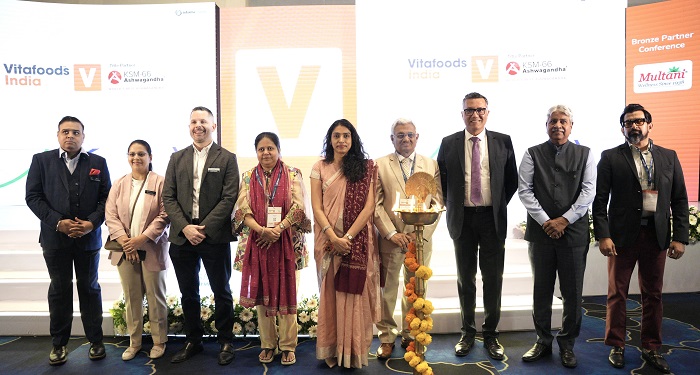
India’s nutraceutical and wellness sector, already surging on the back of strong demand and innovation, gained fresh momentum at the 4th edition of Vitafoods India, held at Mumbai’s Jio World Convention Centre. The three-day event, from 11–13 February 2026, brought together India’s nutraceutical, functional food, beverage, and dietary supplement ecosystem.
The inaugural ceremony was attended by Pritee Chaudhary, IRS, Regional Director, Food Safety and Standards Authority of India (FSSAI), West Region, Mumbai; Krishna Methekar, Joint Director, FSSAI Mumbai; and other senior officials. This edition featured over 200 domestic and international exhibitors and more than 40 industry experts who shared insights across 19 knowledge-driven sessions.
India’s nutraceutical growth is being driven by demographic and lifestyle shifts, with science-backed nutrition powering preventive healthcare. By 2050, the elderly population is projected to reach 347 million, spurring demand for clean-label functional foods that support energy, cognition, and metabolic health. A growing middle class is investing in daily wellness, while rising obesity levels are accelerating demand for weight management solutions, particularly among consumers aged 25–45 who are integrating supplements into their daily routines. These converging trends reinforce the relevance of Vitafoods India as a platform where functional foods, nutraceutical innovation, and scalable, science-driven solutions come together to address India’s evolving health priorities.
Pritee Chaudhary said, “India’s nutraceutical industry is closely aligned with the vision of Viksit Bharat 2047 and represents a strategic pillar for nation-building. Currently accounting for nearly 2% of the global market, the sector’s long-term potential could surpass pharmaceuticals tenfold, given nutraceuticals’ role in daily preventive healthcare through supplements, probiotics, and prebiotics. India benefits from strong pharmaceutical expertise, a consultative FSSAI regulatory framework, and a growing manufacturing base in hubs such as Gujarat and Himachal Pradesh. With 60–70 FTAs in place with key markets including the UK, EU, USA, Mauritius, UAE, and Australia, along with rising emphasis on research, molecule development, and scientific validation, the industry is poised to scale responsibly and strengthen its global leadership over the next five years.”
Kaushik Desai, Secretary General, Health Foods and Dietary Supplements Association (HADSA), said, “The global nutraceutical industry is projected to reach USD 919 billion by 2030, growing at a CAGR of 7% across functional foods, dietary supplements, and personalised nutrition. As the market expands, stronger collaboration between FSSAI and industry is essential to ensure safety, quality, and regulatory compliance, alongside greater emphasis on clinically validated, evidence-based products to reinforce consumer trust. Rising demand for sustainable, plant-based, and clean-label solutions, coupled with the growth of e-commerce and direct-to-consumer channels, is accelerating innovation. India’s biodiversity and traditional medicine heritage provide a strong foundation for globally competitive offerings, and with focused investment in research, innovation, and compliance, the sector can significantly expand access to preventive healthcare.”
Highlighting the transformation of India’s botanical ingredients sector, Hitesh Patel, Managing Director, K Patel Phytoextraction, stated, “The botanical ingredients sector in India is advancing through structured cultivation, farmer partnerships, sustainable and organic practices, and strict compliance with Japanese, European, and American regulatory standards. While an earlier 50% US tariff created temporary pressure, the revised 18% rate is expected to stabilise volumes in the coming months, with European supplies remaining steady. The industry has evolved from traditional ratio-based Ayurveda formulations to standardised extracts validated through HPLC and GC, and is now progressing toward clinically researched, scientifically validated ingredients. Platforms like Vitafoods India reflect this transformation and reinforce India’s global positioning.”
Sandeep Gupta, Founder and Director, Expert Nutraceutical Advocacy Council (ENAC), said, “India’s nutraceutical sector is at a defining stage of growth. While our share of the global market remains modest, the country has strong manufacturing capabilities, rich biodiversity, and deep expertise in natural ingredients and phyto extracts that position us for greater global relevance. The priority now is deeper collaboration across industry, academia, and government to strengthen quality, innovation, and domestic value creation. By bringing together industry leaders and policymakers to address opportunities and regulatory pathways, we can chart a structured roadmap for sustainable and credible growth.”
Yogesh Mudras, Managing Director, Informa Markets in India, said, “India is entering a decisive decade in which nutrition will shape the country’s health and productivity outcomes. As per capita disposable income is projected to approach ₹2.5 lakh by 2030, consumers are increasingly investing in preventive health, personalised nutrition, and everyday wellness. This shift is supported by national initiatives such as the National Nutrition Strategy and an evolving regulatory ecosystem under FSSAI, creating a strong foundation for responsible industry growth. In this context, Vitafoods India 2025–2026 is more than an exhibition; it is a vision platform where science, policy, and innovation converge to move the nutraceutical sector from intent to impact and from domestic expansion to global leadership.”
The show featured a strong line-up of exhibitors across ingredients and raw materials, branded finished products, services and equipment, as well as contract manufacturing and private label solutions, offering visitors a comprehensive view of the industry’s current momentum and future direction.
Key exhibitors included KSM-66 Ashwagandha, Meteoric Biopharma; Krishna Enzytech / Collagen Lifesciences; Akums Drugs and Pharmaceuticals; Siddhayu Ayurvedic Research Foundation; Vantage Nutrition; Inhalation Health; Bio-gen Extracts; IMCD India; Arjuna Natural; Barentz India; Botanic Healthcare Group; BACFO Pharmaceuticals India; Natural Remedies; Lonza Capsules & Health Ingredients; Elmach Packages India; Omniactive Health Technologies; and Crius Life Sciences.
Arushi Jain, Akums Drugs & Pharmaceuticals, said, “India’s nutraceutical and Ayurvedic products market is expanding rapidly, driven by rising health awareness and a shift toward preventive healthcare. This growth is further supported by increasing lifestyle diseases, strong consumer trust in Ayurveda, digital accessibility, and evolving FSSAI and AYUSH regulations. The sector is projected to grow at a CAGR of 13.6% to reach USD 64.83 billion, while Ayurvedic products are expected to expand at an even faster CAGR of 18.4% to USD 22.37 billion by 2030. Trends such as plant-based, clean-label formulations, innovative formats like gummies and functional beverages, and personalised nutrition are gaining traction, particularly among younger urban consumers who are integrating nutraceuticals into their daily routines.”
Puunam G. Kaushik, Deputy Managing Director and Chief Corporate Affairs Officer, Meteoric Biopharmaceuticals, stated, “The Government of India has allocated ₹10,000 crore for the biopharmaceutical industry over five years from 2026 to 2031, creating significant opportunities for companies to scale innovation and capacity. In parallel, the nutraceutical sector is poised for strong expansion in India and the Asia-Pacific region, as the global shift toward preventive healthcare has accelerated post-Covid. The market is expected to grow at least threefold over the next five years, driven by increased focus on immunity, nutrition, and wellness. At Vitafoods India, the emphasis is on next-generation food ingredients and nutraceutical solutions, including prebiotics, probiotics, synbiotics, and emerging postbiotics, alongside clinically validated offerings in kidney health, women’s health, and gut health, as well as advancing research in the gut-skin microbiome.”
Gaurav Soni and Madhu Krishnamani, Founders and Managing Directors, Botanic Healthcare, said, “At Botanic Healthcare, we develop science-led nutraceutical solutions that combine traditional herbal knowledge with modern delivery technologies to support preventive and lifestyle-focused nutrition. As demand rises for clinically validated, high-bioavailability solutions across metabolic health, immunity, skin, and vision care, our portfolio reflects a shift toward outcome-driven innovation. Women’s wellness remains a key focus, and at Vitafoods India 2026, we are launching Aspariva, a standardised Shatavari extract formulated to support women’s health through evidence-based development. With a ₹250 crore equity investment and the commissioning of our dedicated liposomal manufacturing facility in Hyderabad, we are strengthening innovation, clinical validation, and global expansion.”
Benny Antony, Joint Managing Director, Arjuna Natural, said, “India’s nutraceutical sector is projected to grow from US$8–9 billion to US$20–30 billion by 2030 at a CAGR of 15–18%, signalling a shift from general wellness to targeted, clinically supported health solutions. Growth is being driven by rising demand for healthy ageing, metabolic balance, mental wellness, stress resilience, and performance nutrition. At Vitafoods India 2026, Arjuna Natural is showcasing patented botanical ingredients, including high-bioavailability turmeric, potent ashwagandha, omega-supporting amla extracts, nitrate-rich endurance actives, and cognitive botanicals. These reflect the growing need for clinically validated, plant-based solutions that strengthen formulation quality and support the next phase of India’s nutraceutical value chain.”
Beyond the exhibition floor, Vitafoods India 2026 introduced immersive experiences such as the Global Trends Zone, Innovation Zone, and Tasting Zone, enabling stakeholders to explore formulations, formats, and flavours shaping the future of wellness consumption.
The show was supported by leading industry bodies, including HADSA (Health Foods and Dietary Supplements Association), AFSTI (Mumbai), CASMB (Chamber for Advancement of Small & Medium Businesses), and Women in Nutraceuticals (WIN), reflecting strong institutional backing and ecosystem alignment.
Alongside the exhibition, a three-day conference was held under the theme ‘Nutri-Critical 2030: Science, Standards and Scale for India’s Global Significance’. The programme examined key industry priorities, including regulatory frameworks, labelling and compliance, research and product innovation, personalised nutrition, healthy ageing, women-centric nutrition, functional foods, retail readiness, market access strategies, next-generation consumers (Gen Z and Alpha), microbiome science, protein adequacy, and sustainable nutrition models.
A significant addition to the 2026 edition was the Leaders Roundtable, a closed-door strategic forum developed in collaboration with the Expert Nutraceutical Advocacy Council (ENAC). The roundtable convened senior professionals from CRAMS, ingredient manufacturing, R&D, regulatory affairs, scientific research, quality assurance, innovation and technology, CROs, policy advocacy, certification, and business strategy, with the objective of enabling structured dialogue on industry challenges and opportunities.
IndiFoodBev — authentic, impactful and influential
An English-language food and beverage processing and packaging industry B2B platform in print and web, IndiFoodBev is in its third year of publication. It is said that the Indian food and beverage industries represent approximately US$ 900 billion in revenues which implies more than 20% of the country’s GDP. Eliminating the wastage on the farmside can help to deliver more protein to a higher number of the population apart from generating sizable exports. The savings in soil, seeds, water, fertilizer, energy and ultimately food and nutrition could be the most immense contribution that country is poised to make to the moderation of climate change.
To improve your marketing and grow sales to the food and beverage processing and packaging industry, talk to us. Our research and consulting company IppStar [www.ippstar.org] can assess your potential and addressable markets in light of the competition. We can discuss marketing, communication, and sales strategies for market entry and growth.
Suppliers and service providers with a strategy and budget for targeted marketing can discuss using our hybrid print, web, video, and social media channels to create brand recognition linked to market relevance. Our technical writers are ready to meet you and your customers for content.
The second largest producer of fruit and vegetables in the world is continuously expanding processing capacities and delivery systems with appropriate innovative technologies. We cover product and consumer trends, nutrition, processing, research, equipment and packaging from farm to thali. Get our 2025 media kit and recalibrate your role in this dynamic market. Enhance your visibility and relevance to existing markets and turn potential customers into conversations. Ask for a sample copy of our bi-monthly in print or our weekly IndiFoodBev eZine each Wednesday.
For editorial info@ippgroup.in — for advertisement ads1@ippgroup.in and for subscriptions subscription@ippgroup.in
Naresh Khanna – 10 February 2025
Subscribe Now