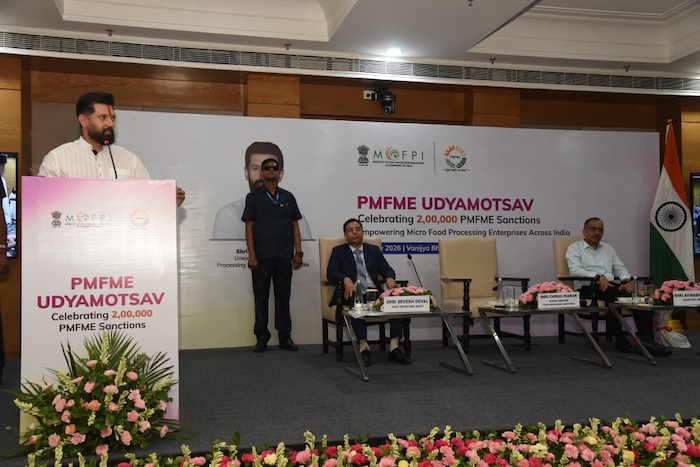
Union minister for food processing industries Chirag Paswan presided over a special event in New Delhi to celebrate achieving a milestone under the Pradhan Mantri Formalisation of Micro Food Processing Enterprises (PMFME) Scheme — the sanction of loans to more than two lakh micro food processing enterprises.

While crossing 2 lakh loan sanctions, the scheme has leveraged project investments of over Rs 20,300 crore. Nearly 90% of beneficiaries are first-generation entrepreneurs and 44% are women entrepreneurs, while over 75,000 PMFME-supported enterprises have entered the formal economy through registrations such as Udyam Aadhaar, Udyam Assist, FSSAI and GST. The Scheme has generated nearly 11 lakh direct and indirect employment opportunities.
The program was attended by the senior officers of the ministry of food processing industries, along with representatives from state governments, partner ministries, banking institutions, development partners, entrepreneurs, and members of self-help groups and farmer producer organizations.
The event featured the release of key publications highlighting the achievements of the Scheme, the sharing of success stories by entrepreneurs, and interactions between the Minister and PMFME beneficiaries whose enterprises reflect the Scheme’s impact on the ground.
In his welcome address, Devesh Deval, joint secretary, MoFPI, while announcing the launch of a nationwide multimedia awareness campaign, conveyed the importance of PMFME Scheme that provides the end to end support to the micro food processing entrepreneurs starting from the financial assistance, training, handholding, branding and marketing to the market linkage. He noted that “PMFME is not merely supporting enterprises — it is transforming livelihoods, strengthening local value chains and creating sustainable employment opportunities across the country.”
AP Das Joshi, secretary, MoFPI, described the milestone as reflecting “the emergence of a stronger ecosystem for micro food processing sector in India,” noting that PMFME combines finance, formalisation, technology, capacity building and market access into an integrated approach for enterprise development. He spoke of the scheme’s network of district resource persons (DRPs), describing their work as reflecting “the successful convergence of Digital India and Ease of Doing Business at the grassroots level.”
Officials also highlighted the scheme’s one district one product (ODOP) approach and its support for 40 common brands covering nearly 200 products, through which PMFME is building local value chains around products such as makhana, millets, spices and GI-tagged products across the country.
Paswan said the achievement of two lakh beneficiaries “demonstrates that this vision is translating into measurable outcomes across the country,” describing the participation of women entrepreneurs, at nearly 44%of all beneficiaries, as “the true spirit of women-led development, a cornerstone of Viksit Bharat.”
The minister commended the performance of leading states including Bihar, Maharashtra, Uttar Pradesh, Tamil Nadu and Madhya Pradesh. He stated that the milestone “is therefore not merely a milestone to celebrate; it is a strong foundation upon which we will build the next phase of India’s food processing growth story,” and expressed appreciation to State Governments, district administrations and field functionaries for transforming “a national policy into a grassroots movement for enterprise development.”
The minister highlighted the scheme’s seed capital support, under which more than 4.18 lakh self help group members have been supported and the ministry’s network of 80 common incubation centers approved across 27 states/UTs, of which 32 have been commissioned. More than 1.76 lakh beneficiaries have been trained under the scheme, of whom 77% are women.
IndiFoodBev — authentic, impactful and influential
An English-language food and beverage processing and packaging industry B2B platform in print and web, IndiFoodBev is in its third year of publication. It is said that the Indian food and beverage industries represent approximately US$ 900 billion in revenues which implies more than 20% of the country’s GDP. Eliminating the wastage on the farmside can help to deliver more protein to a higher number of the population apart from generating sizable exports. The savings in soil, seeds, water, fertilizer, energy and ultimately food and nutrition could be the most immense contribution that country is poised to make to the moderation of climate change.
To improve your marketing and grow sales to the food and beverage processing and packaging industry, talk to us. Our research and consulting company IppStar [www.ippstar.org] can assess your potential and addressable markets in light of the competition. We can discuss marketing, communication, and sales strategies for market entry and growth.
Suppliers and service providers with a strategy and budget for targeted marketing can discuss using our hybrid print, web, video, and social media channels to create brand recognition linked to market relevance. Our technical writers are ready to meet you and your customers for content.
The second largest producer of fruit and vegetables in the world is continuously expanding processing capacities and delivery systems with appropriate innovative technologies. We cover product and consumer trends, nutrition, processing, research, equipment and packaging from farm to thali. Get our 2025 media kit and recalibrate your role in this dynamic market. Enhance your visibility and relevance to existing markets and turn potential customers into conversations. Ask for a sample copy of our bi-monthly in print or our weekly IndiFoodBev eZine each Wednesday.
For editorial info@ippgroup.in — for advertisement ads1@ippgroup.in and for subscriptions subscription@ippgroup.in
Naresh Khanna – 10 February 2025
Subscribe Now