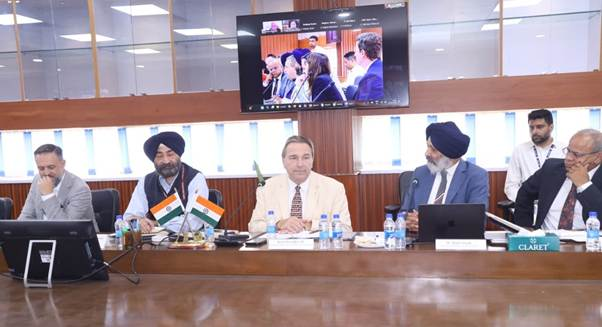
The National Institute of Food Technology Entrepreneurship and Management, Kundli (NIFTEM-K) organized a roundtable on ‘Pulse Protein Innovation, Value Addition and Strategic Partnerships’ on 13 October 2026 – bringing together senior government representatives, academic leaders, industry associations and research organizations from India and Canada to strengthen bilateral cooperation in pulse protein innovation, food processing, research and sustainable nutrition.

The conference was attended by Ken Cheveldayoff, minister of advanced education, government of Saskatchewan, Canada, along with David Anderson, managing director, government of Saskatchewan, and Harish Vaidyanathan, senior trade officer, Saskatchewan India Office.
The University of Saskatchewan (USask) delegation included Baljit Singh, vice-president (research); Trever Crowe, associate dean (research and graduate studies); Ajay Dalai, professor; and Supratim Ghosh, professor.
Industry and research organizations were represented by Greg Cherewyk, president, Pulse Canada; Julianne Curran, vice-president (Market Innovation), Pulse Canada; Carl Potts, executive director, Saskatchewan Pulse Growers; Leanne Fischbuch, executive director, Alberta Pulse Growers; Bob Behari, CEO, Enviroway; and Prachi Kaul, director, Shastri Indo-Canadian Institute.
Representatives of Indian organizations and industry, including Nutrition International, Nutricircle, India Pulses and Grains Association, ICAR–Indian Institute of Pulses Research, Kanpur, the International Crops Research Institute for the Semi-Arid Tropics (ICRISAT), Diet Foods, Good Food Institute India and IIT Delhi, also participated in the discussions.
In his address, Cheveldayoff highlighted the importance of India–Saskatchewan relations and the value of personal connections in strengthening ties between India and Canada. He underlined the opportunities for closer cooperation in higher education, research, innovation and academic exchange, noting the potential for institutions and industry to work together on shared priorities.
Harinder Singh Oberoi, director, NIFTEM-K, emphasized the importance of translating the points mentioned in the Memorandum of Understanding between NIFTEM-K and the University of Saskatchewan into tangible outcomes. He stated that the partnership should move beyond the agreement to a clear, time-bound program of action that delivers meaningful benefits for both countries.
He expressed his gratitude to all the stakeholders and expressed satisfaction about the significant progress made during the short period of about seven months after the MoU was signed. He highlighted the goal of working towards establishing the joint Centre of Excellence at NIFTEM-K within the next year, supported by a practical road map, defined milestones and institutional coordination.
The discussions also recognized key challenges in pulse processing and protein ingredient development. These include ensuring consistency in raw materials and ingredients, managing process energy requirements and energy use, optimizing processing conditions, and preserving or improving the functional properties of pulse proteins. Participants also highlighted the importance of addressing texture-related challenges and developing fit-for-purpose pulse-based ingredients that can support value addition and the development of innovative food products.
Dr. Oberoi said the partners should identify priority research areas and agree on an actionable plan for the first two years. Potential areas of collaboration include pulse protein extraction and processing, value addition, development of innovative and nutritious food products, joint research projects and publications, joint PhD degree program, student and faculty exchanges, training programs, and collaborative research funding. He also highlighted the importance of industry participation to help translate research into scalable technologies, commercial products and wider market opportunities.
Baljit Singh mentioned that USask has identified PhD students who will do part of their research work at NIFTEM-K. He said a collaborative project entitled “ Sustainable health innovation in fortification (lentils) for SDG 2.2 (end all forms of malnutrition), has been submitted by USask in collaboration with NIFTEM-K and other international partners for funding by Government of Canada.
The roundtable coordinated by Baljit Singh provided a platform for academic and industry stakeholders to discuss research collaboration, capacity building, technology development and commercialization. Participants explored opportunities to develop value-added pulse-based foods, strengthen links between researchers and businesses, and address emerging needs in sustainable and plant-based nutrition. The discussions also focused on creating a coordinated framework through which research priorities, expertise and facilities in India and Canada can complement each other.
The conference forms part of the broader effort to advance the joint Centre of Excellence, with NIFTEM-K and the University of Saskatchewan serving as co-chairs of the initiative, as stated in the conference background. The proposed collaboration is intended to bring together academic expertise, government support and industry engagement to advance pulse protein innovation and strengthen research and educational links between the two countries.
The roundtable concluded with an emphasis on converting the discussions into defined priorities, responsibilities and timelines. The proposed roadmap and two-year research priorities are expected to provide a foundation for sustained institutional cooperation and measurable progress in pulse protein research, value addition and innovation, further strengthening India–Canada academic, scientific and industry partnerships.
IndiFoodBev — authentic, impactful and influential
An English-language food and beverage processing and packaging industry B2B platform in print and web, IndiFoodBev is in its third year of publication. It is said that the Indian food and beverage industries represent approximately US$ 900 billion in revenues which implies more than 20% of the country’s GDP. Eliminating the wastage on the farmside can help to deliver more protein to a higher number of the population apart from generating sizable exports. The savings in soil, seeds, water, fertilizer, energy and ultimately food and nutrition could be the most immense contribution that country is poised to make to the moderation of climate change.
To improve your marketing and grow sales to the food and beverage processing and packaging industry, talk to us. Our research and consulting company IppStar [www.ippstar.org] can assess your potential and addressable markets in light of the competition. We can discuss marketing, communication, and sales strategies for market entry and growth.
Suppliers and service providers with a strategy and budget for targeted marketing can discuss using our hybrid print, web, video, and social media channels to create brand recognition linked to market relevance. Our technical writers are ready to meet you and your customers for content.
The second largest producer of fruit and vegetables in the world is continuously expanding processing capacities and delivery systems with appropriate innovative technologies. We cover product and consumer trends, nutrition, processing, research, equipment and packaging from farm to thali. Get our 2025 media kit and recalibrate your role in this dynamic market. Enhance your visibility and relevance to existing markets and turn potential customers into conversations. Ask for a sample copy of our bi-monthly in print or our weekly IndiFoodBev eZine each Wednesday.
For editorial info@ippgroup.in — for advertisement ads1@ippgroup.in and for subscriptions subscription@ippgroup.in
Naresh Khanna – 10 February 2025
Subscribe Now