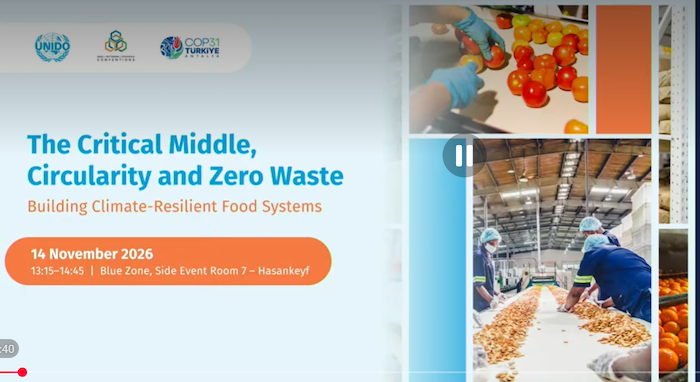
During the ongoing UNFCCC COP31, the United Nations Industrial Development Organization (UNIDO) unveiled plans to establish the Critical Middle Coalition, a new global platform bringing together governments, businesses, investors and development partners to accelerate actions across the midstream of food value chains.
UNIDO called for coordinated action and investment to strengthen processing, storage, packaging, logistics and distribution, building on COP31’s focus on implementation to turn global commitments into country-level action.
Outlined at a dedicated COP31 side event The Critical Middle, Circularity and Zero Waste: Building Climate-Resilient Food Systems, which brought together speakers including the FAO, Tetra Pak and UNEP, the plans mark a step towards turning growing recognition of the Critical Middle into coordinated action. The proposed Coalition builds on UNIDO’s work to develop the first comprehensive normative framework with research support from Wageningen University & Research for the Critical Middle, carrying forward momentum from the World Without Hunger Conference, UNFSS+4 and COP30.
Spanning processing, storage, packaging, logistics and distribution, the Critical Middle transforms, protects and moves food to bring consumers safe, affordable products. It accounts for approximately 30–40% of value added and employment across food value chains, particularly in low and middle-income countries.
The Coalition will aim to respond to mounting pressures on the global food system. Around 2.1 billion people face moderate or severe food insecurity, while climate shocks are disrupting food value chains. Weaknesses in processing, storage and distribution compound these challenges, increasing food losses and consumer costs.
Discussions highlighted how fragmented policy, infrastructure gaps and limited access to finance constrain these essential functions. Speakers explored how stronger partnerships and targeted investment could address these barriers while reducing food loss and waste, strengthening climate resilience and creating economic opportunities, including through circular economy and zero-waste approaches.
The Coalition will aim to provide a common platform to align policy, mobilise investment and help micro, small and medium-sized enterprises access finance and technical support. Through stronger partnerships and knowledge sharing, it will seek to scale solutions that reduce food loss and waste, improve access to safe, nutritious and affordable food, and translate shared priorities into investment-ready initiatives with measurable results.
Marina Ponti, deputy to the director general and managing director of SDG Innovation and Economic Transformation at UNIDO: “For many years, food-security efforts have rightly focused on increasing production. But producing more food is not enough if too much of it is lost before reaching the consumer. Nor is it enough if too little of its value remains in the places where it is produced. We want to make the Critical Middle stronger so that more food reaches markets instead of being lost and more value and decent jobs are created in producing countries particularly for women and young people.”
Máximo Torero, chief economist, Food and Agriculture Organization of the United Nations (FAO): “The cost of a healthy diet is driven less by what happens on the farm than by what happens across the Critical Middle. We find that 70 to 75% of the cost of a healthy diet accumulates after the farm gate, in handling, storage, transport, processing and trade. The Critical Middle is essential, and it is the way we need to operate to reduce the cost of a healthy diet.”
Dominic Waughray, executive vice president, World Business Council for Sustainable Development (WBCSD): “The Critical Middle is where food systems either hold together or break down.”
Martin Scott, executive vice president Sustainability & Communications at Tetra Pak: “Strengthening the critical middle of food systems is essential to building resilience, accelerating the climate transition and creating economic value. At Tetra Pak we see the importance of this every day across the value chain. Progress requires ambition, partnerships and practical action. We welcome plans for the Critical Middle Coalition, and we’re ready to help turn shared ambition into impact.”
Following COP31, UNIDO will work with partners to define the Coalition’s initial priorities and identify opportunities for country-level collaboration, aligned with national food system ambitions.
IndiFoodBev — authentic, impactful and influential
An English-language food and beverage processing and packaging industry B2B platform in print and web, IndiFoodBev is in its third year of publication. It is said that the Indian food and beverage industries represent approximately US$ 900 billion in revenues which implies more than 20% of the country’s GDP. Eliminating the wastage on the farmside can help to deliver more protein to a higher number of the population apart from generating sizable exports. The savings in soil, seeds, water, fertilizer, energy and ultimately food and nutrition could be the most immense contribution that country is poised to make to the moderation of climate change.
To improve your marketing and grow sales to the food and beverage processing and packaging industry, talk to us. Our research and consulting company IppStar [www.ippstar.org] can assess your potential and addressable markets in light of the competition. We can discuss marketing, communication, and sales strategies for market entry and growth.
Suppliers and service providers with a strategy and budget for targeted marketing can discuss using our hybrid print, web, video, and social media channels to create brand recognition linked to market relevance. Our technical writers are ready to meet you and your customers for content.
The second largest producer of fruit and vegetables in the world is continuously expanding processing capacities and delivery systems with appropriate innovative technologies. We cover product and consumer trends, nutrition, processing, research, equipment and packaging from farm to thali. Get our 2025 media kit and recalibrate your role in this dynamic market. Enhance your visibility and relevance to existing markets and turn potential customers into conversations. Ask for a sample copy of our bi-monthly in print or our weekly IndiFoodBev eZine each Wednesday.
For editorial info@ippgroup.in — for advertisement ads1@ippgroup.in and for subscriptions subscription@ippgroup.in
Naresh Khanna – 10 February 2025
Subscribe Now