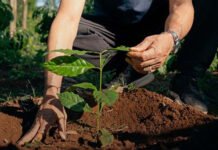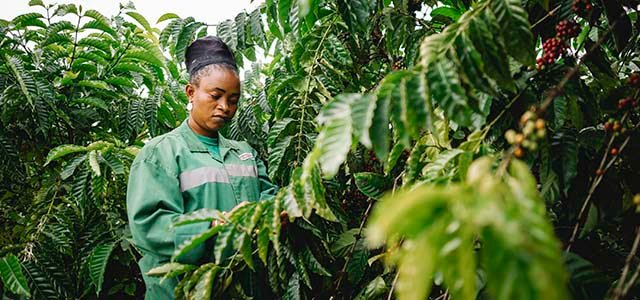
New research conducted in Côte d’Ivoire shows that planting a mix of six rigorously tested and validated robusta coffee varieties can increase yields by up to 86%, using the same inputs as the commonly used local plant variety.
Coffee production in Côte d’Ivoire plays an important role in farmer livelihoods, but the sector is increasingly exposed to climate variability and productivity constraints. Improving the performance and reliability of coffee production has therefore become a priority for local research and development efforts.
The new findings come from multi-year research carried out by the Nestlé Institute of Agricultural Sciences in collaboration with the Centre National de Recherche Agronomique (CNRA). Since 2018, plant science experts from both organizations have studied 18 robusta varieties across four coffee-growing regions in Côte d’Ivoire. They evaluated yield, flavor, bean quality, drought tolerance, and overall performance under climate stress. The six best-performing varieties, two developed by Nestlé and four by CNRA, were then tested to see how they perform together.
Further trials showed that planting a combination of these six varieties delivers the strongest results by boosting yield while enhancing performance under climate stress and overall cup quality. Sensory tests confirmed that coffee made from this robusta mix has a smoother flavor, with less bitterness and fewer woody notes typically associated with robusta coffee.
The six varieties have now been officially registered in Côte d’Ivoire, and the varietal mix will be made available to farmers through cooperatives under the Nescafé Plan, Nestlé’s sustainable coffee sourcing program.
“Côte d’Ivoire, the third-largest coffee producer in Africa, is feeling the effects of climate change, with shifting rainfall and rising temperatures impacting crop health and yield,” said Hubert Coffi, agronomy manager for the Nestlé Institute of Agricultural Sciences in Côte d’Ivoire. “Together with partners such as CNRA, we are exploring resilient coffee varieties to help protect farmers’ livelihoods and ensure consumers can continue to enjoy great-tasting coffee in the future.”
Nestlé’s coffee plant breeding work in Côte d’Ivoire is led by experts at its experimental farm in Zambakro, in collaboration with local research partners and the Nestlé Institute of Agricultural Sciences Plant Sciences Department in Tours, France.
In parallel, Nestlé’s experts work closely with local farmers to improve agricultural practices. At Zambakro, farmers receive hands-on training in regenerative agriculture, supporting the long-term viability of coffee production.
These efforts build on Nestlé’s work using classical breeding methods to develop high-yielding, disease- and drought-tolerant coffee plant varieties suited to evolving local growing conditions in key coffee-producing countries. The varieties are developed, tested under real farm conditions, and made available to farmers. Other recent examples include the development of Roubi 1 and Roubi 2, two robusta varieties delivering up to 50% higher yields in Mexico, and Star 4, a novel Arabica variety with larger beans and resistance to coffee leaf rust, registered in Brazil.
IndiFoodBev — authentic, impactful and influential
An English-language food and beverage processing and packaging industry B2B platform in print and web, IndiFoodBev is in its third year of publication. It is said that the Indian food and beverage industries represent approximately US$ 900 billion in revenues which implies more than 20% of the country’s GDP. Eliminating the wastage on the farmside can help to deliver more protein to a higher number of the population apart from generating sizable exports. The savings in soil, seeds, water, fertilizer, energy and ultimately food and nutrition could be the most immense contribution that country is poised to make to the moderation of climate change.
To improve your marketing and grow sales to the food and beverage processing and packaging industry, talk to us. Our research and consulting company IppStar [www.ippstar.org] can assess your potential and addressable markets in light of the competition. We can discuss marketing, communication, and sales strategies for market entry and growth.
Suppliers and service providers with a strategy and budget for targeted marketing can discuss using our hybrid print, web, video, and social media channels to create brand recognition linked to market relevance. Our technical writers are ready to meet you and your customers for content.
The second largest producer of fruit and vegetables in the world is continuously expanding processing capacities and delivery systems with appropriate innovative technologies. We cover product and consumer trends, nutrition, processing, research, equipment and packaging from farm to thali. Get our 2025 media kit and recalibrate your role in this dynamic market. Enhance your visibility and relevance to existing markets and turn potential customers into conversations. Ask for a sample copy of our bi-monthly in print or our weekly IndiFoodBev eZine each Wednesday.
For editorial info@ippgroup.in — for advertisement ads1@ippgroup.in and for subscriptions subscription@ippgroup.in
Naresh Khanna – 10 February 2025
Subscribe Now