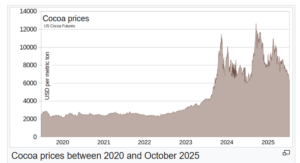
As cocoa prices slowly fall after a record high across the globe, real chocolate is poised for a comeback after a year dominated by smaller bars, added fillers, and cocoa-light alternatives, Reuters reported, stating that a roughly 70% slide in cocoa futures since late 2024 is making traditional recipes more profitable again.

The shift could mean lower prices for consumers, improved demand for cocoa farmers, and a reversal away from products that contain too little cocoa to qualify as chocolate. Reuters notes that Hershey plans to increase cocoa content in its “chocolate candy” range, returning all Hershey’s and Reese’s products to original recipes next year after criticism over reformulations.
Industry experts, including consultant Roger Bradshaw, told Reuters that the move makes financial sense at current prices, and others may follow, though companies such as Mondelez and Nestlé have not commented, while Ferrero says recipes are not driven by short-term price swings.
After cocoa prices surged above US$12,000 per metric ton in 2024 due to weather and disease, manufacturers cut cocoa use, shrank products, and invested in alternatives such as ChoViva.
 Cocoa trees are highly sensitive to shifts in temperature and rainfall, as well as unpredictable weather, droughts, and new plant diseases that reduce yields across major growing regions. When less cocoa is produced, the cost of raw beans rises, which ultimately increases the price of chocolate. Most of the world’s cocoa is produced in the West African countries of Ghana and Ivory Coast.
Reuters highlights that this shift reduced demand, contributing to the subsequent 70% price drop, with demand potentially hitting nine-year lows before recovering this year.
Because chocolate makers hedge prices months in advance, it can take up to 10 months for cheaper cocoa to reach store shelves, though some companies, including Mondelez, have already lowered prices in Europe.
Barry Callebaut expects modest volume growth and says that at current prices, real chocolate can be cheaper to produce than cocoa-free alternatives, prompting some clients to switch back, Reuters reports.
Regulatory changes are also playing a role in the comeback, including a new Brazilian law requiring dark chocolate to contain at least 35% cocoa solids, aligning it more closely with European and North American standards.
The rise of alternatives
Cocoa-free chocolate alternatives use innovative ingredients such as sunflower seeds, fava beans, and carob, fermented and roasted to replicate real chocolate. Driven by volatile cocoa prices and supply shortages, these planet-friendly treats are formulated with fats like shea butter or coconut oil.
A host of names in the food-tech space are bringing these alternatives to the market. ChoViva by Planet A Foods is a widely available cocoa substitute made from ground sunflower seeds processed using a proprietary fermentation platform. It is expanding across supermarkets globally in Europe and is used by giants such as Nestlé, Barry Callebaut, and others.
“It tastes, looks and feels like chocolate – but it doesn’t harm our planet: ChoViva, the world’s leading cocoa-free chocolate alternative made from sunflower seeds, has skyrocketed in the market, with an ever-growing range of products. Our innovative ingredient was created for the food industry and comes with all the characteristics of chocolate, from the snappy experience to the velvety mouthfeel and rich taste,” states a Planet A Foods creative posted on its website.
NextCoa by Voyage Foods is a bean-free confectionery ingredient designed to mimic the exact sensory properties of traditional chocolate. Nukoko, based in the UK, uses domestic fava beans combined with controlled fermentation to create a bean-to-bar experience with less sugar and higher protein.
ISM & ProSweets 2026 also showcased an industry innovating in cocoa-free alternatives to combat cocoa volatility. Innovators, including Puratos and Cargill, have announced cultivated cocoa investments.
Cocoa prices have eased after surging in 2024 and 2025, but Rabobank commodity analyst Oran van Dort told foodingredientsfirst.com that he does not expect prices to return to historic levels amid systemic supply issues.
Mondelēz’s 2025 earnings nearly halved as record cocoa costs overshadowed revenue growth, while Hershey’s net income dropped 60%, the website reported.
While the return to traditional chocolate could benefit roughly two million cocoa farmers in Ivory Coast and Ghana, experts caution that demand may take up to 2.5 years to fully recover.
Longer-term trends, including Gen Z’s openness to alternatives and the impact of weight-loss drugs, may keep some cocoa-free products in the market despite the current shift back, according to analysts cited by Reuters.
IndiFoodBev — authentic, impactful and influential
An English-language food and beverage processing and packaging industry B2B platform in print and web, IndiFoodBev is in its third year of publication. It is said that the Indian food and beverage industries represent approximately US$ 900 billion in revenues which implies more than 20% of the country’s GDP. Eliminating the wastage on the farmside can help to deliver more protein to a higher number of the population apart from generating sizable exports. The savings in soil, seeds, water, fertilizer, energy and ultimately food and nutrition could be the most immense contribution that country is poised to make to the moderation of climate change.
To improve your marketing and grow sales to the food and beverage processing and packaging industry, talk to us. Our research and consulting company IppStar [www.ippstar.org] can assess your potential and addressable markets in light of the competition. We can discuss marketing, communication, and sales strategies for market entry and growth.
Suppliers and service providers with a strategy and budget for targeted marketing can discuss using our hybrid print, web, video, and social media channels to create brand recognition linked to market relevance. Our technical writers are ready to meet you and your customers for content.
The second largest producer of fruit and vegetables in the world is continuously expanding processing capacities and delivery systems with appropriate innovative technologies. We cover product and consumer trends, nutrition, processing, research, equipment and packaging from farm to thali. Get our 2025 media kit and recalibrate your role in this dynamic market. Enhance your visibility and relevance to existing markets and turn potential customers into conversations. Ask for a sample copy of our bi-monthly in print or our weekly IndiFoodBev eZine each Wednesday.
For editorial info@ippgroup.in — for advertisement ads1@ippgroup.in and for subscriptions subscription@ippgroup.in
Naresh Khanna – 10 February 2025
Subscribe Now