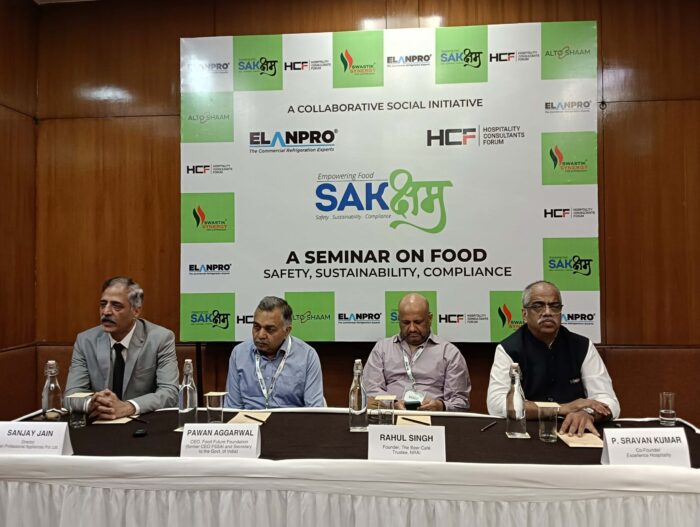
At the Saksham dialog chapter New Delhi on 16 April at the India Habitat Centre, Industry leaders, regulators and operators across the food service and hospitality sector got together to address the growing impact of cost pressures and evolving compliance expectations on business continuity and sectoral growth.

At a press conference held alongside the seminar, industry stakeholders and leaders from across the HoReCa and F&B space highlighted that rising energy costs, input volatility and tightening margins are increasingly influencing everyday operational decisions bringing sharper focus to maintenance practices, procurement choices and compliance consistency.
As regulatory expectations evolve, the emphasis is also shifting from enforcement-led compliance to building systems that ensure consistency at scale. Sharing this perspective, Pawan Agarwal, CEO, Food Future Foundation and former CEO, FSSAI, said, “In a high-pressure environment, the risk is not deliberate non-compliance, but inconsistency in execution. In India, licensing is still often viewed as a compliance requirement, whereas it should be seen as a foundation for quality and safety. The real shift we need is from enforcement to building systems that work on the ground. Platforms like Saksham can play an important role in driving this change by enabling industry-wide understanding and practical adoption.”
HoReCa operators on the ground are already navigating difficult trade-offs. With rising LPG costs, logistics pressures and input inflation, maintaining the same level of operational rigour is becoming increasingly challenging.
Sharing the concern, Rahul Singh, founder and CEO, Beer Café, trustee, NRAI, said, “Growth in this sector cannot come at the cost of discipline. As costs rise, staying within defined operational and regulatory boundaries becomes even more critical.”
Sustained cost pressures are also beginning to influence operational decisions in areas that directly impact long term efficiency and risk. Highlighting the execution gap, P Sravan Kumar, Excellence Hospitality Projects, said, “The client and the owner, in a food business, are on the same page, contrary to popular belief, since they cannot survive without each other. But the real founding principles for the business to survive are the three fundamentals of safety, sustainability, and compliance. Failure on any one of them is sure to have a spiralling effect on the other two. In the short term, one may resort to cutting corners, but in the long run, ignoring these will lead to collapse of not only the individual business but also the food business eco-system. At Saksham, we attempt to sensitize the stakeholders, with a hope that each one will take one forward step, one step at a time.”
As businesses expand across formats, the need to move from fragmented practices to integrated systems is becoming increasingly evident. Emphasising this role of structured interventions, Sanjay Jain, director, Elanpro, said, “The focus now has to be on enabling businesses to move from intent to execution. Saksham is designed to create that shift—by bringing together the right expertise, frameworks and industry dialog to support more structured and consistent operations.”
Rethinking how the industry operates
These discussions formed the core of the Delhi edition of Saksham. Saksham is a knowledge-led industry initiative by Elanpro, in association with HCF, focused on advancing safety, sustainability and compliance across the food service and hospitality sector.
Designed as a platform to address real-world operational challenges, Saksham brought together several participants including chefs, hotel engineers, restaurant operators, food business owners, consultants and emerging F&B entrepreneurs to examine evolving risks and solutions shaping the sector.
The seminar in Delhi brought together key industry voices including Chef Manjit Gill, Pawan Agarwal, Rahul Singh, Animesh Gupta, VP, Varun Beverages, Swapnil Deshpande, vice president – business development, Swastik Synergy and Vikas Ahluwalia, AVP and national head – Zone, The Park Hotels among others, reflecting a cross-section of leadership across operations, policy and hospitality.
From dialog to implementation
As the platform evolves, Saksham is moving beyond dialog toward structured on-ground execution. Participants received access to expert advisory support, including a one-time diagnostic audit across safety, compliance or sustainability. Delivered by empanelled specialists, this intervention provides a structured assessment, key risk indicators and actionable recommendations. The initiative is designed to help businesses translate insights into measurable improvements, bridging the gap between awareness and implementation.
Strengthening How the Industry Operates at Scale
Saksham has already been conducted in Bengaluru and Pune, and is planned across cities including Kolkata and Indore. As the platform expands, it aims to strengthen industry standards by enabling more structured operations, improving workforce capability and supporting the transition toward safer, more efficient and compliant food businesses.
Through Saksham, Elanpro is building a long-term, execution-focused ecosystem to drive operational excellence across India’s food service and hospitality sector.
IndiFoodBev — authentic, impactful and influential
An English-language food and beverage processing and packaging industry B2B platform in print and web, IndiFoodBev is in its third year of publication. It is said that the Indian food and beverage industries represent approximately US$ 900 billion in revenues which implies more than 20% of the country’s GDP. Eliminating the wastage on the farmside can help to deliver more protein to a higher number of the population apart from generating sizable exports. The savings in soil, seeds, water, fertilizer, energy and ultimately food and nutrition could be the most immense contribution that country is poised to make to the moderation of climate change.
To improve your marketing and grow sales to the food and beverage processing and packaging industry, talk to us. Our research and consulting company IppStar [www.ippstar.org] can assess your potential and addressable markets in light of the competition. We can discuss marketing, communication, and sales strategies for market entry and growth.
Suppliers and service providers with a strategy and budget for targeted marketing can discuss using our hybrid print, web, video, and social media channels to create brand recognition linked to market relevance. Our technical writers are ready to meet you and your customers for content.
The second largest producer of fruit and vegetables in the world is continuously expanding processing capacities and delivery systems with appropriate innovative technologies. We cover product and consumer trends, nutrition, processing, research, equipment and packaging from farm to thali. Get our 2025 media kit and recalibrate your role in this dynamic market. Enhance your visibility and relevance to existing markets and turn potential customers into conversations. Ask for a sample copy of our bi-monthly in print or our weekly IndiFoodBev eZine each Wednesday.
For editorial info@ippgroup.in — for advertisement ads1@ippgroup.in and for subscriptions subscription@ippgroup.in
Naresh Khanna – 10 February 2025
Subscribe Now