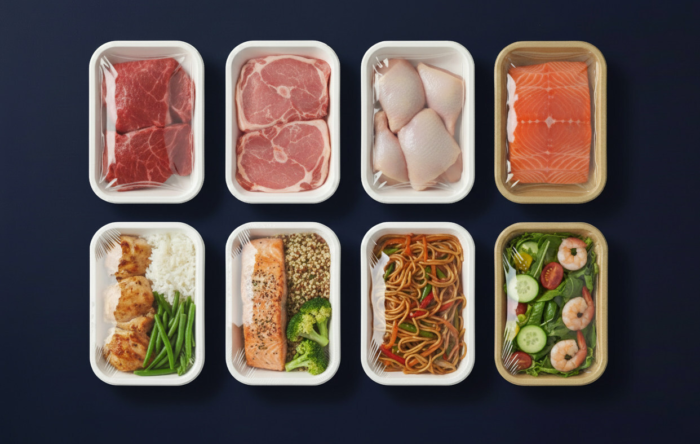
Yangi, a provider of renewable packaging innovations, has launched a production-ready dry-formed fiber tray for meat, fish, deli, and ready meals, enabled by Cellera, the company’s turnkey dry forming technology. As a fully integrated industrial platform, Cellera delivers cost-competitive high-volume output with repeatable precision, providing the operational stability that packaging producers and converters need to scale with confidence, the company stated.
With premium surface quality, predictable performance, and expanded design freedom, the tray sets a new standard for fiber packaging, enabling brands to finally move beyond the limitations of wet-molded fiber.
Built for real food & brands
The tray has been developed to meet the functional requirements of various food applications. Tested for consumer use in chilled, frozen, microwave, and oven settings, the tray maintains its shape, strength, and stability across typical consumer handling. With sealing capabilities and compatibility with modified atmosphere packaging (MAP), it supports shelf-life ambitions across protein and ready-meal applications.
Made from renewable, responsibly sourced virgin fibers, the tray features a PFAS-free composition and a functional laminate applied selectively to high-demand applications. Recyclability is dependent on the selected laminate, with certain structures designed to be compatible with existing paper recycling systems, supporting fiber recovery after use.
Integrated fiber chemistry also ensures the right outer properties of the tray. The tray is available in bleached and unbleached options, and the size can be adapted to the required format. It supports debossing, high-resolution digital printing across the full surface — including the sides — as well as a label-ready finish.
“The tray can be used as designed or customized to meet specific product, barrier, and design requirements,” says Hanna Rudel, chief commercial officer at Yangi. “It gives brands and converters the flexibility to adopt fiber-based packaging that is intentional, premium, and high-performing without compromising on design, functionality, or cost.”
The standard in dry forming
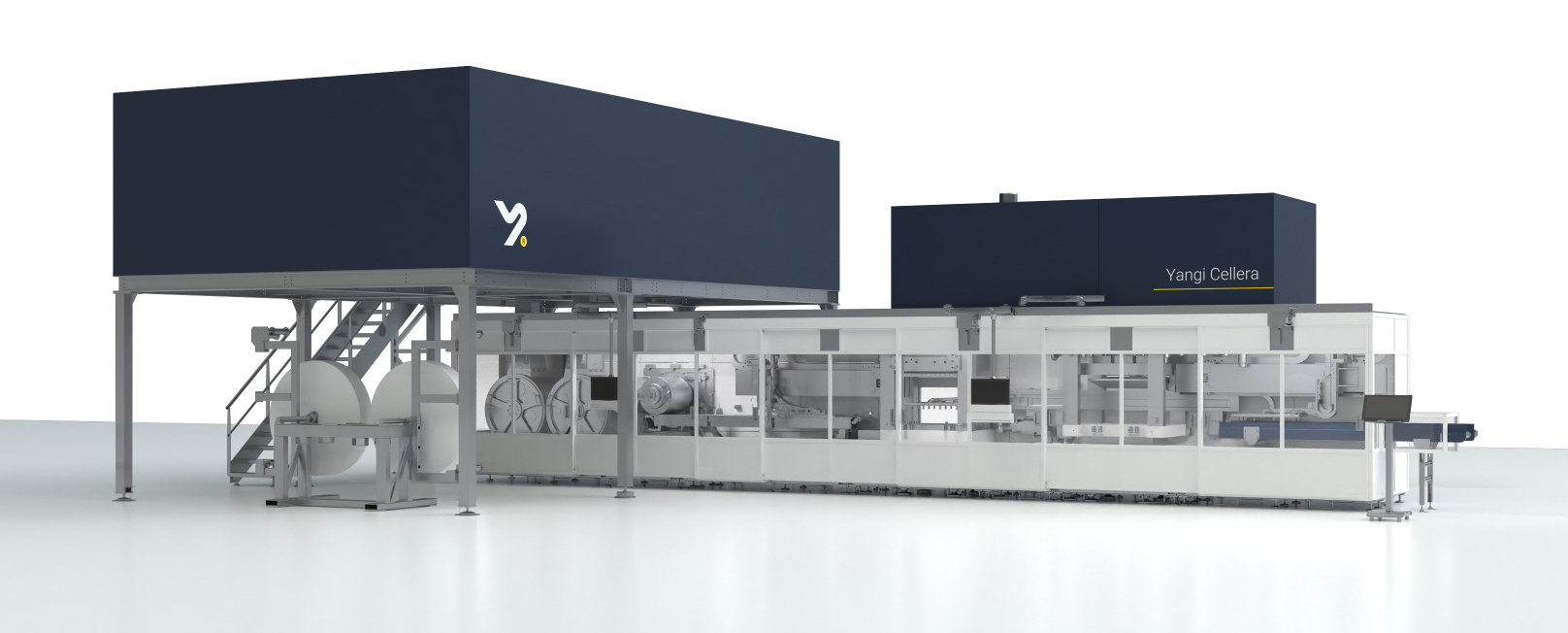
The tray is produced using Cellera, Yangi’s dry forming platform, which combines precision dual-drum airlaid formation, in-line custom pad formation, and precision transfer technology to deliver maximum fiber control and optimized material use in every product, unlocking smooth, uniform surfaces previously unattainable with renewable fibers.
By eliminating the wet stage of traditional pulp molding, Cellera also simplifies production, reduces process complexity, and enables industrial-scale dry forming with fast 4–6 second cycle times. The result is predictable, high-volume output with tighter tolerances, consistent quality, and lower energy and water use. Dry forming represents a fundamental shift in fiber packaging production, replacing wet pulp processes with a precise, scalable, and design-flexible approach.
“With renewable materials, a PFAS-free composition, ~ 80% lower CO₂ impact compared to plastic alternatives, and scalable industrial reliability, Yangi’s dry-formed tray represents more than just a product launch,” says Anna Altner, founder at Yangi. “For packaging producers and brands seeking alternatives to wet-molded fiber, it signals the arrival of dry forming as the new benchmark in fiber-based packaging,” she concludes.
IndiFoodBev — authentic, impactful and influential
An English-language food and beverage processing and packaging industry B2B platform in print and web, IndiFoodBev is in its third year of publication. It is said that the Indian food and beverage industries represent approximately US$ 900 billion in revenues which implies more than 20% of the country’s GDP. Eliminating the wastage on the farmside can help to deliver more protein to a higher number of the population apart from generating sizable exports. The savings in soil, seeds, water, fertilizer, energy and ultimately food and nutrition could be the most immense contribution that country is poised to make to the moderation of climate change.
To improve your marketing and grow sales to the food and beverage processing and packaging industry, talk to us. Our research and consulting company IppStar [www.ippstar.org] can assess your potential and addressable markets in light of the competition. We can discuss marketing, communication, and sales strategies for market entry and growth.
Suppliers and service providers with a strategy and budget for targeted marketing can discuss using our hybrid print, web, video, and social media channels to create brand recognition linked to market relevance. Our technical writers are ready to meet you and your customers for content.
The second largest producer of fruit and vegetables in the world is continuously expanding processing capacities and delivery systems with appropriate innovative technologies. We cover product and consumer trends, nutrition, processing, research, equipment and packaging from farm to thali. Get our 2025 media kit and recalibrate your role in this dynamic market. Enhance your visibility and relevance to existing markets and turn potential customers into conversations. Ask for a sample copy of our bi-monthly in print or our weekly IndiFoodBev eZine each Wednesday.
For editorial info@ippgroup.in — for advertisement ads1@ippgroup.in and for subscriptions subscription@ippgroup.in
Naresh Khanna – 10 February 2025
Subscribe Now